

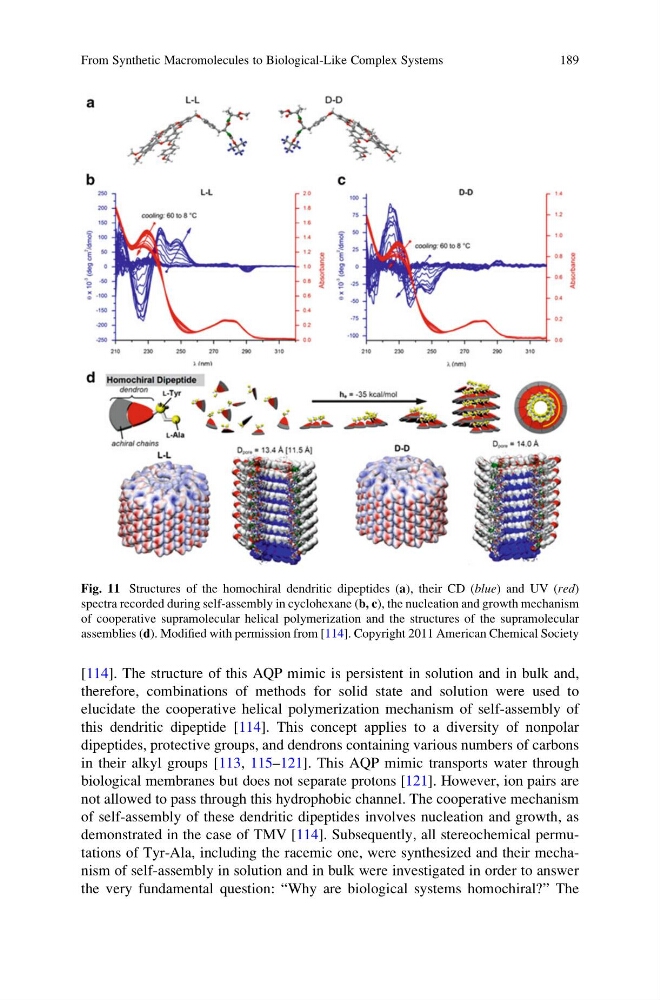
[114]. The structure of this AQP mimic is persistent in solution and in bulk and,
therefore, combinations of methods for solid state and solution were used to
elucidate the cooperative helical polymerization mechanism of self-assembly of
this dendritic dipeptide [114]. This concept applies to a diversity of nonpolar
dipeptides, protective groups, and dendrons containing various numbers of carbons
in their alkyl groups [113, 115–121]. This AQP mimic transports water through
biological membranes but does not separate protons [121]. However, ion pairs are
not allowed to pass through this hydrophobic channel. The cooperative mechanism
of self-assembly of these dendritic dipeptides involves nucleation and growth, as
demonstrated in the case of TMV [114]. Subsequently, all stereochemical permutations of Tyr-Ala, including the racemic one, were synthesized and their mechanism of self-assembly in solution and in bulk were investigated in order to answer
the very fundamental question: “Why are biological systems homochiral?” The
Fig. 11 Structures of the homochiral dendritic dipeptides (a), their CD (blue) and UV (red)
spectra recorded during self-assembly in cyclohexane (b, c), the nucleation and growth mechanism
of cooperative supramolecular helical polymerization and the structures of the supramolecular
assemblies (d). Modified with permission from [114]. Copyright 2011 American Chemical Society
From Synthetic Macromolecules to Biological-Like Complex Systems
189
therefore, combinations of methods for solid state and solution were used to
elucidate the cooperative helical polymerization mechanism of self-assembly of
this dendritic dipeptide [114]. This concept applies to a diversity of nonpolar
dipeptides, protective groups, and dendrons containing various numbers of carbons
in their alkyl groups [113, 115–121]. This AQP mimic transports water through
biological membranes but does not separate protons [121]. However, ion pairs are
not allowed to pass through this hydrophobic channel. The cooperative mechanism
of self-assembly of these dendritic dipeptides involves nucleation and growth, as
demonstrated in the case of TMV [114]. Subsequently, all stereochemical permutations of Tyr-Ala, including the racemic one, were synthesized and their mechanism of self-assembly in solution and in bulk were investigated in order to answer
the very fundamental question: “Why are biological systems homochiral?” The
Fig. 11 Structures of the homochiral dendritic dipeptides (a), their CD (blue) and UV (red)
spectra recorded during self-assembly in cyclohexane (b, c), the nucleation and growth mechanism
of cooperative supramolecular helical polymerization and the structures of the supramolecular
assemblies (d). Modified with permission from [114]. Copyright 2011 American Chemical Society
From Synthetic Macromolecules to Biological-Like Complex Systems
189