

2 A Few Personal Remarks About Early Times
with Hermann Staudinger, Magda Staudinger
and Hermann F. Mark
2.1 On My Way to Freiburg: How to Start to Work With
a Nobel Prize Winner: Cherchez la Femme!
It was spring 1954 and I was sitting in a train travelling down the Rhine to Freiburg,
on my way to meet Professor Staudinger. I arrived early and had a little bit of time
and the only person I knew was Else, a former schoolmate of mine. She was
working at the Weinbau-Institut (School for Viniculture) in Freiburg. “For heaven’s
sake, Helmut”, said Else, “don’t you know that Staudinger got a Nobel Prize, and
for months has been surrounded by ‘press and people’. You will never have a
chance to meet him!”
Sure, I knew that. But in those days – the World War was not yet so far away –
Nobel Prizes did not mean so much for a young student. Having worked several
times in the rubber industry between terms, I had become interested in polymer
science. The experts in industry, e.g. Dr. Graulich at Bayer Leverkusen, suggested
that for a polymer-oriented Dipl. Chem. and Ph.D. thesis, I should go to the “old
man’s” Institut fu ¨r Makromolekulare Chemie in Freiburg. The old man was
Hermann Staudinger. Here I was! To “help me”, Else came up with a peculiar
proposal: “If you cannot get close to him, just tell the secretary that you and your
parents are friends of Prof. Vogt.” He was the boss of Else and director of the
Weinbau-Institut, member of the Freiburger Rotary Club, and thus a colleague of
Hermann Staudinger. I felt uncomfortable!
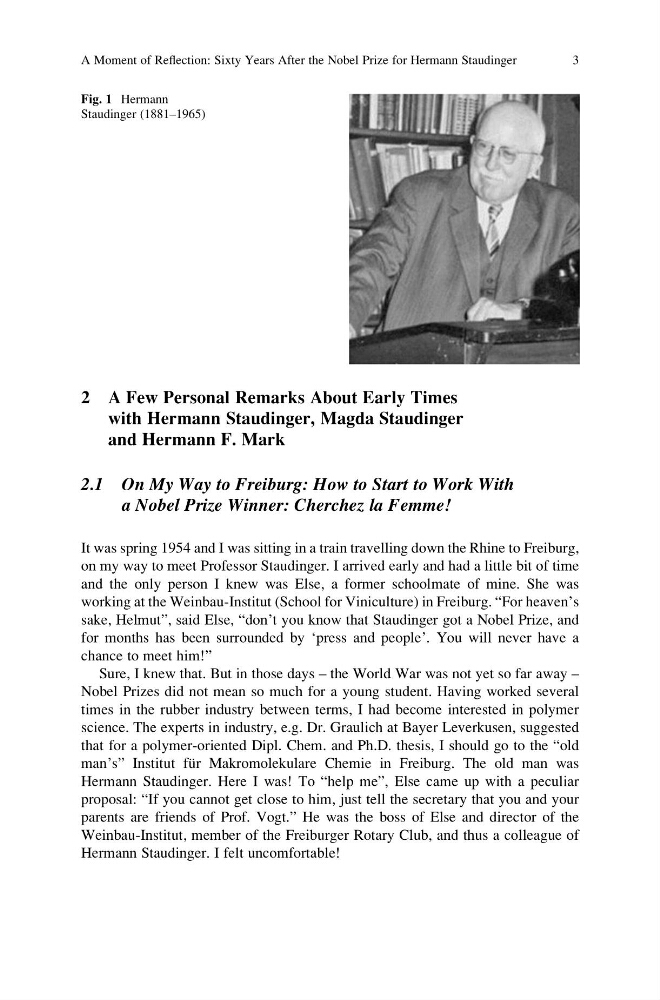
Fig. 1 Hermann
Staudinger (1881–1965)
A Moment of Reflection: Sixty Years After the Nobel Prize for Hermann Staudinger
3
with Hermann Staudinger, Magda Staudinger
and Hermann F. Mark
2.1 On My Way to Freiburg: How to Start to Work With
a Nobel Prize Winner: Cherchez la Femme!
It was spring 1954 and I was sitting in a train travelling down the Rhine to Freiburg,
on my way to meet Professor Staudinger. I arrived early and had a little bit of time
and the only person I knew was Else, a former schoolmate of mine. She was
working at the Weinbau-Institut (School for Viniculture) in Freiburg. “For heaven’s
sake, Helmut”, said Else, “don’t you know that Staudinger got a Nobel Prize, and
for months has been surrounded by ‘press and people’. You will never have a
chance to meet him!”
Sure, I knew that. But in those days – the World War was not yet so far away –
Nobel Prizes did not mean so much for a young student. Having worked several
times in the rubber industry between terms, I had become interested in polymer
science. The experts in industry, e.g. Dr. Graulich at Bayer Leverkusen, suggested
that for a polymer-oriented Dipl. Chem. and Ph.D. thesis, I should go to the “old
man’s” Institut fu ¨r Makromolekulare Chemie in Freiburg. The old man was
Hermann Staudinger. Here I was! To “help me”, Else came up with a peculiar
proposal: “If you cannot get close to him, just tell the secretary that you and your
parents are friends of Prof. Vogt.” He was the boss of Else and director of the
Weinbau-Institut, member of the Freiburger Rotary Club, and thus a colleague of
Hermann Staudinger. I felt uncomfortable!
Fig. 1 Hermann
Staudinger (1881–1965)
A Moment of Reflection: Sixty Years After the Nobel Prize for Hermann Staudinger
3