

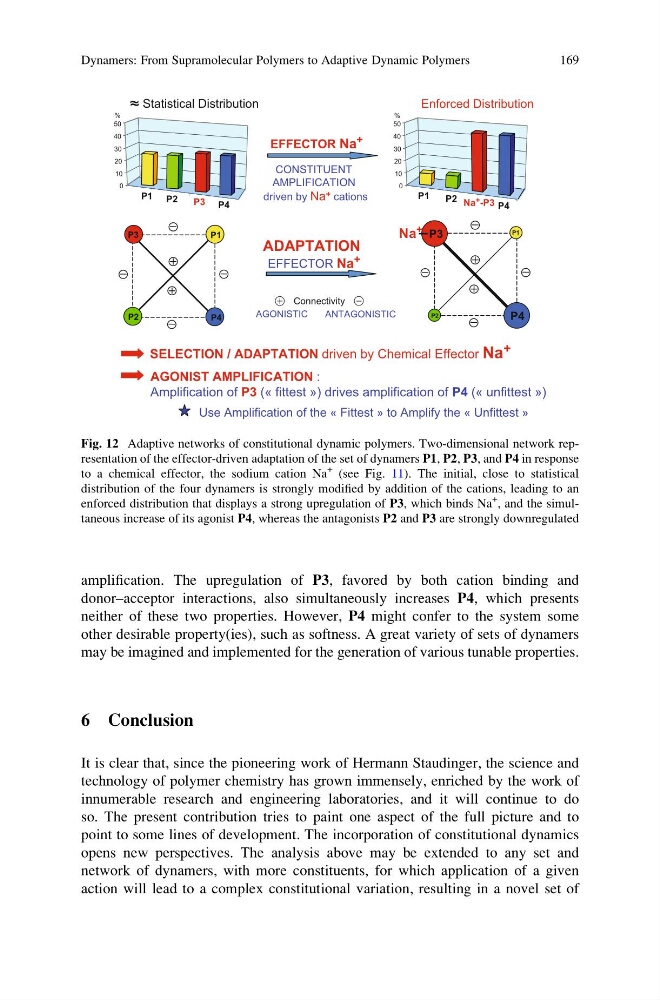
amplification. The upregulation of P3, favored by both cation binding and
donor–acceptor interactions, also simultaneously increases P4, which presents
neither of these two properties. However, P4 might confer to the system some
other desirable property(ies), such as softness. A great variety of sets of dynamers
may be imagined and implemented for the generation of various tunable properties.
6 Conclusion
It is clear that, since the pioneering work of Hermann Staudinger, the science and
technology of polymer chemistry has grown immensely, enriched by the work of
innumerable research and engineering laboratories, and it will continue to do
so. The present contribution tries to paint one aspect of the full picture and to
point to some lines of development. The incorporation of constitutional dynamics
opens new perspectives. The analysis above may be extended to any set and
network of dynamers, with more constituents, for which application of a given
action will lead to a complex constitutional variation, resulting in a novel set of
ADAPTATION
CONSTITUENT
AMPLIFICATION
driven by Na + cations
EFFECTOR Na +
AGONIST AMPLIFICATION :
Amplification of P3 (« fittest ») drives amplification of P4 (« unfittest »)
P3
P1
P2
P4
AGONISTIC
ANTAGONISTIC
Connectivity
Na + P3
P4
P1
P2
_
Use Amplification of the « Fittest » to Amplify the « Unfittest »
EFFECTOR Na +
SELECTION / ADAPTATION driven by Chemical Effector Na +
Enforced Distribution
%
0
10
20
30
40
50
P1
Na + -P3 P4
P2
~ Statistical Distribution
%
P1
P3 P4
0
10
20
30
40
50
P2
~
Fig. 12 Adaptive networks of constitutional dynamic polymers. Two-dimensional network representation of the effector-driven adaptation of the set of dynamers P1, P2, P3, and P4 in response
to a chemical effector, the sodium cation Na
+ (see Fig. 11). The initial, close to statistical
distribution of the four dynamers is strongly modified by addition of the cations, leading to an
enforced distribution that displays a strong upregulation of P3, which binds Na
+ , and the simultaneous increase of its agonist P4, whereas the antagonists P2 and P3 are strongly downregulated
Dynamers: From Supramolecular Polymers to Adaptive Dynamic Polymers
169
donor–acceptor interactions, also simultaneously increases P4, which presents
neither of these two properties. However, P4 might confer to the system some
other desirable property(ies), such as softness. A great variety of sets of dynamers
may be imagined and implemented for the generation of various tunable properties.
6 Conclusion
It is clear that, since the pioneering work of Hermann Staudinger, the science and
technology of polymer chemistry has grown immensely, enriched by the work of
innumerable research and engineering laboratories, and it will continue to do
so. The present contribution tries to paint one aspect of the full picture and to
point to some lines of development. The incorporation of constitutional dynamics
opens new perspectives. The analysis above may be extended to any set and
network of dynamers, with more constituents, for which application of a given
action will lead to a complex constitutional variation, resulting in a novel set of
ADAPTATION
CONSTITUENT
AMPLIFICATION
driven by Na + cations
EFFECTOR Na +
AGONIST AMPLIFICATION :
Amplification of P3 (« fittest ») drives amplification of P4 (« unfittest »)
P3
P1
P2
P4
AGONISTIC
ANTAGONISTIC
Connectivity
Na + P3
P4
P1
P2
_
Use Amplification of the « Fittest » to Amplify the « Unfittest »
EFFECTOR Na +
SELECTION / ADAPTATION driven by Chemical Effector Na +
Enforced Distribution
%
0
10
20
30
40
50
P1
Na + -P3 P4
P2
~ Statistical Distribution
%
P1
P3 P4
0
10
20
30
40
50
P2
~
Fig. 12 Adaptive networks of constitutional dynamic polymers. Two-dimensional network representation of the effector-driven adaptation of the set of dynamers P1, P2, P3, and P4 in response
to a chemical effector, the sodium cation Na
+ (see Fig. 11). The initial, close to statistical
distribution of the four dynamers is strongly modified by addition of the cations, leading to an
enforced distribution that displays a strong upregulation of P3, which binds Na
+ , and the simultaneous increase of its agonist P4, whereas the antagonists P2 and P3 are strongly downregulated
Dynamers: From Supramolecular Polymers to Adaptive Dynamic Polymers
169