

It has been pointed out that an intriguing feature of such ACNs is that agonistically related constituents amplify each other [43]. As a consequence, enhancement
of the “fittest,” in response to a given effector, also induces promotion or survival of
the “unfittest” (with respect to an effector or a set of conditions)! It may well happen
that the unfittest for a given effector E may present specific desirable properties, so
that the effector E may be used to indirectly drive amplification of the unfittest and
thus the generation of these properties.
These considerations also apply to a set of dynamic polymers undergoing
redistribution of the monomeric components when subjected to the action of
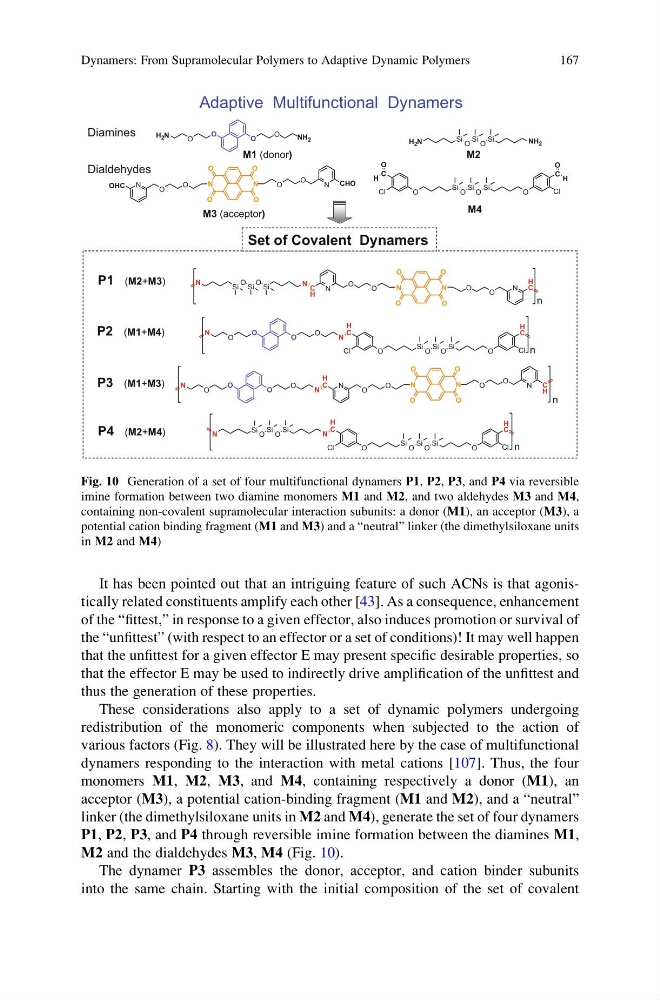
various factors (Fig. 8). They will be illustrated here by the case of multifunctional
dynamers responding to the interaction with metal cations [107]. Thus, the four
monomers M1, M2, M3, and M4, containing respectively a donor (M1), an
acceptor (M3), a potential cation-binding fragment (M1 and M2), and a “neutral”
linker (the dimethylsiloxane units in M2 and M4), generate the set of four dynamers
P1, P2, P3, and P4 through reversible imine formation between the diamines M1,
M2 and the dialdehydes M3, M4 (Fig. 10).
The dynamer P3 assembles the donor, acceptor, and cation binder subunits
into the same chain. Starting with the initial composition of the set of covalent
Adaptive Multifunctional Dynamers
P1 (M2+M3)
P2 (M1+M4)
P3 (M1+M3)
P4 (M2+M4)
M1 (donor)
M2
M3 (acceptor)
M4
Set of Covalent Dynamers
Diamines
Dialdehydes
n
N C
H
N
O
O
N
N
O
O
O
O
O
O
N
H
C
Si
O Si
O Si
N
n
H
C
N
O
O
O
O
N
O
Si O
Si O
Si
O
H
C
Cl
Cl
n
H
C
N
Si
O
Si
O
N
O
Si O
Si O
Si
O
H
C
Si
Cl
Cl
n
N
O
O
O
O
N C
H
H
C
N
O
O
O
O
N
N
N
O
O
O
O
CHO
OHC N
O
O
O
O
N
N
N
O
O
O
O
C
C
H
O
H
O
O
Si O
Si O
Si
O
Cl
Cl
NH 2
H 2 N
O
O
O
O
NH 2
H 2 N
Si O
Si O
Si
Fig. 10 Generation of a set of four multifunctional dynamers P1, P2, P3, and P4 via reversible
imine formation between two diamine monomers M1 and M2, and two aldehydes M3 and M4,
containing non-covalent supramolecular interaction subunits: a donor (M1), an acceptor (M3), a
potential cation binding fragment (M1 and M3) and a “neutral” linker (the dimethylsiloxane units
in M2 and M4)
Dynamers: From Supramolecular Polymers to Adaptive Dynamic Polymers
167
of the “fittest,” in response to a given effector, also induces promotion or survival of
the “unfittest” (with respect to an effector or a set of conditions)! It may well happen
that the unfittest for a given effector E may present specific desirable properties, so
that the effector E may be used to indirectly drive amplification of the unfittest and
thus the generation of these properties.
These considerations also apply to a set of dynamic polymers undergoing
redistribution of the monomeric components when subjected to the action of
various factors (Fig. 8). They will be illustrated here by the case of multifunctional
dynamers responding to the interaction with metal cations [107]. Thus, the four
monomers M1, M2, M3, and M4, containing respectively a donor (M1), an
acceptor (M3), a potential cation-binding fragment (M1 and M2), and a “neutral”
linker (the dimethylsiloxane units in M2 and M4), generate the set of four dynamers
P1, P2, P3, and P4 through reversible imine formation between the diamines M1,
M2 and the dialdehydes M3, M4 (Fig. 10).
The dynamer P3 assembles the donor, acceptor, and cation binder subunits
into the same chain. Starting with the initial composition of the set of covalent
Adaptive Multifunctional Dynamers
P1 (M2+M3)
P2 (M1+M4)
P3 (M1+M3)
P4 (M2+M4)
M1 (donor)
M2
M3 (acceptor)
M4
Set of Covalent Dynamers
Diamines
Dialdehydes
n
N C
H
N
O
O
N
N
O
O
O
O
O
O
N
H
C
Si
O Si
O Si
N
n
H
C
N
O
O
O
O
N
O
Si O
Si O
Si
O
H
C
Cl
Cl
n
H
C
N
Si
O
Si
O
N
O
Si O
Si O
Si
O
H
C
Si
Cl
Cl
n
N
O
O
O
O
N C
H
H
C
N
O
O
O
O
N
N
N
O
O
O
O
CHO
OHC N
O
O
O
O
N
N
N
O
O
O
O
C
C
H
O
H
O
O
Si O
Si O
Si
O
Cl
Cl
NH 2
H 2 N
O
O
O
O
NH 2
H 2 N
Si O
Si O
Si
Fig. 10 Generation of a set of four multifunctional dynamers P1, P2, P3, and P4 via reversible
imine formation between two diamine monomers M1 and M2, and two aldehydes M3 and M4,
containing non-covalent supramolecular interaction subunits: a donor (M1), an acceptor (M3), a
potential cation binding fragment (M1 and M3) and a “neutral” linker (the dimethylsiloxane units
in M2 and M4)
Dynamers: From Supramolecular Polymers to Adaptive Dynamic Polymers
167