

set of conditions. Because of their intrinsic ability to exchange their components,
these materials may in principle select them in response to external stimuli or
environmental factors and therefore behave as adaptive materials of either molecular or supramolecular nature. The dynamic and combinatorial features of dynamic
materials, in particular of dynamers, give access to higher levels of behavior such as
healing, adaptability, and response to external stimulants (heat, light, chemical
additives, etc.).
Supramolecular chemistry has opened new perspectives in materials science
towards the design and engineering of supramolecular materials. In particular, a
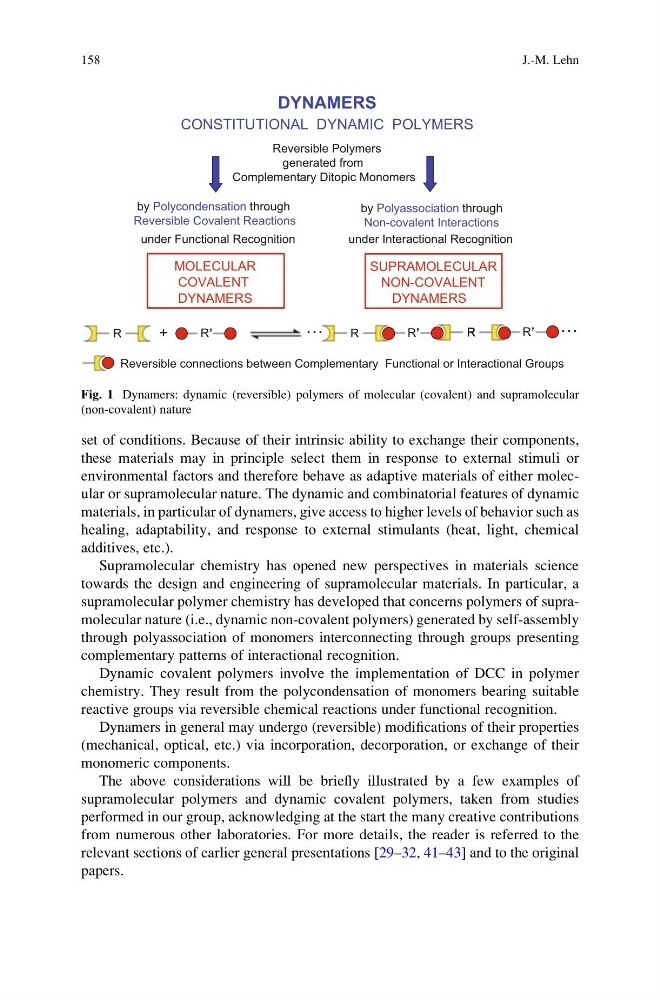
supramolecular polymer chemistry has developed that concerns polymers of supramolecular nature (i.e., dynamic non-covalent polymers) generated by self-assembly
through polyassociation of monomers interconnecting through groups presenting
complementary patterns of interactional recognition.
Dynamic covalent polymers involve the implementation of DCC in polymer
chemistry. They result from the polycondensation of monomers bearing suitable
reactive groups via reversible chemical reactions under functional recognition.
Dynamers in general may undergo (reversible) modifications of their properties
(mechanical, optical, etc.) via incorporation, decorporation, or exchange of their
monomeric components.
The above considerations will be briefly illustrated by a few examples of
supramolecular polymers and dynamic covalent polymers, taken from studies
performed in our group, acknowledging at the start the many creative contributions
from numerous other laboratories. For more details, the reader is referred to the
relevant sections of earlier general presentations [29–32, 41–43] and to the original
papers.
DYNAMERS
CONSTITUTIONAL DYNAMIC POLYMERS
Reversible Polymers
generated from
Complementary Ditopic Monomers
by Polyassociation through
Non-covalent Interactions
by Polycondensation through
Reversible Covalent Reactions
MOLECULAR
COVALENT
DYNAMERS
SUPRAMOLECULAR
NON-COVALENT
DYNAMERS
under Functional Recognition
under Interactional Recognition
Reversible connections between Complementary Functional or Interactional Groups
R’
R
R
R’
R
R’
R
+
…
…
Fig. 1 Dynamers: dynamic (reversible) polymers of molecular (covalent) and supramolecular
(non-covalent) nature
158
J.-M. Lehn
these materials may in principle select them in response to external stimuli or
environmental factors and therefore behave as adaptive materials of either molecular or supramolecular nature. The dynamic and combinatorial features of dynamic
materials, in particular of dynamers, give access to higher levels of behavior such as
healing, adaptability, and response to external stimulants (heat, light, chemical
additives, etc.).
Supramolecular chemistry has opened new perspectives in materials science
towards the design and engineering of supramolecular materials. In particular, a
supramolecular polymer chemistry has developed that concerns polymers of supramolecular nature (i.e., dynamic non-covalent polymers) generated by self-assembly
through polyassociation of monomers interconnecting through groups presenting
complementary patterns of interactional recognition.
Dynamic covalent polymers involve the implementation of DCC in polymer
chemistry. They result from the polycondensation of monomers bearing suitable
reactive groups via reversible chemical reactions under functional recognition.
Dynamers in general may undergo (reversible) modifications of their properties
(mechanical, optical, etc.) via incorporation, decorporation, or exchange of their
monomeric components.
The above considerations will be briefly illustrated by a few examples of
supramolecular polymers and dynamic covalent polymers, taken from studies
performed in our group, acknowledging at the start the many creative contributions
from numerous other laboratories. For more details, the reader is referred to the
relevant sections of earlier general presentations [29–32, 41–43] and to the original
papers.
DYNAMERS
CONSTITUTIONAL DYNAMIC POLYMERS
Reversible Polymers
generated from
Complementary Ditopic Monomers
by Polyassociation through
Non-covalent Interactions
by Polycondensation through
Reversible Covalent Reactions
MOLECULAR
COVALENT
DYNAMERS
SUPRAMOLECULAR
NON-COVALENT
DYNAMERS
under Functional Recognition
under Interactional Recognition
Reversible connections between Complementary Functional or Interactional Groups
R’
R
R
R’
R
R’
R
+
…
…
Fig. 1 Dynamers: dynamic (reversible) polymers of molecular (covalent) and supramolecular
(non-covalent) nature
158
J.-M. Lehn