

6 Polymer Activities in Japan in Those Times
To facilitate understanding of the atmosphere greeting the Staudingers in 1957, it
may be helpful to provide a brief overview on the growth of polymer activities in
this country up to the mid-1950s. Looking back on the history, these years were the
inflection point where a rapid expansion was just taking off. Japanese people, as
well as the society, were making sure of directions to leave the turmoil of World
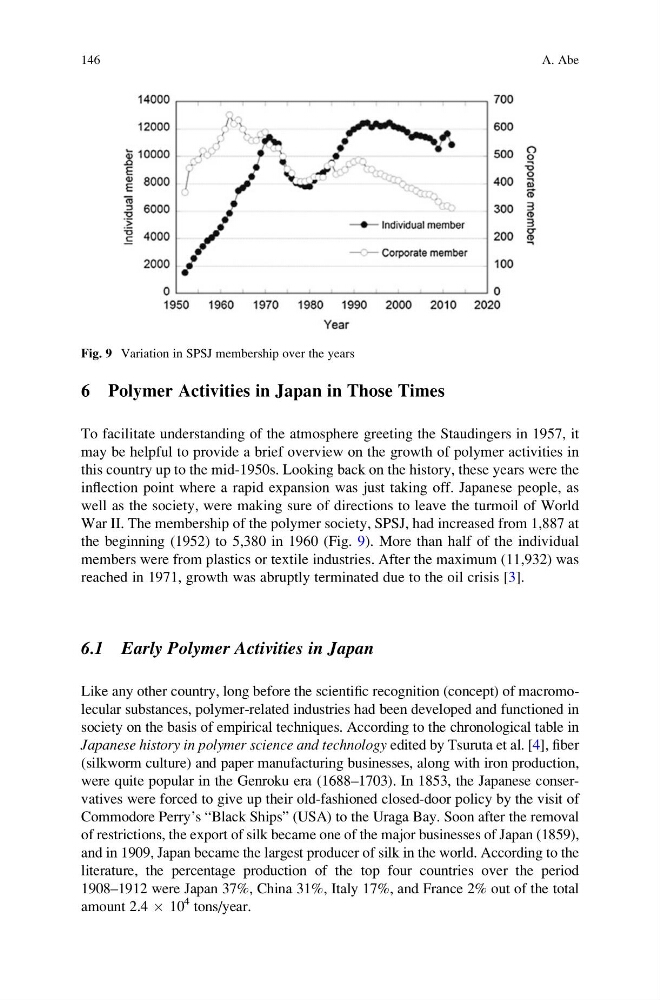
War II. The membership of the polymer society, SPSJ, had increased from 1,887 at
the beginning (1952) to 5,380 in 1960 (Fig. 9). More than half of the individual
members were from plastics or textile industries. After the maximum (11,932) was
reached in 1971, growth was abruptly terminated due to the oil crisis [3].
6.1 Early Polymer Activities in Japan
Like any other country, long before the scientific recognition (concept) of macromolecular substances, polymer-related industries had been developed and functioned in
society on the basis of empirical techniques. According to the chronological table in
Japanese history in polymer science and technology edited by Tsuruta et al. [4], fiber
(silkworm culture) and paper manufacturing businesses, along with iron production,
were quite popular in the Genroku era (1688–1703). In 1853, the Japanese conservatives were forced to give up their old-fashioned closed-door policy by the visit of
Commodore Perry’s “Black Ships” (USA) to the Uraga Bay. Soon after the removal
of restrictions, the export of silk became one of the major businesses of Japan (1859),
and in 1909, Japan became the largest producer of silk in the world. According to the
literature, the percentage production of the top four countries over the period
1908–1912 were Japan 37%, China 31%, Italy 17%, and France 2% out of the total
amount 2.4 Â 10
4 tons/year.
Fig. 9 Variation in SPSJ membership over the years
146
A. Abe
To facilitate understanding of the atmosphere greeting the Staudingers in 1957, it
may be helpful to provide a brief overview on the growth of polymer activities in
this country up to the mid-1950s. Looking back on the history, these years were the
inflection point where a rapid expansion was just taking off. Japanese people, as
well as the society, were making sure of directions to leave the turmoil of World
War II. The membership of the polymer society, SPSJ, had increased from 1,887 at
the beginning (1952) to 5,380 in 1960 (Fig. 9). More than half of the individual
members were from plastics or textile industries. After the maximum (11,932) was
reached in 1971, growth was abruptly terminated due to the oil crisis [3].
6.1 Early Polymer Activities in Japan
Like any other country, long before the scientific recognition (concept) of macromolecular substances, polymer-related industries had been developed and functioned in
society on the basis of empirical techniques. According to the chronological table in
Japanese history in polymer science and technology edited by Tsuruta et al. [4], fiber
(silkworm culture) and paper manufacturing businesses, along with iron production,
were quite popular in the Genroku era (1688–1703). In 1853, the Japanese conservatives were forced to give up their old-fashioned closed-door policy by the visit of
Commodore Perry’s “Black Ships” (USA) to the Uraga Bay. Soon after the removal
of restrictions, the export of silk became one of the major businesses of Japan (1859),
and in 1909, Japan became the largest producer of silk in the world. According to the
literature, the percentage production of the top four countries over the period
1908–1912 were Japan 37%, China 31%, Italy 17%, and France 2% out of the total
amount 2.4 Â 10
4 tons/year.
Fig. 9 Variation in SPSJ membership over the years
146
A. Abe