

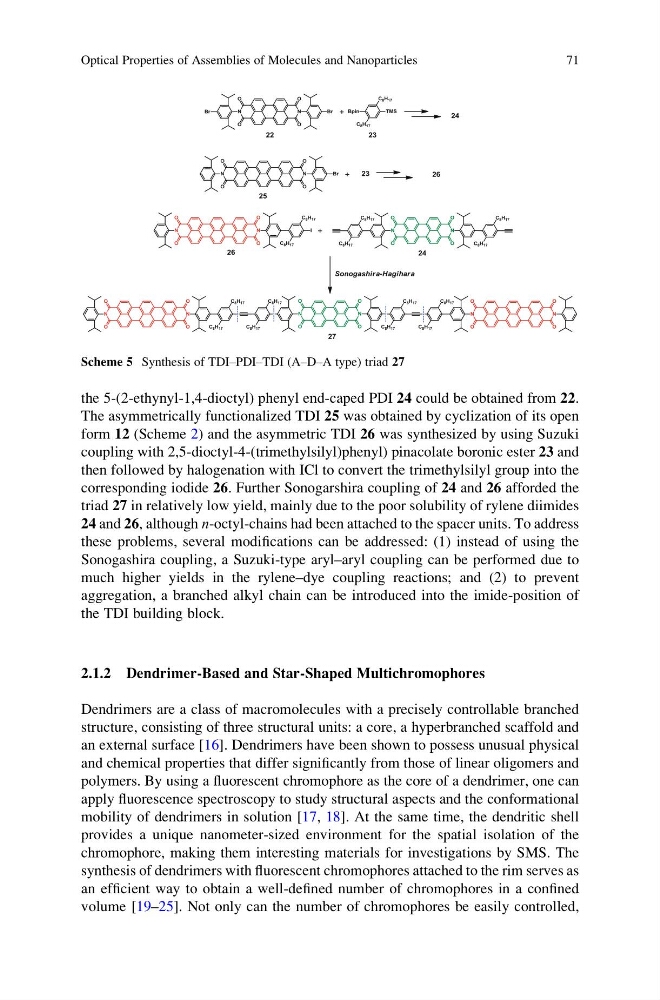
the 5-(2-ethynyl-1,4-dioctyl) phenyl end-caped PDI 24 could be obtained from 22.
The asymmetrically functionalized TDI 25 was obtained by cyclization of its open
form 12 (Scheme 2) and the asymmetric TDI 26 was synthesized by using Suzuki
coupling with 2,5-dioctyl-4-(trimethylsilyl)phenyl) pinacolate boronic ester 23 and
then followed by halogenation with ICl to convert the trimethylsilyl group into the
corresponding iodide 26. Further Sonogarshira coupling of 24 and 26 afforded the
triad 27 in relatively low yield, mainly due to the poor solubility of rylene diimides
24 and 26, although n-octyl-chains had been attached to the spacer units. To address
these problems, several modifications can be addressed: (1) instead of using the
Sonogashira coupling, a Suzuki-type aryl–aryl coupling can be performed due to
much higher yields in the rylene–dye coupling reactions; and (2) to prevent
aggregation, a branched alkyl chain can be introduced into the imide-position of
the TDI building block.
2.1.2 Dendrimer-Based and Star-Shaped Multichromophores
Dendrimers are a class of macromolecules with a precisely controllable branched
structure, consisting of three structural units: a core, a hyperbranched scaffold and
an external surface [16]. Dendrimers have been shown to possess unusual physical
and chemical properties that differ significantly from those of linear oligomers and
polymers. By using a fluorescent chromophore as the core of a dendrimer, one can
apply fluorescence spectroscopy to study structural aspects and the conformational
mobility of dendrimers in solution [17, 18]. At the same time, the dendritic shell
provides a unique nanometer-sized environment for the spatial isolation of the
chromophore, making them interesting materials for investigations by SMS. The
synthesis of dendrimers with fluorescent chromophores attached to the rim serves as
an efficient way to obtain a well-defined number of chromophores in a confined
volume [19–25]. Not only can the number of chromophores be easily controlled,
Scheme 5 Synthesis of TDI–PDI–TDI (A–D–A type) triad 27
Optical Properties of Assemblies of Molecules and Nanoparticles
71
The asymmetrically functionalized TDI 25 was obtained by cyclization of its open
form 12 (Scheme 2) and the asymmetric TDI 26 was synthesized by using Suzuki
coupling with 2,5-dioctyl-4-(trimethylsilyl)phenyl) pinacolate boronic ester 23 and
then followed by halogenation with ICl to convert the trimethylsilyl group into the
corresponding iodide 26. Further Sonogarshira coupling of 24 and 26 afforded the
triad 27 in relatively low yield, mainly due to the poor solubility of rylene diimides
24 and 26, although n-octyl-chains had been attached to the spacer units. To address
these problems, several modifications can be addressed: (1) instead of using the
Sonogashira coupling, a Suzuki-type aryl–aryl coupling can be performed due to
much higher yields in the rylene–dye coupling reactions; and (2) to prevent
aggregation, a branched alkyl chain can be introduced into the imide-position of
the TDI building block.
2.1.2 Dendrimer-Based and Star-Shaped Multichromophores
Dendrimers are a class of macromolecules with a precisely controllable branched
structure, consisting of three structural units: a core, a hyperbranched scaffold and
an external surface [16]. Dendrimers have been shown to possess unusual physical
and chemical properties that differ significantly from those of linear oligomers and
polymers. By using a fluorescent chromophore as the core of a dendrimer, one can
apply fluorescence spectroscopy to study structural aspects and the conformational
mobility of dendrimers in solution [17, 18]. At the same time, the dendritic shell
provides a unique nanometer-sized environment for the spatial isolation of the
chromophore, making them interesting materials for investigations by SMS. The
synthesis of dendrimers with fluorescent chromophores attached to the rim serves as
an efficient way to obtain a well-defined number of chromophores in a confined
volume [19–25]. Not only can the number of chromophores be easily controlled,
Scheme 5 Synthesis of TDI–PDI–TDI (A–D–A type) triad 27
Optical Properties of Assemblies of Molecules and Nanoparticles
71