

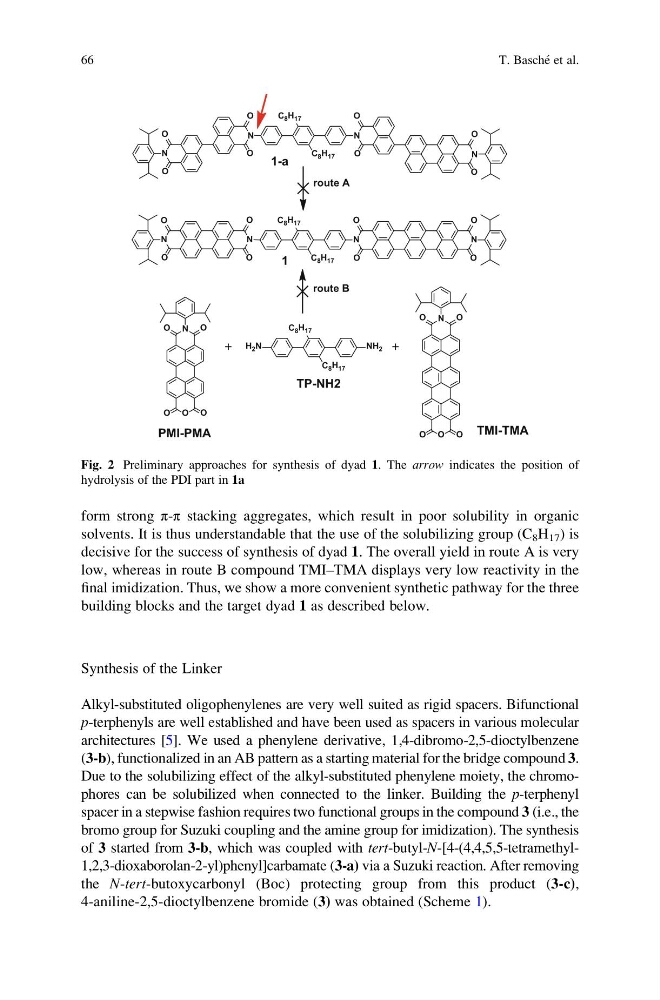
form strong π-π stacking aggregates, which result in poor solubility in organic
solvents. It is thus understandable that the use of the solubilizing group (C 8 H 17 ) is
decisive for the success of synthesis of dyad 1. The overall yield in route A is very
low, whereas in route B compound TMI–TMA displays very low reactivity in the
final imidization. Thus, we show a more convenient synthetic pathway for the three
building blocks and the target dyad 1 as described below.
Synthesis of the Linker
Alkyl-substituted oligophenylenes are very well suited as rigid spacers. Bifunctional
p-terphenyls are well established and have been used as spacers in various molecular
architectures [5]. We used a phenylene derivative, 1,4-dibromo-2,5-dioctylbenzene
(3-b), functionalized in an AB pattern as a starting material for the bridge compound 3.
Due to the solubilizing effect of the alkyl-substituted phenylene moiety, the chromophores can be solubilized when connected to the linker. Building the p-terphenyl
spacer in a stepwise fashion requires two functional groups in the compound 3 (i.e., the
bromo group for Suzuki coupling and the amine group for imidization). The synthesis
of 3 started from 3-b, which was coupled with tert-butyl-N-[4-(4,4,5,5-tetramethyl1,2,3-dioxaborolan-2-yl)phenyl]carbamate (3-a) via a Suzuki reaction. After removing
the N-tert-butoxycarbonyl (Boc) protecting group from this product (3-c),
4-aniline-2,5-dioctylbenzene bromide (3) was obtained (Scheme 1).
N
N
O
O
O
O
N
O
O
N
O
O
C 8 H 17
C 8 H 17
N
N
O
O
O
O
N
O
O
N
O
O
C 8 H 17
C 8 H 17
N
O
O
O
O
O
N
O
O
O
O
O
C 8 H 17
C 8 H 17
H 2 N
NH 2
route A
route B
1
1-a
PMI-PMA
TMI-TMA
TP-NH2
Fig. 2 Preliminary approaches for synthesis of dyad 1. The arrow indicates the position of
hydrolysis of the PDI part in 1a
66
T. Basche ´ et al.
solvents. It is thus understandable that the use of the solubilizing group (C 8 H 17 ) is
decisive for the success of synthesis of dyad 1. The overall yield in route A is very
low, whereas in route B compound TMI–TMA displays very low reactivity in the
final imidization. Thus, we show a more convenient synthetic pathway for the three
building blocks and the target dyad 1 as described below.
Synthesis of the Linker
Alkyl-substituted oligophenylenes are very well suited as rigid spacers. Bifunctional
p-terphenyls are well established and have been used as spacers in various molecular
architectures [5]. We used a phenylene derivative, 1,4-dibromo-2,5-dioctylbenzene
(3-b), functionalized in an AB pattern as a starting material for the bridge compound 3.
Due to the solubilizing effect of the alkyl-substituted phenylene moiety, the chromophores can be solubilized when connected to the linker. Building the p-terphenyl
spacer in a stepwise fashion requires two functional groups in the compound 3 (i.e., the
bromo group for Suzuki coupling and the amine group for imidization). The synthesis
of 3 started from 3-b, which was coupled with tert-butyl-N-[4-(4,4,5,5-tetramethyl1,2,3-dioxaborolan-2-yl)phenyl]carbamate (3-a) via a Suzuki reaction. After removing
the N-tert-butoxycarbonyl (Boc) protecting group from this product (3-c),
4-aniline-2,5-dioctylbenzene bromide (3) was obtained (Scheme 1).
N
N
O
O
O
O
N
O
O
N
O
O
C 8 H 17
C 8 H 17
N
N
O
O
O
O
N
O
O
N
O
O
C 8 H 17
C 8 H 17
N
O
O
O
O
O
N
O
O
O
O
O
C 8 H 17
C 8 H 17
H 2 N
NH 2
route A
route B
1
1-a
PMI-PMA
TMI-TMA
TP-NH2
Fig. 2 Preliminary approaches for synthesis of dyad 1. The arrow indicates the position of
hydrolysis of the PDI part in 1a
66
T. Basche ´ et al.