

(EET) process, to evaluate the limits of Fo ¨rster theory and to reverse the EET
[2–4]. In this section, we summarize the synthesis of multichromophores including
dyads, triads, dendritic and star-shaped systems, with an emphasis on the structural
design and the systematic comparison of different synthetic approaches. Singlemolecule investigations of these compounds focusing on EET are described in
Sect. 3. It must be emphasized that valid photophysical answers cannot simply be
obtained from trivial or even commercially available chromophores but must be
built on conceptual and synthetic breakthroughs. Herein, optimized reaction
pathways are discussed with respect to solubility, reactivity, and accessibility of
the building blocks used. Key reactions used are imidization, Suzuki coupling and
cyclization of biaryl intermediates to ribbon-type arenes. In most cases, the initial
synthetic target is the asymmetric introduction of different functional groups into
the perylene diimide and terrylene diimide by imidization. Combined with rigorous
purifications, this optimized multichromophore synthesis is the basis for creative
photophysics.
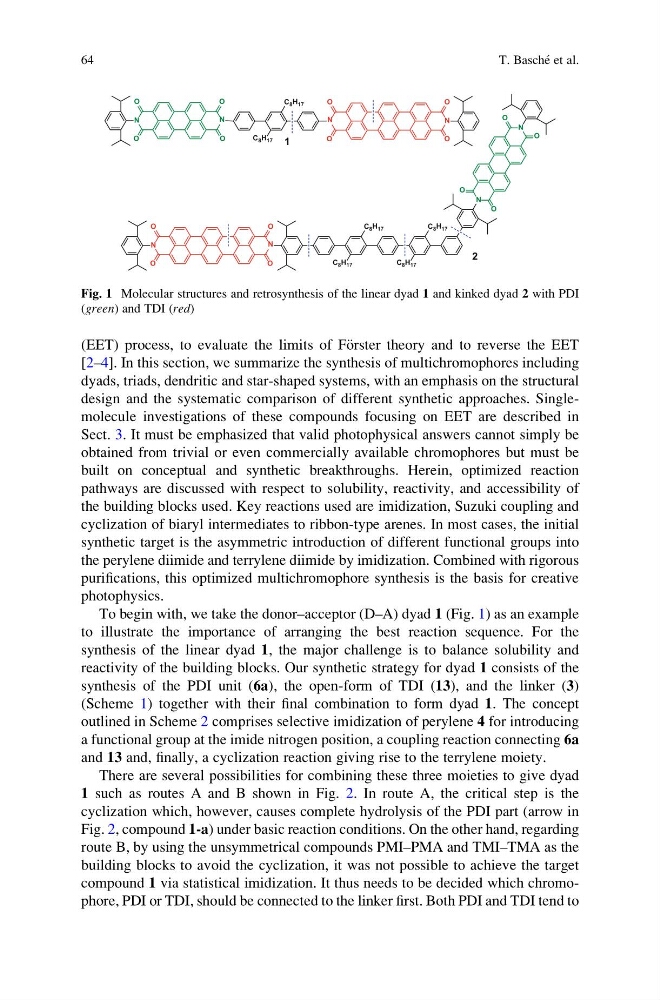
To begin with, we take the donor–acceptor (D–A) dyad 1 (Fig. 1) as an example
to illustrate the importance of arranging the best reaction sequence. For the
synthesis of the linear dyad 1, the major challenge is to balance solubility and
reactivity of the building blocks. Our synthetic strategy for dyad 1 consists of the
synthesis of the PDI unit (6a), the open-form of TDI (13), and the linker (3)
(Scheme 1) together with their final combination to form dyad 1. The concept
outlined in Scheme 2 comprises selective imidization of perylene 4 for introducing
a functional group at the imide nitrogen position, a coupling reaction connecting 6a
and 13 and, finally, a cyclization reaction giving rise to the terrylene moiety.
There are several possibilities for combining these three moieties to give dyad
1 such as routes A and B shown in Fig. 2. In route A, the critical step is the
cyclization which, however, causes complete hydrolysis of the PDI part (arrow in
Fig. 2, compound 1-a) under basic reaction conditions. On the other hand, regarding
route B, by using the unsymmetrical compounds PMI–PMA and TMI–TMA as the
building blocks to avoid the cyclization, it was not possible to achieve the target
compound 1 via statistical imidization. It thus needs to be decided which chromophore, PDI or TDI, should be connected to the linker first. Both PDI and TDI tend to
N
O
O
N
O
O
N
O
O
N
O
O
C 8 H 17
C 8 H 17
C 8 H 17
C 8 H 17
C 8 H 17
C 8 H 17
N
O
O
N
O
O
N
O
O
N
O
O
1
2
Fig. 1 Molecular structures and retrosynthesis of the linear dyad 1 and kinked dyad 2 with PDI
(green) and TDI (red)
64
T. Basche ´ et al.
[2–4]. In this section, we summarize the synthesis of multichromophores including
dyads, triads, dendritic and star-shaped systems, with an emphasis on the structural
design and the systematic comparison of different synthetic approaches. Singlemolecule investigations of these compounds focusing on EET are described in
Sect. 3. It must be emphasized that valid photophysical answers cannot simply be
obtained from trivial or even commercially available chromophores but must be
built on conceptual and synthetic breakthroughs. Herein, optimized reaction
pathways are discussed with respect to solubility, reactivity, and accessibility of
the building blocks used. Key reactions used are imidization, Suzuki coupling and
cyclization of biaryl intermediates to ribbon-type arenes. In most cases, the initial
synthetic target is the asymmetric introduction of different functional groups into
the perylene diimide and terrylene diimide by imidization. Combined with rigorous
purifications, this optimized multichromophore synthesis is the basis for creative
photophysics.
To begin with, we take the donor–acceptor (D–A) dyad 1 (Fig. 1) as an example
to illustrate the importance of arranging the best reaction sequence. For the
synthesis of the linear dyad 1, the major challenge is to balance solubility and
reactivity of the building blocks. Our synthetic strategy for dyad 1 consists of the
synthesis of the PDI unit (6a), the open-form of TDI (13), and the linker (3)
(Scheme 1) together with their final combination to form dyad 1. The concept
outlined in Scheme 2 comprises selective imidization of perylene 4 for introducing
a functional group at the imide nitrogen position, a coupling reaction connecting 6a
and 13 and, finally, a cyclization reaction giving rise to the terrylene moiety.
There are several possibilities for combining these three moieties to give dyad
1 such as routes A and B shown in Fig. 2. In route A, the critical step is the
cyclization which, however, causes complete hydrolysis of the PDI part (arrow in
Fig. 2, compound 1-a) under basic reaction conditions. On the other hand, regarding
route B, by using the unsymmetrical compounds PMI–PMA and TMI–TMA as the
building blocks to avoid the cyclization, it was not possible to achieve the target
compound 1 via statistical imidization. It thus needs to be decided which chromophore, PDI or TDI, should be connected to the linker first. Both PDI and TDI tend to
N
O
O
N
O
O
N
O
O
N
O
O
C 8 H 17
C 8 H 17
C 8 H 17
C 8 H 17
C 8 H 17
C 8 H 17
N
O
O
N
O
O
N
O
O
N
O
O
1
2
Fig. 1 Molecular structures and retrosynthesis of the linear dyad 1 and kinked dyad 2 with PDI
(green) and TDI (red)
64
T. Basche ´ et al.