

E P
½ ¼
ð
P
dA
1
2
κ K À K 0
ð
Þ
2 þ κ K G
&
'
þ
þ
∂P
γ:
ð1Þ
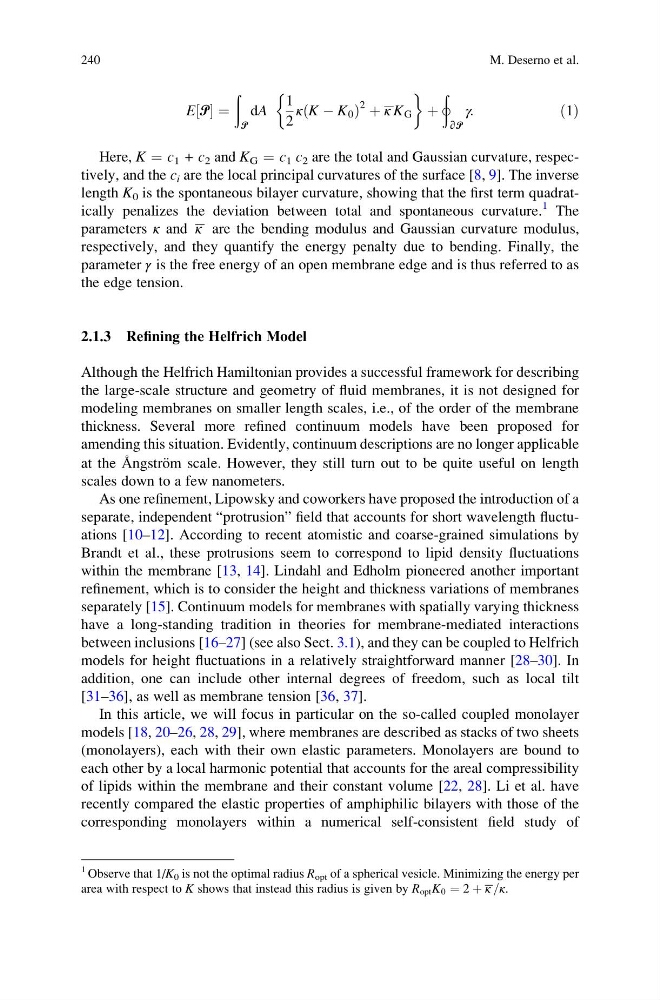
Here, K ¼ c 1 + c 2 and K G ¼ c 1 c 2 are the total and Gaussian curvature, respectively, and the c i are the local principal curvatures of the surface [8, 9]. The inverse
length K 0 is the spontaneous bilayer curvature, showing that the first term quadratically penalizes the deviation between total and spontaneous curvature.
1 The
parameters κ and κ are the bending modulus and Gaussian curvature modulus,
respectively, and they quantify the energy penalty due to bending. Finally, the
parameter γ is the free energy of an open membrane edge and is thus referred to as
the edge tension.
2.1.3 Refining the Helfrich Model
Although the Helfrich Hamiltonian provides a successful framework for describing
the large-scale structure and geometry of fluid membranes, it is not designed for
modeling membranes on smaller length scales, i.e., of the order of the membrane
thickness. Several more refined continuum models have been proposed for
amending this situation. Evidently, continuum descriptions are no longer applicable
at the Ångstro ¨m scale. However, they still turn out to be quite useful on length
scales down to a few nanometers.
As one refinement, Lipowsky and coworkers have proposed the introduction of a
separate, independent “protrusion” field that accounts for short wavelength fluctuations [10–12]. According to recent atomistic and coarse-grained simulations by
Brandt et al., these protrusions seem to correspond to lipid density fluctuations
within the membrane [13, 14]. Lindahl and Edholm pioneered another important
refinement, which is to consider the height and thickness variations of membranes
separately [15]. Continuum models for membranes with spatially varying thickness
have a long-standing tradition in theories for membrane-mediated interactions
between inclusions [16–27] (see also Sect. 3.1), and they can be coupled to Helfrich
models for height fluctuations in a relatively straightforward manner [28–30]. In
addition, one can include other internal degrees of freedom, such as local tilt
[31–36], as well as membrane tension [36, 37].
In this article, we will focus in particular on the so-called coupled monolayer
models [18, 20–26, 28, 29], where membranes are described as stacks of two sheets
(monolayers), each with their own elastic parameters. Monolayers are bound to
each other by a local harmonic potential that accounts for the areal compressibility
of lipids within the membrane and their constant volume [22, 28]. Li et al. have
recently compared the elastic properties of amphiphilic bilayers with those of the
corresponding monolayers within a numerical self-consistent field study of
1 Observe that 1/K 0 is not the optimal radius R opt of a spherical vesicle. Minimizing the energy per
area with respect to K shows that instead this radius is given by R opt K 0 ¼ 2 þ κ =κ.
240
M. Deserno et al.
½ ¼
ð
P
dA
1
2
κ K À K 0
ð
Þ
2 þ κ K G
&
'
þ
þ
∂P
γ:
ð1Þ
Here, K ¼ c 1 + c 2 and K G ¼ c 1 c 2 are the total and Gaussian curvature, respectively, and the c i are the local principal curvatures of the surface [8, 9]. The inverse
length K 0 is the spontaneous bilayer curvature, showing that the first term quadratically penalizes the deviation between total and spontaneous curvature.
1 The
parameters κ and κ are the bending modulus and Gaussian curvature modulus,
respectively, and they quantify the energy penalty due to bending. Finally, the
parameter γ is the free energy of an open membrane edge and is thus referred to as
the edge tension.
2.1.3 Refining the Helfrich Model
Although the Helfrich Hamiltonian provides a successful framework for describing
the large-scale structure and geometry of fluid membranes, it is not designed for
modeling membranes on smaller length scales, i.e., of the order of the membrane
thickness. Several more refined continuum models have been proposed for
amending this situation. Evidently, continuum descriptions are no longer applicable
at the Ångstro ¨m scale. However, they still turn out to be quite useful on length
scales down to a few nanometers.
As one refinement, Lipowsky and coworkers have proposed the introduction of a
separate, independent “protrusion” field that accounts for short wavelength fluctuations [10–12]. According to recent atomistic and coarse-grained simulations by
Brandt et al., these protrusions seem to correspond to lipid density fluctuations
within the membrane [13, 14]. Lindahl and Edholm pioneered another important
refinement, which is to consider the height and thickness variations of membranes
separately [15]. Continuum models for membranes with spatially varying thickness
have a long-standing tradition in theories for membrane-mediated interactions
between inclusions [16–27] (see also Sect. 3.1), and they can be coupled to Helfrich
models for height fluctuations in a relatively straightforward manner [28–30]. In
addition, one can include other internal degrees of freedom, such as local tilt
[31–36], as well as membrane tension [36, 37].
In this article, we will focus in particular on the so-called coupled monolayer
models [18, 20–26, 28, 29], where membranes are described as stacks of two sheets
(monolayers), each with their own elastic parameters. Monolayers are bound to
each other by a local harmonic potential that accounts for the areal compressibility
of lipids within the membrane and their constant volume [22, 28]. Li et al. have
recently compared the elastic properties of amphiphilic bilayers with those of the
corresponding monolayers within a numerical self-consistent field study of
1 Observe that 1/K 0 is not the optimal radius R opt of a spherical vesicle. Minimizing the energy per
area with respect to K shows that instead this radius is given by R opt K 0 ¼ 2 þ κ =κ.
240
M. Deserno et al.