

polymers [94]. Results of the release experiments are summarized in Table 1.
Complexes with linear PLL were very stable and DNA was not released by any of
the applied competitors. In contrast, complexes with brush polymers were less stable
and both heparin and BSA were able to release DNA, depending on the excess of
competitor to DNA.
Additionally, it was investigated whether complexation of DNA with
polycations could guard DNA from degradation by DNase. Degradation assays
with DNase revealed that none of the complexes provided enhanced protection
against DNase degradation. Recent reports on DNA protection against DNase
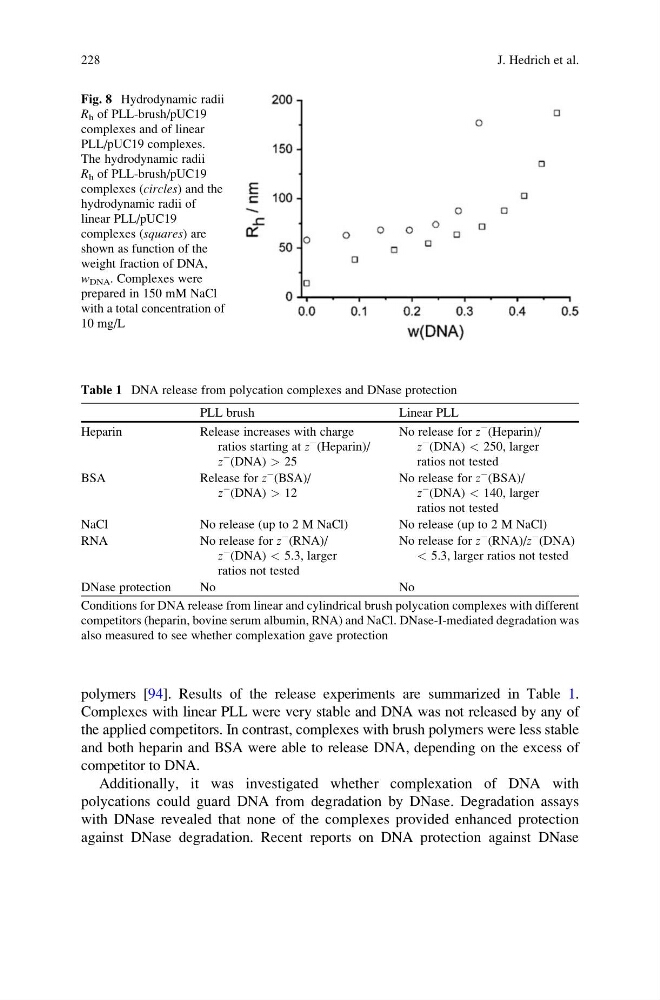
Fig. 8 Hydrodynamic radii
R h of PLL-brush/pUC19
complexes and of linear
PLL/pUC19 complexes.
The hydrodynamic radii
R h of PLL-brush/pUC19
complexes (circles) and the
hydrodynamic radii of
linear PLL/pUC19
complexes (squares) are
shown as function of the
weight fraction of DNA,
w DNA . Complexes were
prepared in 150 mM NaCl
with a total concentration of
10 mg/L
Table 1 DNA release from polycation complexes and DNase protection
PLL brush
Linear PLL
Heparin
Release increases with charge
ratios starting at z
À
(Heparin)/
z
À
(DNA) > 25
No release for z
À (Heparin)/
z
À (DNA) < 250, larger
ratios not tested
BSA
Release for z
À (BSA)/
z
À
(DNA) > 12
No release for z
À (BSA)/
z
À (DNA) < 140, larger
ratios not tested
NaCl
No release (up to 2 M NaCl)
No release (up to 2 M NaCl)
RNA
No release for z
À
(RNA)/
z
À
(DNA) < 5.3, larger
ratios not tested
No release for z
À (RNA)/z
À (DNA)
< 5.3, larger ratios not tested
DNase protection
No
No
Conditions for DNA release from linear and cylindrical brush polycation complexes with different
competitors (heparin, bovine serum albumin, RNA) and NaCl. DNase-I-mediated degradation was
also measured to see whether complexation gave protection
228
J. Hedrich et al.
Complexes with linear PLL were very stable and DNA was not released by any of
the applied competitors. In contrast, complexes with brush polymers were less stable
and both heparin and BSA were able to release DNA, depending on the excess of
competitor to DNA.
Additionally, it was investigated whether complexation of DNA with
polycations could guard DNA from degradation by DNase. Degradation assays
with DNase revealed that none of the complexes provided enhanced protection
against DNase degradation. Recent reports on DNA protection against DNase
Fig. 8 Hydrodynamic radii
R h of PLL-brush/pUC19
complexes and of linear
PLL/pUC19 complexes.
The hydrodynamic radii
R h of PLL-brush/pUC19
complexes (circles) and the
hydrodynamic radii of
linear PLL/pUC19
complexes (squares) are
shown as function of the
weight fraction of DNA,
w DNA . Complexes were
prepared in 150 mM NaCl
with a total concentration of
10 mg/L
Table 1 DNA release from polycation complexes and DNase protection
PLL brush
Linear PLL
Heparin
Release increases with charge
ratios starting at z
À
(Heparin)/
z
À
(DNA) > 25
No release for z
À (Heparin)/
z
À (DNA) < 250, larger
ratios not tested
BSA
Release for z
À (BSA)/
z
À
(DNA) > 12
No release for z
À (BSA)/
z
À (DNA) < 140, larger
ratios not tested
NaCl
No release (up to 2 M NaCl)
No release (up to 2 M NaCl)
RNA
No release for z
À
(RNA)/
z
À
(DNA) < 5.3, larger
ratios not tested
No release for z
À (RNA)/z
À (DNA)
< 5.3, larger ratios not tested
DNase protection
No
No
Conditions for DNA release from linear and cylindrical brush polycation complexes with different
competitors (heparin, bovine serum albumin, RNA) and NaCl. DNase-I-mediated degradation was
also measured to see whether complexation gave protection
228
J. Hedrich et al.