

2.2 Polymers for Transfection
Rod-like, semiflexible, and ring-shaped polymers were claimed to be promising
candidates as drug delivery vehicles, showing prolonged in vivo circulation times
[70–73] and excellent accumulation in tumor cells [72, 74]. Reports on complexes
of stiff polycations with DNA are rare. Besides other reports [75, 76], pullulan
modified with spermine groups was reported to transfect T24 cells of a human
bladder cancer cell line [77], HepG2 cells of a human hepatoma cell line [78, 79],
and human microvascular endothelial cells [80].
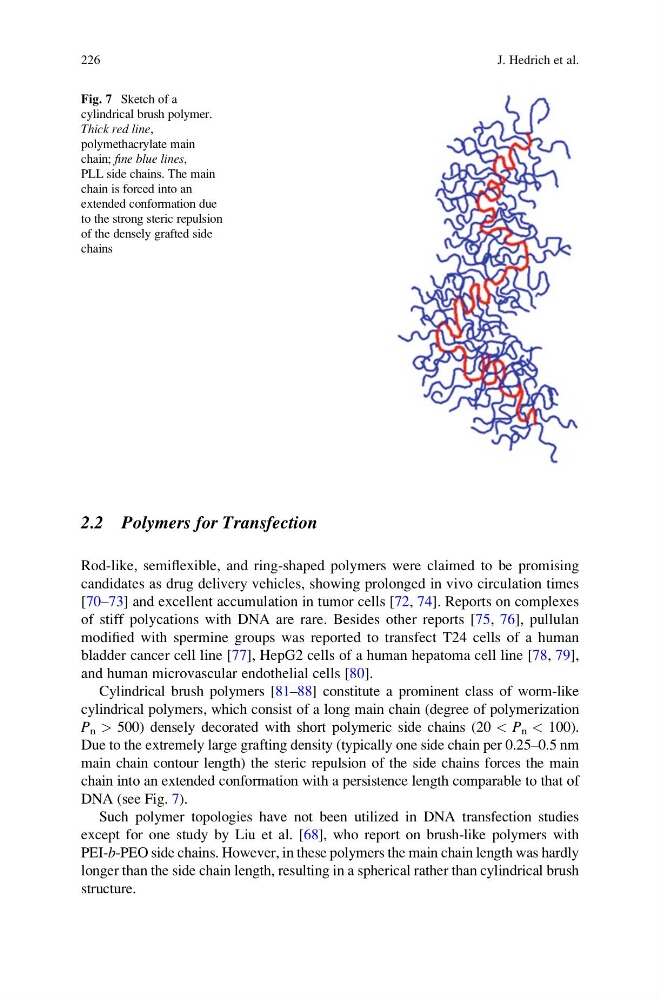
Cylindrical brush polymers [81–88] constitute a prominent class of worm-like
cylindrical polymers, which consist of a long main chain (degree of polymerization
P n > 500) densely decorated with short polymeric side chains (20 < P n < 100).
Due to the extremely large grafting density (typically one side chain per 0.25–0.5 nm
main chain contour length) the steric repulsion of the side chains forces the main
chain into an extended conformation with a persistence length comparable to that of
DNA (see Fig. 7).
Such polymer topologies have not been utilized in DNA transfection studies
except for one study by Liu et al. [68], who report on brush-like polymers with
PEI-b-PEO side chains. However, in these polymers the main chain length was hardly
longer than the side chain length, resulting in a spherical rather than cylindrical brush
structure.
Fig. 7 Sketch of a
cylindrical brush polymer.
Thick red line,
polymethacrylate main
chain; fine blue lines,
PLL side chains. The main
chain is forced into an
extended conformation due
to the strong steric repulsion
of the densely grafted side
chains
226
J. Hedrich et al.
Rod-like, semiflexible, and ring-shaped polymers were claimed to be promising
candidates as drug delivery vehicles, showing prolonged in vivo circulation times
[70–73] and excellent accumulation in tumor cells [72, 74]. Reports on complexes
of stiff polycations with DNA are rare. Besides other reports [75, 76], pullulan
modified with spermine groups was reported to transfect T24 cells of a human
bladder cancer cell line [77], HepG2 cells of a human hepatoma cell line [78, 79],
and human microvascular endothelial cells [80].
Cylindrical brush polymers [81–88] constitute a prominent class of worm-like
cylindrical polymers, which consist of a long main chain (degree of polymerization
P n > 500) densely decorated with short polymeric side chains (20 < P n < 100).
Due to the extremely large grafting density (typically one side chain per 0.25–0.5 nm
main chain contour length) the steric repulsion of the side chains forces the main
chain into an extended conformation with a persistence length comparable to that of
DNA (see Fig. 7).
Such polymer topologies have not been utilized in DNA transfection studies
except for one study by Liu et al. [68], who report on brush-like polymers with
PEI-b-PEO side chains. However, in these polymers the main chain length was hardly
longer than the side chain length, resulting in a spherical rather than cylindrical brush
structure.
Fig. 7 Sketch of a
cylindrical brush polymer.
Thick red line,
polymethacrylate main
chain; fine blue lines,
PLL side chains. The main
chain is forced into an
extended conformation due
to the strong steric repulsion
of the densely grafted side
chains
226
J. Hedrich et al.