

substrates only [284–288]. From an experimental point of view, this is motivated by
the fact that most surface-sensitive techniques such as scanning tunneling microscopy, low-energy electron diffraction, or photoelectron spectroscopy require
conductive samples. Moreover, when considering covalent coupling based on an
Ullmann-type reaction, a metallic surface has been regarded as mandatory because it
is known to act as a catalyst.
Molecular electronics applications will, however, require decoupling the
electronic structure of the polymer architecture from the supporting substrate.
Moreover, extending the material base from metals to the comparatively heterogeneous group of bulk insulators offers the potential for tailoring the substrate
properties to the specific, application-oriented needs.
We have, therefore, explored on-surfaces synthesis on a bulk insulator surface.
As a prerequisite, we investigated strategies for anchoring organic molecules to
insulating surfaces in order to avoid molecule desorption upon thermal activation of
the linking reaction [289]. We succeeded in presenting the first demonstration of a
covalent linking reaction on an insulating surface in an ultrahigh vacuum environment [290]. We then built upon this proof-of-concept work by exploring concepts
for hierarchical structure formation to pave the way for creating complex polymer
architectures on surfaces [291].
Insulating materials span a wide range from weakly van-der-Waals bonded
molecular crystals to covalent crystals such as diamond or titanium dioxide to
ionic crystals such as potassium bromide or calcium fluoride. Therefore, a general
description of molecule–surface interactions is challenging in the case of insulating
substrates. However, compared to metals, the interaction of organic molecules with
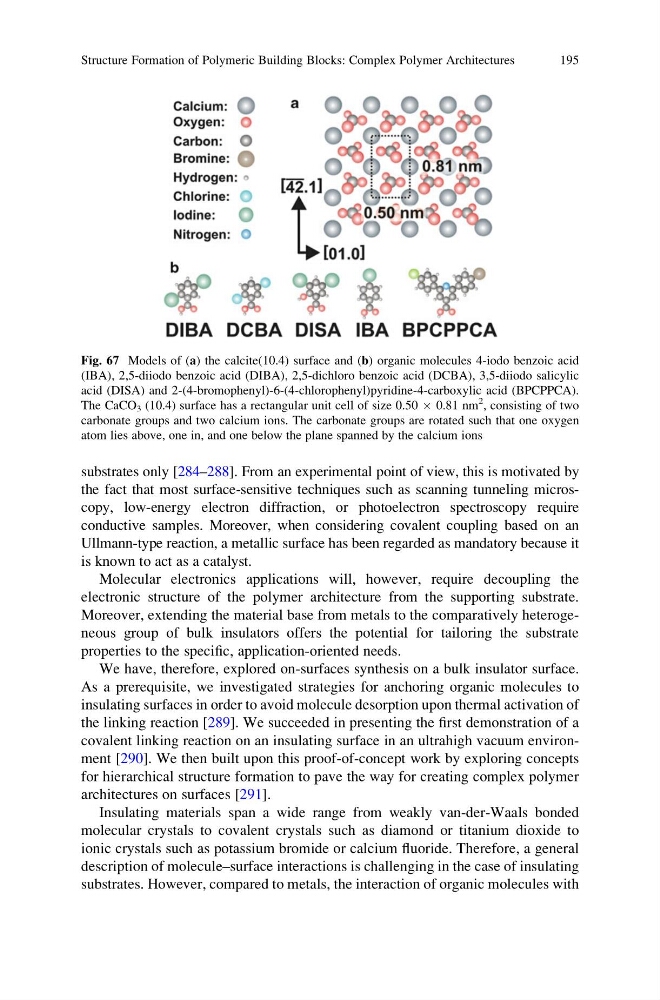
Fig. 67 Models of (a) the calcite(10.4) surface and (b) organic molecules 4-iodo benzoic acid
(IBA), 2,5-diiodo benzoic acid (DIBA), 2,5-dichloro benzoic acid (DCBA), 3,5-diiodo salicylic
acid (DISA) and 2-(4-bromophenyl)-6-(4-chlorophenyl)pyridine-4-carboxylic acid (BPCPPCA).
The CaCO 3 (10.4) surface has a rectangular unit cell of size 0.50 Â 0.81 nm
2
, consisting of two
carbonate groups and two calcium ions. The carbonate groups are rotated such that one oxygen
atom lies above, one in, and one below the plane spanned by the calcium ions
Structure Formation of Polymeric Building Blocks: Complex Polymer Architectures
195
the fact that most surface-sensitive techniques such as scanning tunneling microscopy, low-energy electron diffraction, or photoelectron spectroscopy require
conductive samples. Moreover, when considering covalent coupling based on an
Ullmann-type reaction, a metallic surface has been regarded as mandatory because it
is known to act as a catalyst.
Molecular electronics applications will, however, require decoupling the
electronic structure of the polymer architecture from the supporting substrate.
Moreover, extending the material base from metals to the comparatively heterogeneous group of bulk insulators offers the potential for tailoring the substrate
properties to the specific, application-oriented needs.
We have, therefore, explored on-surfaces synthesis on a bulk insulator surface.
As a prerequisite, we investigated strategies for anchoring organic molecules to
insulating surfaces in order to avoid molecule desorption upon thermal activation of
the linking reaction [289]. We succeeded in presenting the first demonstration of a
covalent linking reaction on an insulating surface in an ultrahigh vacuum environment [290]. We then built upon this proof-of-concept work by exploring concepts
for hierarchical structure formation to pave the way for creating complex polymer
architectures on surfaces [291].
Insulating materials span a wide range from weakly van-der-Waals bonded
molecular crystals to covalent crystals such as diamond or titanium dioxide to
ionic crystals such as potassium bromide or calcium fluoride. Therefore, a general
description of molecule–surface interactions is challenging in the case of insulating
substrates. However, compared to metals, the interaction of organic molecules with
Fig. 67 Models of (a) the calcite(10.4) surface and (b) organic molecules 4-iodo benzoic acid
(IBA), 2,5-diiodo benzoic acid (DIBA), 2,5-dichloro benzoic acid (DCBA), 3,5-diiodo salicylic
acid (DISA) and 2-(4-bromophenyl)-6-(4-chlorophenyl)pyridine-4-carboxylic acid (BPCPPCA).
The CaCO 3 (10.4) surface has a rectangular unit cell of size 0.50 Â 0.81 nm
2
, consisting of two
carbonate groups and two calcium ions. The carbonate groups are rotated such that one oxygen
atom lies above, one in, and one below the plane spanned by the calcium ions
Structure Formation of Polymeric Building Blocks: Complex Polymer Architectures
195