

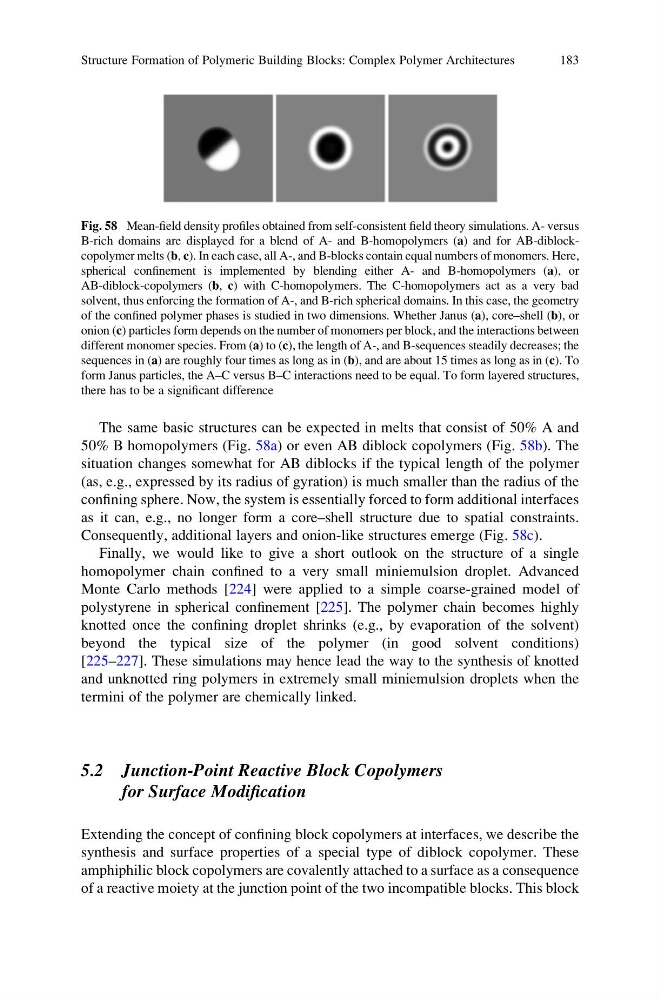
The same basic structures can be expected in melts that consist of 50% A and
50% B homopolymers (Fig. 58a) or even AB diblock copolymers (Fig. 58b). The
situation changes somewhat for AB diblocks if the typical length of the polymer
(as, e.g., expressed by its radius of gyration) is much smaller than the radius of the
confining sphere. Now, the system is essentially forced to form additional interfaces
as it can, e.g., no longer form a core–shell structure due to spatial constraints.
Consequently, additional layers and onion-like structures emerge (Fig. 58c).
Finally, we would like to give a short outlook on the structure of a single
homopolymer chain confined to a very small miniemulsion droplet. Advanced
Monte Carlo methods [224] were applied to a simple coarse-grained model of
polystyrene in spherical confinement [225]. The polymer chain becomes highly
knotted once the confining droplet shrinks (e.g., by evaporation of the solvent)
beyond the typical size of the polymer (in good solvent conditions)
[225–227]. These simulations may hence lead the way to the synthesis of knotted
and unknotted ring polymers in extremely small miniemulsion droplets when the
termini of the polymer are chemically linked.
5.2 Junction-Point Reactive Block Copolymers
for Surface Modification
Extending the concept of confining block copolymers at interfaces, we describe the
synthesis and surface properties of a special type of diblock copolymer. These
amphiphilic block copolymers are covalently attached to a surface as a consequence
of a reactive moiety at the junction point of the two incompatible blocks. This block
Fig. 58 Mean-field density profiles obtained from self-consistent field theory simulations. A- versus
B-rich domains are displayed for a blend of A- and B-homopolymers (a) and for AB-diblockcopolymer melts (b, c). In each case, all A-, and B-blocks contain equal numbers of monomers. Here,
spherical confinement is implemented by blending either A- and B-homopolymers (a), or
AB-diblock-copolymers (b, c) with C-homopolymers. The C-homopolymers act as a very bad
solvent, thus enforcing the formation of A-, and B-rich spherical domains. In this case, the geometry
of the confined polymer phases is studied in two dimensions. Whether Janus (a), core–shell (b), or
onion (c) particles form depends on the number of monomers per block, and the interactions between
different monomer species. From (a) to (c), the length of A-, and B-sequences steadily decreases; the
sequences in (a) are roughly four times as long as in (b), and are about 15 times as long as in (c). To
form Janus particles, the A–C versus B–C interactions need to be equal. To form layered structures,
there has to be a significant difference
Structure Formation of Polymeric Building Blocks: Complex Polymer Architectures
183
50% B homopolymers (Fig. 58a) or even AB diblock copolymers (Fig. 58b). The
situation changes somewhat for AB diblocks if the typical length of the polymer
(as, e.g., expressed by its radius of gyration) is much smaller than the radius of the
confining sphere. Now, the system is essentially forced to form additional interfaces
as it can, e.g., no longer form a core–shell structure due to spatial constraints.
Consequently, additional layers and onion-like structures emerge (Fig. 58c).
Finally, we would like to give a short outlook on the structure of a single
homopolymer chain confined to a very small miniemulsion droplet. Advanced
Monte Carlo methods [224] were applied to a simple coarse-grained model of
polystyrene in spherical confinement [225]. The polymer chain becomes highly
knotted once the confining droplet shrinks (e.g., by evaporation of the solvent)
beyond the typical size of the polymer (in good solvent conditions)
[225–227]. These simulations may hence lead the way to the synthesis of knotted
and unknotted ring polymers in extremely small miniemulsion droplets when the
termini of the polymer are chemically linked.
5.2 Junction-Point Reactive Block Copolymers
for Surface Modification
Extending the concept of confining block copolymers at interfaces, we describe the
synthesis and surface properties of a special type of diblock copolymer. These
amphiphilic block copolymers are covalently attached to a surface as a consequence
of a reactive moiety at the junction point of the two incompatible blocks. This block
Fig. 58 Mean-field density profiles obtained from self-consistent field theory simulations. A- versus
B-rich domains are displayed for a blend of A- and B-homopolymers (a) and for AB-diblockcopolymer melts (b, c). In each case, all A-, and B-blocks contain equal numbers of monomers. Here,
spherical confinement is implemented by blending either A- and B-homopolymers (a), or
AB-diblock-copolymers (b, c) with C-homopolymers. The C-homopolymers act as a very bad
solvent, thus enforcing the formation of A-, and B-rich spherical domains. In this case, the geometry
of the confined polymer phases is studied in two dimensions. Whether Janus (a), core–shell (b), or
onion (c) particles form depends on the number of monomers per block, and the interactions between
different monomer species. From (a) to (c), the length of A-, and B-sequences steadily decreases; the
sequences in (a) are roughly four times as long as in (b), and are about 15 times as long as in (c). To
form Janus particles, the A–C versus B–C interactions need to be equal. To form layered structures,
there has to be a significant difference
Structure Formation of Polymeric Building Blocks: Complex Polymer Architectures
183