

and PDIs is their ability to organize efficiently in different packing motifs and, in
particular, their degree of intra- and intermolecular order. The degree of structural
perfection strongly affects their properties (absorbance, fluorescence, and charge
transport) and results in applications in organic field-effect transistors, light-emitting
diodes, and organic solar cells.
In a systematic investigation of the self-assembly, dynamics, and kinetics of
phase formation of donor–acceptor substituted perylene derivatives, the role of the
strong dipole associated with the diphenylamine-functionalized perylenemonoimides molecules was elucidated. The close packing manifested itself in strong
heteronuclear dipolar couplings, which were exploited in solid-state NMR. The
structural investigation revealed that the self-assembly and thermodynamic
properties of perylene derivatives are significantly different from those of the
corresponding HBC compounds. Perylenes, with a small π–π overlap, form a
crystalline phase as well, but the residues do not tilt with respect to the columnar
axis. Because such a tilt is absent in perylenes, the intercolumnar thermal expansion
is always positive, being similar to the intracolumnar thermal expansion. This
constitutes a primary difference between the self-assembly motifs of the crystalline
phase of perylenes and those of the HBCs. The phase formation involves a delicate
balance of short-range interactions and packing. Our results suggest that branched
chains substituted away from bay positions are important as space-filling agents
within the alkyl domains for the formation of the crystalline phase.
The solid-state NMR experiments unraveled the role of intramolecular hydrogen
bonding in stabilizing the crystalline phase as well as the influence of non-hydrogenbonded moieties on the twist angle between successive monomers [209].
With respect to the dynamics, both solid-state NMR and DS revealed a relatively
immobile core within the crystalline phase. Perylene derivatives that do not crystallize undergo an isotropic liquid-to-glass transformation at a temperature that was
found to depend on the number of methylene units in the alkyl chains. The phase
transformation kinetics from the high temperature isotropic phase to the crystalline
phase at lower temperatures revealed a long-lived metastable state as a result of the
soft potential. The crystalline phase is formed via nucleation and growth. The
transformation kinetics is controlled by the nucleation barriers. The existence of
slow molecular dynamics and of very slow phase transformation suggests that care
should be taken in establishing the equilibrium phases of discotic liquid crystals.
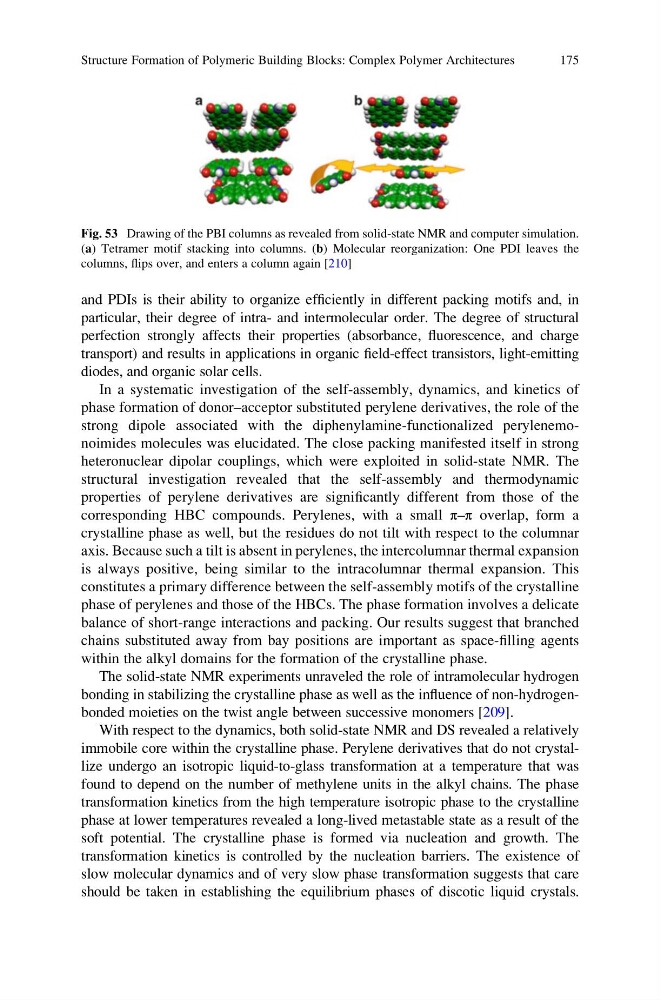
Fig. 53 Drawing of the PBI columns as revealed from solid-state NMR and computer simulation.
(a) Tetramer motif stacking into columns. (b) Molecular reorganization: One PDI leaves the
columns, flips over, and enters a column again [210]
Structure Formation of Polymeric Building Blocks: Complex Polymer Architectures
175
particular, their degree of intra- and intermolecular order. The degree of structural
perfection strongly affects their properties (absorbance, fluorescence, and charge
transport) and results in applications in organic field-effect transistors, light-emitting
diodes, and organic solar cells.
In a systematic investigation of the self-assembly, dynamics, and kinetics of
phase formation of donor–acceptor substituted perylene derivatives, the role of the
strong dipole associated with the diphenylamine-functionalized perylenemonoimides molecules was elucidated. The close packing manifested itself in strong
heteronuclear dipolar couplings, which were exploited in solid-state NMR. The
structural investigation revealed that the self-assembly and thermodynamic
properties of perylene derivatives are significantly different from those of the
corresponding HBC compounds. Perylenes, with a small π–π overlap, form a
crystalline phase as well, but the residues do not tilt with respect to the columnar
axis. Because such a tilt is absent in perylenes, the intercolumnar thermal expansion
is always positive, being similar to the intracolumnar thermal expansion. This
constitutes a primary difference between the self-assembly motifs of the crystalline
phase of perylenes and those of the HBCs. The phase formation involves a delicate
balance of short-range interactions and packing. Our results suggest that branched
chains substituted away from bay positions are important as space-filling agents
within the alkyl domains for the formation of the crystalline phase.
The solid-state NMR experiments unraveled the role of intramolecular hydrogen
bonding in stabilizing the crystalline phase as well as the influence of non-hydrogenbonded moieties on the twist angle between successive monomers [209].
With respect to the dynamics, both solid-state NMR and DS revealed a relatively
immobile core within the crystalline phase. Perylene derivatives that do not crystallize undergo an isotropic liquid-to-glass transformation at a temperature that was
found to depend on the number of methylene units in the alkyl chains. The phase
transformation kinetics from the high temperature isotropic phase to the crystalline
phase at lower temperatures revealed a long-lived metastable state as a result of the
soft potential. The crystalline phase is formed via nucleation and growth. The
transformation kinetics is controlled by the nucleation barriers. The existence of
slow molecular dynamics and of very slow phase transformation suggests that care
should be taken in establishing the equilibrium phases of discotic liquid crystals.
Fig. 53 Drawing of the PBI columns as revealed from solid-state NMR and computer simulation.
(a) Tetramer motif stacking into columns. (b) Molecular reorganization: One PDI leaves the
columns, flips over, and enters a column again [210]
Structure Formation of Polymeric Building Blocks: Complex Polymer Architectures
175