

S ¼ 0.5 for
13
C1
H dipole–dipole coupling, or
2
H quadrupole coupling, centered
around the C–H (C–D) bond direction. Imperfections of the packing in the LC phase,
where disks are inclined to the column axis, lead to a reduction, S < 0.5. Thus,
S provides both dynamic and structural information. In general, solid-state NMR can
provide site-selective information about the amplitude and time scales of molecular
motions over broad ranges of length and time [164].
Advances in the synthesis, characterization, and understanding of macromolecular
and supramolecular systems have led to an enormous variety and complexity in the
field of soft matter science [165]. The traditional separations in terms of structure
versus dynamics, crystalline versus amorphous, or experiment versus theory are
increasingly overcome. As far as characterization of such materials is concerned,
no experimental or theoretical/simulation approach alone can provide full information. Instead, a combination of techniques is called for and conclusions should be
backed by results provided by as many complimentary methods as possible
[166]. Combining scattering or NMR spectroscopy with computer simulation is
well established today in the study of structure and dynamics of biomacromolecules
[167]. Prominent examples of such an approach in the supramolecular field involve
the combination of X-ray scattering, spectroscopy and computer simulation to elucidate the packing in newly synthesized columnar systems [168]. The versatility of
magnetic resonance techniques, in particular solid-state-type NMR, in elucidating the
interplay between structure and dynamics in these systems is evident from the
examples provided below. Yet none of the results in the examples are based on a
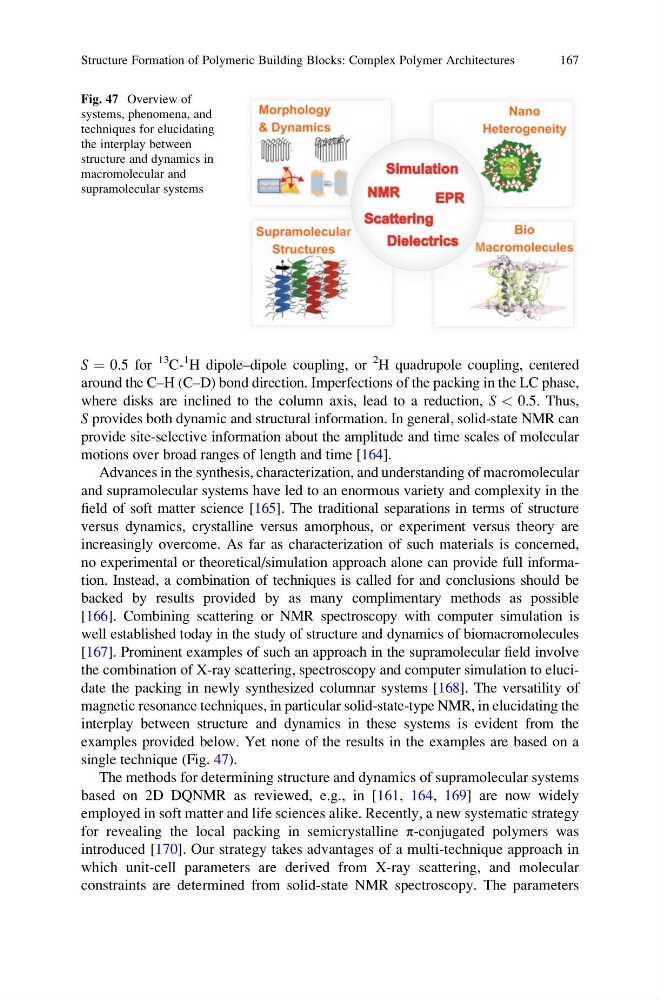
single technique (Fig. 47).
The methods for determining structure and dynamics of supramolecular systems
based on 2D DQNMR as reviewed, e.g., in [161, 164, 169] are now widely
employed in soft matter and life sciences alike. Recently, a new systematic strategy
for revealing the local packing in semicrystalline π-conjugated polymers was
introduced [170]. Our strategy takes advantages of a multi-technique approach in
which unit-cell parameters are derived from X-ray scattering, and molecular
constraints are determined from solid-state NMR spectroscopy. The parameters
Fig. 47 Overview of
systems, phenomena, and
techniques for elucidating
the interplay between
structure and dynamics in
macromolecular and
supramolecular systems
Structure Formation of Polymeric Building Blocks: Complex Polymer Architectures
167
13
C1
H dipole–dipole coupling, or
2
H quadrupole coupling, centered
around the C–H (C–D) bond direction. Imperfections of the packing in the LC phase,
where disks are inclined to the column axis, lead to a reduction, S < 0.5. Thus,
S provides both dynamic and structural information. In general, solid-state NMR can
provide site-selective information about the amplitude and time scales of molecular
motions over broad ranges of length and time [164].
Advances in the synthesis, characterization, and understanding of macromolecular
and supramolecular systems have led to an enormous variety and complexity in the
field of soft matter science [165]. The traditional separations in terms of structure
versus dynamics, crystalline versus amorphous, or experiment versus theory are
increasingly overcome. As far as characterization of such materials is concerned,
no experimental or theoretical/simulation approach alone can provide full information. Instead, a combination of techniques is called for and conclusions should be
backed by results provided by as many complimentary methods as possible
[166]. Combining scattering or NMR spectroscopy with computer simulation is
well established today in the study of structure and dynamics of biomacromolecules
[167]. Prominent examples of such an approach in the supramolecular field involve
the combination of X-ray scattering, spectroscopy and computer simulation to elucidate the packing in newly synthesized columnar systems [168]. The versatility of
magnetic resonance techniques, in particular solid-state-type NMR, in elucidating the
interplay between structure and dynamics in these systems is evident from the
examples provided below. Yet none of the results in the examples are based on a
single technique (Fig. 47).
The methods for determining structure and dynamics of supramolecular systems
based on 2D DQNMR as reviewed, e.g., in [161, 164, 169] are now widely
employed in soft matter and life sciences alike. Recently, a new systematic strategy
for revealing the local packing in semicrystalline π-conjugated polymers was
introduced [170]. Our strategy takes advantages of a multi-technique approach in
which unit-cell parameters are derived from X-ray scattering, and molecular
constraints are determined from solid-state NMR spectroscopy. The parameters
Fig. 47 Overview of
systems, phenomena, and
techniques for elucidating
the interplay between
structure and dynamics in
macromolecular and
supramolecular systems
Structure Formation of Polymeric Building Blocks: Complex Polymer Architectures
167