

W = 1
W = 2
W = 3
W = 4
W = 5
W = 6
0.48
0.52
0.56
0
0.1
0.2
0.3
0.4
φ
eff (N,U
c )
n
-0.5
U = U c (W)
W = 7
W = 8
W = 9
W = 10
Fig. 6 Plot of the effective crossover exponent ϕ eff (N ) versus n
À 0.5 at U ¼ U c (W )
for the different choices of W, as indicated. Note that ϕ eff (N,U,W ) is defined as
ϕ eff N; U; W
ð
Þ¼ln
4θs 2N, U, W
ð
Þ
θs N=2;U;W
ð
Þ =ln4
n
o
, where θ s is the fraction of adsorbed monomers at the
surface. Reprinted with permission from [32]
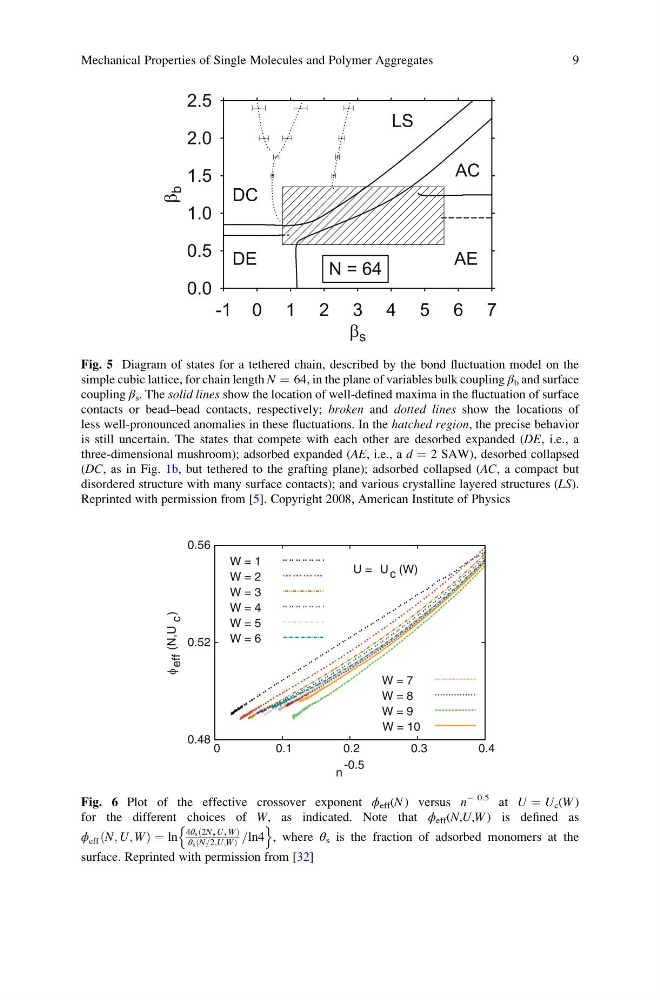
Fig. 5 Diagram of states for a tethered chain, described by the bond fluctuation model on the
simple cubic lattice, for chain length N ¼ 64, in the plane of variables bulk coupling β b and surface
coupling β s . The solid lines show the location of well-defined maxima in the fluctuation of surface
contacts or bead–bead contacts, respectively; broken and dotted lines show the locations of
less well-pronounced anomalies in these fluctuations. In the hatched region, the precise behavior
is still uncertain. The states that compete with each other are desorbed expanded (DE, i.e., a
three-dimensional mushroom); adsorbed expanded (AE, i.e., a d ¼ 2 SAW), desorbed collapsed
(DC, as in Fig. 1b, but tethered to the grafting plane); adsorbed collapsed (AC, a compact but
disordered structure with many surface contacts); and various crystalline layered structures (LS).
Reprinted with permission from [5]. Copyright 2008, American Institute of Physics
Mechanical Properties of Single Molecules and Polymer Aggregates
9
W = 2
W = 3
W = 4
W = 5
W = 6
0.48
0.52
0.56
0
0.1
0.2
0.3
0.4
φ
eff (N,U
c )
n
-0.5
U = U c (W)
W = 7
W = 8
W = 9
W = 10
Fig. 6 Plot of the effective crossover exponent ϕ eff (N ) versus n
À 0.5 at U ¼ U c (W )
for the different choices of W, as indicated. Note that ϕ eff (N,U,W ) is defined as
ϕ eff N; U; W
ð
Þ¼ln
4θs 2N, U, W
ð
Þ
θs N=2;U;W
ð
Þ =ln4
n
o
, where θ s is the fraction of adsorbed monomers at the
surface. Reprinted with permission from [32]
Fig. 5 Diagram of states for a tethered chain, described by the bond fluctuation model on the
simple cubic lattice, for chain length N ¼ 64, in the plane of variables bulk coupling β b and surface
coupling β s . The solid lines show the location of well-defined maxima in the fluctuation of surface
contacts or bead–bead contacts, respectively; broken and dotted lines show the locations of
less well-pronounced anomalies in these fluctuations. In the hatched region, the precise behavior
is still uncertain. The states that compete with each other are desorbed expanded (DE, i.e., a
three-dimensional mushroom); adsorbed expanded (AE, i.e., a d ¼ 2 SAW), desorbed collapsed
(DC, as in Fig. 1b, but tethered to the grafting plane); adsorbed collapsed (AC, a compact but
disordered structure with many surface contacts); and various crystalline layered structures (LS).
Reprinted with permission from [5]. Copyright 2008, American Institute of Physics
Mechanical Properties of Single Molecules and Polymer Aggregates
9