

3.4 Intramolecular Phase Separation Within Cylindrical
Copolymer Brushes with Incompatible Side Chains
In addition to the side chain conformation, chemically different side chains attached
to the same main chain may also have a pronounced impact on the main chain
conformation, particularly if the respective side chains are incompatible. Demixing
of the side chain is hampered by the fact that the chemically different side chains
are bound to the same main chain, leading to highly frustrated single chain
structures. In order to experimentally address this point, the phase separation
within statistical cylindrical brush copolymers comprising PMMA and poly-2vinylpyridinium (PVP) side chains was investigated [93, 94]. The samples
were prepared by radical copolymerization of methacryloyl end-functionalized
PMMA (M n
sc
¼ 3,700 g/mol) and PVP (M n
sc
¼ 5,100 g/mol) macromonomers.
Copolymer brushes with two different compositions were synthesized and
characterized as shown in Table 1. Subsequent quaternization of the PVP
side chains with ethylbromide was conducted in order to enhance incompatibility.
AFM pictures taken from the nonquaternized copolymer brushes after spincasting a dilute solution in chloroform onto mica revealed the usual wormlike
conformation (Fig. 22). However, the same preparation of the quaternized samples
yielded cylindrical brushes with pronounced and regular curvatures. The shorter
contour length sample 22PVP47-co-78PMMA35-QEB50 almost exclusively
formed horseshoe structures (Fig. 23) and the longer copolymer brush 73PVP47co-27PMMA35-QEB70 showed a meander-like conformation (Fig. 23). This
behavior was interpreted as intramolecular phase separation of the PMMA and
quaternized PVP side chains, as sketched in Fig. 24.
Later, some attempts were made to quantify the curvature of sample 21PVP47-co79PMMA44 as function of the degree of quaternization and of the quaternization
agent, i.e., ethyl versus benzyl bromide [94]. With increasing degree of
quaternization of the PVP side chains, the curvature radius varies from R curv ¼ 27 nm
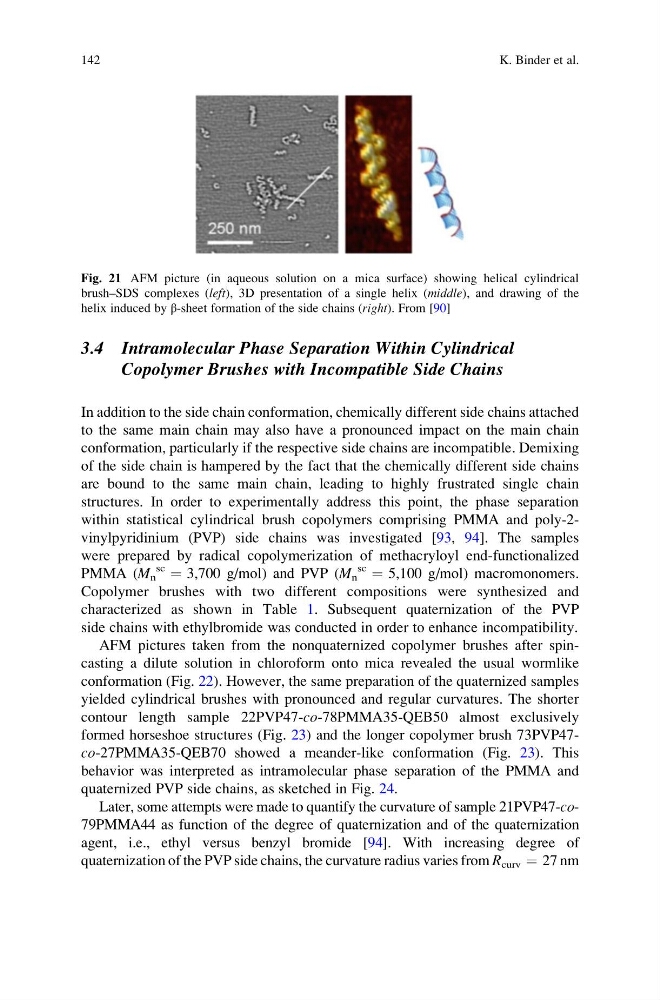
Fig. 21 AFM picture (in aqueous solution on a mica surface) showing helical cylindrical
brush–SDS complexes (left), 3D presentation of a single helix (middle), and drawing of the
helix induced by β-sheet formation of the side chains (right). From [90]
142
K. Binder et al.
Copolymer Brushes with Incompatible Side Chains
In addition to the side chain conformation, chemically different side chains attached
to the same main chain may also have a pronounced impact on the main chain
conformation, particularly if the respective side chains are incompatible. Demixing
of the side chain is hampered by the fact that the chemically different side chains
are bound to the same main chain, leading to highly frustrated single chain
structures. In order to experimentally address this point, the phase separation
within statistical cylindrical brush copolymers comprising PMMA and poly-2vinylpyridinium (PVP) side chains was investigated [93, 94]. The samples
were prepared by radical copolymerization of methacryloyl end-functionalized
PMMA (M n
sc
¼ 3,700 g/mol) and PVP (M n
sc
¼ 5,100 g/mol) macromonomers.
Copolymer brushes with two different compositions were synthesized and
characterized as shown in Table 1. Subsequent quaternization of the PVP
side chains with ethylbromide was conducted in order to enhance incompatibility.
AFM pictures taken from the nonquaternized copolymer brushes after spincasting a dilute solution in chloroform onto mica revealed the usual wormlike
conformation (Fig. 22). However, the same preparation of the quaternized samples
yielded cylindrical brushes with pronounced and regular curvatures. The shorter
contour length sample 22PVP47-co-78PMMA35-QEB50 almost exclusively
formed horseshoe structures (Fig. 23) and the longer copolymer brush 73PVP47co-27PMMA35-QEB70 showed a meander-like conformation (Fig. 23). This
behavior was interpreted as intramolecular phase separation of the PMMA and
quaternized PVP side chains, as sketched in Fig. 24.
Later, some attempts were made to quantify the curvature of sample 21PVP47-co79PMMA44 as function of the degree of quaternization and of the quaternization
agent, i.e., ethyl versus benzyl bromide [94]. With increasing degree of
quaternization of the PVP side chains, the curvature radius varies from R curv ¼ 27 nm
Fig. 21 AFM picture (in aqueous solution on a mica surface) showing helical cylindrical
brush–SDS complexes (left), 3D presentation of a single helix (middle), and drawing of the
helix induced by β-sheet formation of the side chains (right). From [90]
142
K. Binder et al.