

V DA %
ð
γ D r 1 ; r 1
ð
Þ
1
r 1 À r 2
j
j
γ
Ã
A r 2 ; r 2
ð
Þd
3 r 1 d
3 r 2 :
(10)
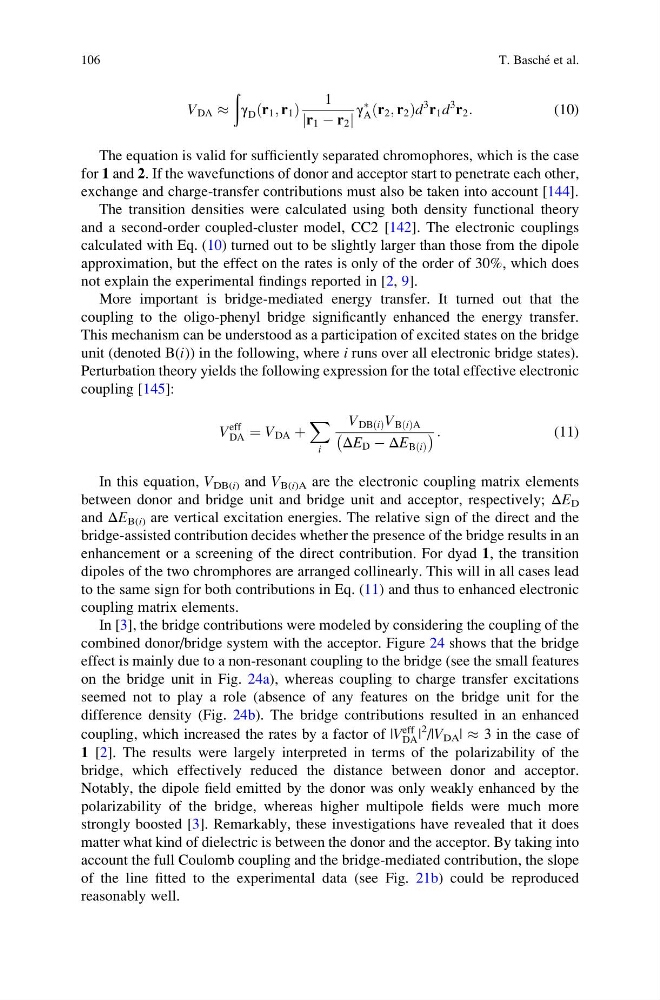
The equation is valid for sufficiently separated chromophores, which is the case
for 1 and 2. If the wavefunctions of donor and acceptor start to penetrate each other,
exchange and charge-transfer contributions must also be taken into account [144].
The transition densities were calculated using both density functional theory
and a second-order coupled-cluster model, CC2 [142]. The electronic couplings
calculated with Eq. (10) turned out to be slightly larger than those from the dipole
approximation, but the effect on the rates is only of the order of 30%, which does
not explain the experimental findings reported in [2, 9].
More important is bridge-mediated energy transfer. It turned out that the
coupling to the oligo-phenyl bridge significantly enhanced the energy transfer.
This mechanism can be understood as a participation of excited states on the bridge
unit (denoted B(i)) in the following, where i runs over all electronic bridge states).
Perturbation theory yields the following expression for the total effective electronic
coupling [145]:
V
eff
DA ¼ V DA þ
X
i
V DB i
ð Þ V B i
ð ÞA
ΔE D À ΔE B i
ð Þ
À
Á :
(11)
In this equation, V DB(i) and V B(i)A are the electronic coupling matrix elements
between donor and bridge unit and bridge unit and acceptor, respectively; ΔE D
and ΔE B(i) are vertical excitation energies. The relative sign of the direct and the
bridge-assisted contribution decides whether the presence of the bridge results in an
enhancement or a screening of the direct contribution. For dyad 1, the transition
dipoles of the two chromphores are arranged collinearly. This will in all cases lead
to the same sign for both contributions in Eq. (11) and thus to enhanced electronic
coupling matrix elements.
In [3], the bridge contributions were modeled by considering the coupling of the
combined donor/bridge system with the acceptor. Figure 24 shows that the bridge
effect is mainly due to a non-resonant coupling to the bridge (see the small features
on the bridge unit in Fig. 24a), whereas coupling to charge transfer excitations
seemed not to play a role (absence of any features on the bridge unit for the
difference density (Fig. 24b). The bridge contributions resulted in an enhanced
coupling, which increased the rates by a factor of |V
eff
DA |
2 /|V DA | % 3 in the case of
1 [2]. The results were largely interpreted in terms of the polarizability of the
bridge, which effectively reduced the distance between donor and acceptor.
Notably, the dipole field emitted by the donor was only weakly enhanced by the
polarizability of the bridge, whereas higher multipole fields were much more
strongly boosted [3]. Remarkably, these investigations have revealed that it does
matter what kind of dielectric is between the donor and the acceptor. By taking into
account the full Coulomb coupling and the bridge-mediated contribution, the slope
of the line fitted to the experimental data (see Fig. 21b) could be reproduced
reasonably well.
106
T. Basche ´ et al.
ð
γ D r 1 ; r 1
ð
Þ
1
r 1 À r 2
j
j
γ
Ã
A r 2 ; r 2
ð
Þd
3 r 1 d
3 r 2 :
(10)
The equation is valid for sufficiently separated chromophores, which is the case
for 1 and 2. If the wavefunctions of donor and acceptor start to penetrate each other,
exchange and charge-transfer contributions must also be taken into account [144].
The transition densities were calculated using both density functional theory
and a second-order coupled-cluster model, CC2 [142]. The electronic couplings
calculated with Eq. (10) turned out to be slightly larger than those from the dipole
approximation, but the effect on the rates is only of the order of 30%, which does
not explain the experimental findings reported in [2, 9].
More important is bridge-mediated energy transfer. It turned out that the
coupling to the oligo-phenyl bridge significantly enhanced the energy transfer.
This mechanism can be understood as a participation of excited states on the bridge
unit (denoted B(i)) in the following, where i runs over all electronic bridge states).
Perturbation theory yields the following expression for the total effective electronic
coupling [145]:
V
eff
DA ¼ V DA þ
X
i
V DB i
ð Þ V B i
ð ÞA
ΔE D À ΔE B i
ð Þ
À
Á :
(11)
In this equation, V DB(i) and V B(i)A are the electronic coupling matrix elements
between donor and bridge unit and bridge unit and acceptor, respectively; ΔE D
and ΔE B(i) are vertical excitation energies. The relative sign of the direct and the
bridge-assisted contribution decides whether the presence of the bridge results in an
enhancement or a screening of the direct contribution. For dyad 1, the transition
dipoles of the two chromphores are arranged collinearly. This will in all cases lead
to the same sign for both contributions in Eq. (11) and thus to enhanced electronic
coupling matrix elements.
In [3], the bridge contributions were modeled by considering the coupling of the
combined donor/bridge system with the acceptor. Figure 24 shows that the bridge
effect is mainly due to a non-resonant coupling to the bridge (see the small features
on the bridge unit in Fig. 24a), whereas coupling to charge transfer excitations
seemed not to play a role (absence of any features on the bridge unit for the
difference density (Fig. 24b). The bridge contributions resulted in an enhanced
coupling, which increased the rates by a factor of |V
eff
DA |
2 /|V DA | % 3 in the case of
1 [2]. The results were largely interpreted in terms of the polarizability of the
bridge, which effectively reduced the distance between donor and acceptor.
Notably, the dipole field emitted by the donor was only weakly enhanced by the
polarizability of the bridge, whereas higher multipole fields were much more
strongly boosted [3]. Remarkably, these investigations have revealed that it does
matter what kind of dielectric is between the donor and the acceptor. By taking into
account the full Coulomb coupling and the bridge-mediated contribution, the slope
of the line fitted to the experimental data (see Fig. 21b) could be reproduced
reasonably well.
106
T. Basche ´ et al.