

contrast to the weak adsorption scenarios considered in Sects. 2–4 where the
adsorption-deporption transition is rather continuous.
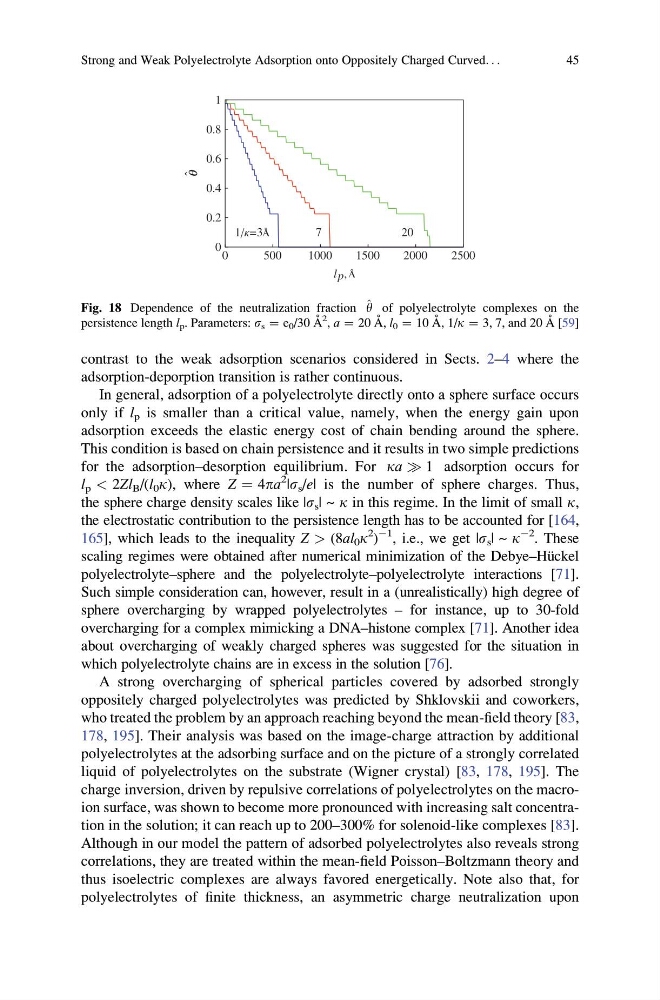
In general, adsorption of a polyelectrolyte directly onto a sphere surface occurs
only if l p is smaller than a critical value, namely, when the energy gain upon
adsorption exceeds the elastic energy cost of chain bending around the sphere.
This condition is based on chain persistence and it results in two simple predictions
for the adsorption–desorption equilibrium. For ka ) 1 adsorption occurs for
l p < 2Zl B /(l 0 k), where Z ¼ 4pa
2 |s s /e| is the number of sphere charges. Thus,
the sphere charge density scales like |s s | ~ k in this regime. In the limit of small k,
the electrostatic contribution to the persistence length has to be accounted for [164,
165], which leads to the inequality Z > (8al 0 k
2
)
À1
, i.e., we get |s s | ~ k
À2
. These
scaling regimes were obtained after numerical minimization of the Debye–Hu ¨ckel
polyelectrolyte–sphere and the polyelectrolyte–polyelectrolyte interactions [71].
Such simple consideration can, however, result in a (unrealistically) high degree of
sphere overcharging by wrapped polyelectrolytes – for instance, up to 30-fold
overcharging for a complex mimicking a DNA–histone complex [71]. Another idea
about overcharging of weakly charged spheres was suggested for the situation in
which polyelectrolyte chains are in excess in the solution [76].
A strong overcharging of spherical particles covered by adsorbed strongly
oppositely charged polyelectrolytes was predicted by Shklovskii and coworkers,
who treated the problem by an approach reaching beyond the mean-field theory [83,
178, 195]. Their analysis was based on the image-charge attraction by additional
polyelectrolytes at the adsorbing surface and on the picture of a strongly correlated
liquid of polyelectrolytes on the substrate (Wigner crystal) [83, 178, 195]. The
charge inversion, driven by repulsive correlations of polyelectrolytes on the macroion surface, was shown to become more pronounced with increasing salt concentration in the solution; it can reach up to 200–300% for solenoid-like complexes [83].
Although in our model the pattern of adsorbed polyelectrolytes also reveals strong
correlations, they are treated within the mean-field Poisson–Boltzmann theory and
thus isoelectric complexes are always favored energetically. Note also that, for
polyelectrolytes of finite thickness, an asymmetric charge neutralization upon
1 3
7
2 0
0
500
1000
1500
2000
2500
0
0.2
0.4
0.6
0.8
1
l p ,
q
Fig. 18 Dependence of the neutralization fraction ^ y of polyelectrolyte complexes on the
persistence length l p . Parameters: s s ¼ e 0 /30 A ˚ 2 , a ¼ 20 A ˚ , l 0 ¼ 10 A ˚ , 1/k ¼ 3, 7, and 20 A ˚ [59]
Strong and Weak Polyelectrolyte Adsorption onto Oppositely Charged Curved. . .
45
adsorption-deporption transition is rather continuous.
In general, adsorption of a polyelectrolyte directly onto a sphere surface occurs
only if l p is smaller than a critical value, namely, when the energy gain upon
adsorption exceeds the elastic energy cost of chain bending around the sphere.
This condition is based on chain persistence and it results in two simple predictions
for the adsorption–desorption equilibrium. For ka ) 1 adsorption occurs for
l p < 2Zl B /(l 0 k), where Z ¼ 4pa
2 |s s /e| is the number of sphere charges. Thus,
the sphere charge density scales like |s s | ~ k in this regime. In the limit of small k,
the electrostatic contribution to the persistence length has to be accounted for [164,
165], which leads to the inequality Z > (8al 0 k
2
)
À1
, i.e., we get |s s | ~ k
À2
. These
scaling regimes were obtained after numerical minimization of the Debye–Hu ¨ckel
polyelectrolyte–sphere and the polyelectrolyte–polyelectrolyte interactions [71].
Such simple consideration can, however, result in a (unrealistically) high degree of
sphere overcharging by wrapped polyelectrolytes – for instance, up to 30-fold
overcharging for a complex mimicking a DNA–histone complex [71]. Another idea
about overcharging of weakly charged spheres was suggested for the situation in
which polyelectrolyte chains are in excess in the solution [76].
A strong overcharging of spherical particles covered by adsorbed strongly
oppositely charged polyelectrolytes was predicted by Shklovskii and coworkers,
who treated the problem by an approach reaching beyond the mean-field theory [83,
178, 195]. Their analysis was based on the image-charge attraction by additional
polyelectrolytes at the adsorbing surface and on the picture of a strongly correlated
liquid of polyelectrolytes on the substrate (Wigner crystal) [83, 178, 195]. The
charge inversion, driven by repulsive correlations of polyelectrolytes on the macroion surface, was shown to become more pronounced with increasing salt concentration in the solution; it can reach up to 200–300% for solenoid-like complexes [83].
Although in our model the pattern of adsorbed polyelectrolytes also reveals strong
correlations, they are treated within the mean-field Poisson–Boltzmann theory and
thus isoelectric complexes are always favored energetically. Note also that, for
polyelectrolytes of finite thickness, an asymmetric charge neutralization upon
1 3
7
2 0
0
500
1000
1500
2000
2500
0
0.2
0.4
0.6
0.8
1
l p ,
q
Fig. 18 Dependence of the neutralization fraction ^ y of polyelectrolyte complexes on the
persistence length l p . Parameters: s s ¼ e 0 /30 A ˚ 2 , a ¼ 20 A ˚ , l 0 ¼ 10 A ˚ , 1/k ¼ 3, 7, and 20 A ˚ [59]
Strong and Weak Polyelectrolyte Adsorption onto Oppositely Charged Curved. . .
45