

a nonionic hydrophilic block, which are complexed with oppositely charged macromolecules. One important application of such IPECs is their potential for mimicking biological phenomena or gene delivery using complexes of DNA with cationic
bis-hydrophilic diblock copolymers. The incorporation of metal ions via their
coordination with functional groups on the polymers is a particular approach for
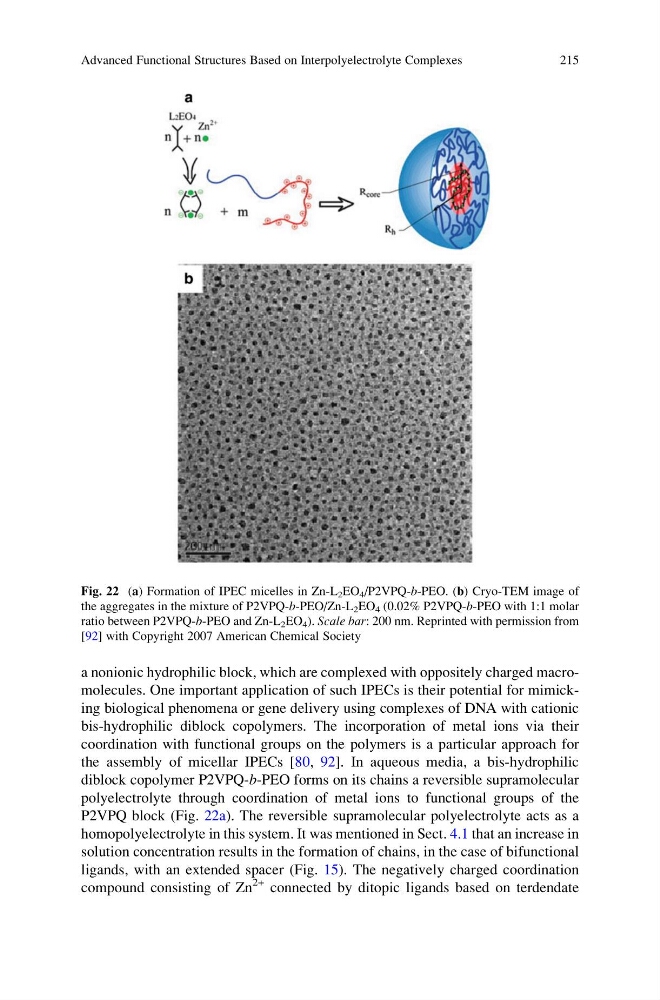
the assembly of micellar IPECs [80, 92]. In aqueous media, a bis-hydrophilic
diblock copolymer P2VPQ-b-PEO forms on its chains a reversible supramolecular
polyelectrolyte through coordination of metal ions to functional groups of the
P2VPQ block (Fig. 22a). The reversible supramolecular polyelectrolyte acts as a
homopolyelectrolyte in this system. It was mentioned in Sect. 4.1 that an increase in
solution concentration results in the formation of chains, in the case of bifunctional
ligands, with an extended spacer (Fig. 15). The negatively charged coordination
compound consisting of Zn
2+ connected by ditopic ligands based on terdendate
Fig. 22 (a) Formation of IPEC micelles in Zn-L 2 EO 4 /P2VPQ-b-PEO. (b) Cryo-TEM image of
the aggregates in the mixture of P2VPQ-b-PEO/Zn-L 2 EO 4 (0.02% P2VPQ-b-PEO with 1:1 molar
ratio between P2VPQ-b-PEO and Zn-L 2 EO 4 ). Scale bar: 200 nm. Reprinted with permission from
[92] with Copyright 2007 American Chemical Society
Advanced Functional Structures Based on Interpolyelectrolyte Complexes
215
bis-hydrophilic diblock copolymers. The incorporation of metal ions via their
coordination with functional groups on the polymers is a particular approach for
the assembly of micellar IPECs [80, 92]. In aqueous media, a bis-hydrophilic
diblock copolymer P2VPQ-b-PEO forms on its chains a reversible supramolecular
polyelectrolyte through coordination of metal ions to functional groups of the
P2VPQ block (Fig. 22a). The reversible supramolecular polyelectrolyte acts as a
homopolyelectrolyte in this system. It was mentioned in Sect. 4.1 that an increase in
solution concentration results in the formation of chains, in the case of bifunctional
ligands, with an extended spacer (Fig. 15). The negatively charged coordination
compound consisting of Zn
2+ connected by ditopic ligands based on terdendate
Fig. 22 (a) Formation of IPEC micelles in Zn-L 2 EO 4 /P2VPQ-b-PEO. (b) Cryo-TEM image of
the aggregates in the mixture of P2VPQ-b-PEO/Zn-L 2 EO 4 (0.02% P2VPQ-b-PEO with 1:1 molar
ratio between P2VPQ-b-PEO and Zn-L 2 EO 4 ). Scale bar: 200 nm. Reprinted with permission from
[92] with Copyright 2007 American Chemical Society
Advanced Functional Structures Based on Interpolyelectrolyte Complexes
215