

of the polymeric counterparts, which is decorated by a hydrophilic corona built up
from excess side chains of the cylindrical polyelectrolyte brush. This leads to a
nanopatterned structure with longitudinal undulations. It is remarkable that such
longitudinal undulations were experimentally observed for IPECs based on a
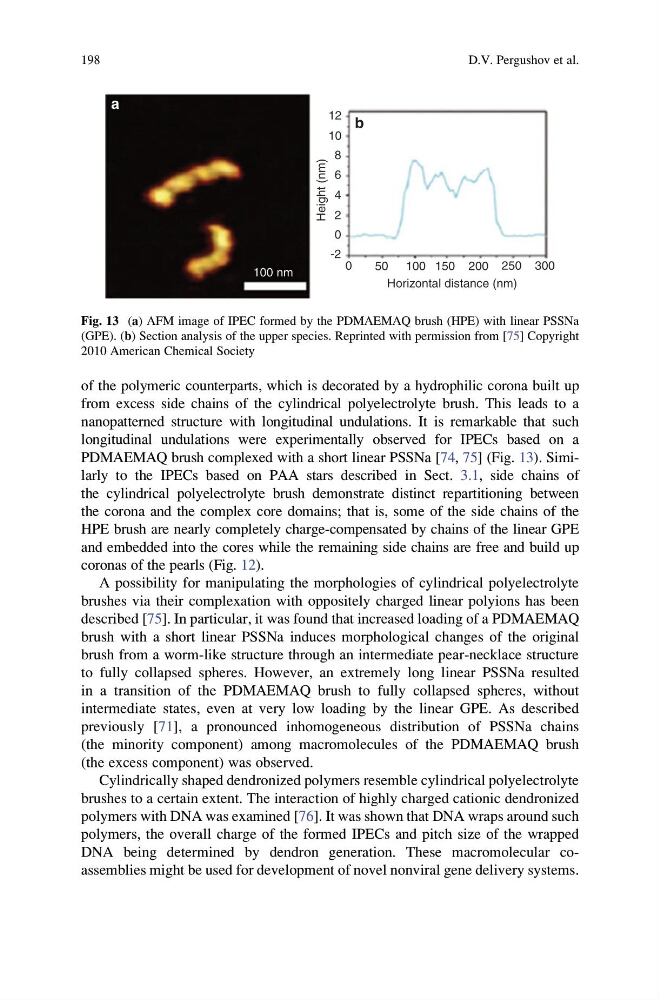
PDMAEMAQ brush complexed with a short linear PSSNa [74, 75] (Fig. 13). Similarly to the IPECs based on PAA stars described in Sect. 3.1, side chains of
the cylindrical polyelectrolyte brush demonstrate distinct repartitioning between
the corona and the complex core domains; that is, some of the side chains of the
HPE brush are nearly completely charge-compensated by chains of the linear GPE
and embedded into the cores while the remaining side chains are free and build up
coronas of the pearls (Fig. 12).
A possibility for manipulating the morphologies of cylindrical polyelectrolyte
brushes via their complexation with oppositely charged linear polyions has been
described [75]. In particular, it was found that increased loading of a PDMAEMAQ
brush with a short linear PSSNa induces morphological changes of the original
brush from a worm-like structure through an intermediate pear-necklace structure
to fully collapsed spheres. However, an extremely long linear PSSNa resulted
in a transition of the PDMAEMAQ brush to fully collapsed spheres, without
intermediate states, even at very low loading by the linear GPE. As described
previously [71], a pronounced inhomogeneous distribution of PSSNa chains
(the minority component) among macromolecules of the PDMAEMAQ brush
(the excess component) was observed.
Cylindrically shaped dendronized polymers resemble cylindrical polyelectrolyte
brushes to a certain extent. The interaction of highly charged cationic dendronized
polymers with DNA was examined [76]. It was shown that DNA wraps around such
polymers, the overall charge of the formed IPECs and pitch size of the wrapped
DNA being determined by dendron generation. These macromolecular coassemblies might be used for development of novel nonviral gene delivery systems.
4
6
8
10
12
2
-2
0
0
50 100 150 200 250 300
Horizontal distance (nm)
Height (nm)
100 nm
a
b
Fig. 13 (a) AFM image of IPEC formed by the PDMAEMAQ brush (HPE) with linear PSSNa
(GPE). (b) Section analysis of the upper species. Reprinted with permission from [75] Copyright
2010 American Chemical Society
198
D.V. Pergushov et al.
from excess side chains of the cylindrical polyelectrolyte brush. This leads to a
nanopatterned structure with longitudinal undulations. It is remarkable that such
longitudinal undulations were experimentally observed for IPECs based on a
PDMAEMAQ brush complexed with a short linear PSSNa [74, 75] (Fig. 13). Similarly to the IPECs based on PAA stars described in Sect. 3.1, side chains of
the cylindrical polyelectrolyte brush demonstrate distinct repartitioning between
the corona and the complex core domains; that is, some of the side chains of the
HPE brush are nearly completely charge-compensated by chains of the linear GPE
and embedded into the cores while the remaining side chains are free and build up
coronas of the pearls (Fig. 12).
A possibility for manipulating the morphologies of cylindrical polyelectrolyte
brushes via their complexation with oppositely charged linear polyions has been
described [75]. In particular, it was found that increased loading of a PDMAEMAQ
brush with a short linear PSSNa induces morphological changes of the original
brush from a worm-like structure through an intermediate pear-necklace structure
to fully collapsed spheres. However, an extremely long linear PSSNa resulted
in a transition of the PDMAEMAQ brush to fully collapsed spheres, without
intermediate states, even at very low loading by the linear GPE. As described
previously [71], a pronounced inhomogeneous distribution of PSSNa chains
(the minority component) among macromolecules of the PDMAEMAQ brush
(the excess component) was observed.
Cylindrically shaped dendronized polymers resemble cylindrical polyelectrolyte
brushes to a certain extent. The interaction of highly charged cationic dendronized
polymers with DNA was examined [76]. It was shown that DNA wraps around such
polymers, the overall charge of the formed IPECs and pitch size of the wrapped
DNA being determined by dendron generation. These macromolecular coassemblies might be used for development of novel nonviral gene delivery systems.
4
6
8
10
12
2
-2
0
0
50 100 150 200 250 300
Horizontal distance (nm)
Height (nm)
100 nm
a
b
Fig. 13 (a) AFM image of IPEC formed by the PDMAEMAQ brush (HPE) with linear PSSNa
(GPE). (b) Section analysis of the upper species. Reprinted with permission from [75] Copyright
2010 American Chemical Society
198
D.V. Pergushov et al.