

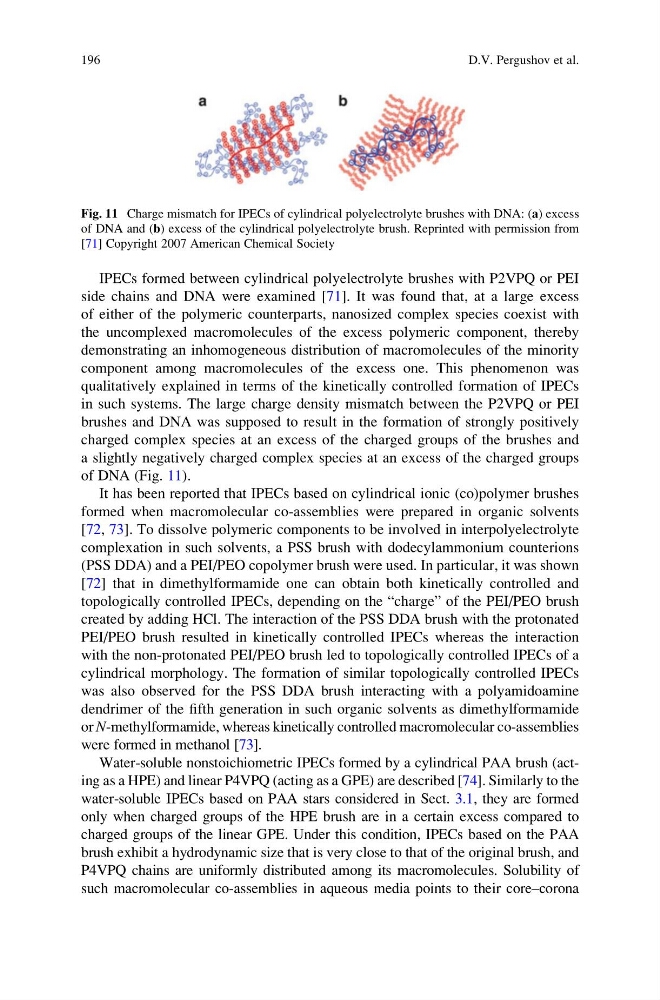
IPECs formed between cylindrical polyelectrolyte brushes with P2VPQ or PEI
side chains and DNA were examined [71]. It was found that, at a large excess
of either of the polymeric counterparts, nanosized complex species coexist with
the uncomplexed macromolecules of the excess polymeric component, thereby
demonstrating an inhomogeneous distribution of macromolecules of the minority
component among macromolecules of the excess one. This phenomenon was
qualitatively explained in terms of the kinetically controlled formation of IPECs
in such systems. The large charge density mismatch between the P2VPQ or PEI
brushes and DNA was supposed to result in the formation of strongly positively
charged complex species at an excess of the charged groups of the brushes and
a slightly negatively charged complex species at an excess of the charged groups
of DNA (Fig. 11).
It has been reported that IPECs based on cylindrical ionic (co)polymer brushes
formed when macromolecular co-assemblies were prepared in organic solvents
[72, 73]. To dissolve polymeric components to be involved in interpolyelectrolyte
complexation in such solvents, a PSS brush with dodecylammonium counterions
(PSS DDA) and a PEI/PEO copolymer brush were used. In particular, it was shown
[72] that in dimethylformamide one can obtain both kinetically controlled and
topologically controlled IPECs, depending on the “charge” of the PEI/PEO brush
created by adding HCl. The interaction of the PSS DDA brush with the protonated
PEI/PEO brush resulted in kinetically controlled IPECs whereas the interaction
with the non-protonated PEI/PEO brush led to topologically controlled IPECs of a
cylindrical morphology. The formation of similar topologically controlled IPECs
was also observed for the PSS DDA brush interacting with a polyamidoamine
dendrimer of the fifth generation in such organic solvents as dimethylformamide
or N-methylformamide, whereas kinetically controlled macromolecular co-assemblies
were formed in methanol [73].
Water-soluble nonstoichiometric IPECs formed by a cylindrical PAA brush (acting as a HPE) and linear P4VPQ (acting as a GPE) are described [74]. Similarly to the
water-soluble IPECs based on PAA stars considered in Sect. 3.1, they are formed
only when charged groups of the HPE brush are in a certain excess compared to
charged groups of the linear GPE. Under this condition, IPECs based on the PAA
brush exhibit a hydrodynamic size that is very close to that of the original brush, and
P4VPQ chains are uniformly distributed among its macromolecules. Solubility of
such macromolecular co-assemblies in aqueous media points to their core–corona
Fig. 11 Charge mismatch for IPECs of cylindrical polyelectrolyte brushes with DNA: (a) excess
of DNA and (b) excess of the cylindrical polyelectrolyte brush. Reprinted with permission from
[71] Copyright 2007 American Chemical Society
196
D.V. Pergushov et al.
side chains and DNA were examined [71]. It was found that, at a large excess
of either of the polymeric counterparts, nanosized complex species coexist with
the uncomplexed macromolecules of the excess polymeric component, thereby
demonstrating an inhomogeneous distribution of macromolecules of the minority
component among macromolecules of the excess one. This phenomenon was
qualitatively explained in terms of the kinetically controlled formation of IPECs
in such systems. The large charge density mismatch between the P2VPQ or PEI
brushes and DNA was supposed to result in the formation of strongly positively
charged complex species at an excess of the charged groups of the brushes and
a slightly negatively charged complex species at an excess of the charged groups
of DNA (Fig. 11).
It has been reported that IPECs based on cylindrical ionic (co)polymer brushes
formed when macromolecular co-assemblies were prepared in organic solvents
[72, 73]. To dissolve polymeric components to be involved in interpolyelectrolyte
complexation in such solvents, a PSS brush with dodecylammonium counterions
(PSS DDA) and a PEI/PEO copolymer brush were used. In particular, it was shown
[72] that in dimethylformamide one can obtain both kinetically controlled and
topologically controlled IPECs, depending on the “charge” of the PEI/PEO brush
created by adding HCl. The interaction of the PSS DDA brush with the protonated
PEI/PEO brush resulted in kinetically controlled IPECs whereas the interaction
with the non-protonated PEI/PEO brush led to topologically controlled IPECs of a
cylindrical morphology. The formation of similar topologically controlled IPECs
was also observed for the PSS DDA brush interacting with a polyamidoamine
dendrimer of the fifth generation in such organic solvents as dimethylformamide
or N-methylformamide, whereas kinetically controlled macromolecular co-assemblies
were formed in methanol [73].
Water-soluble nonstoichiometric IPECs formed by a cylindrical PAA brush (acting as a HPE) and linear P4VPQ (acting as a GPE) are described [74]. Similarly to the
water-soluble IPECs based on PAA stars considered in Sect. 3.1, they are formed
only when charged groups of the HPE brush are in a certain excess compared to
charged groups of the linear GPE. Under this condition, IPECs based on the PAA
brush exhibit a hydrodynamic size that is very close to that of the original brush, and
P4VPQ chains are uniformly distributed among its macromolecules. Solubility of
such macromolecular co-assemblies in aqueous media points to their core–corona
Fig. 11 Charge mismatch for IPECs of cylindrical polyelectrolyte brushes with DNA: (a) excess
of DNA and (b) excess of the cylindrical polyelectrolyte brush. Reprinted with permission from
[71] Copyright 2007 American Chemical Society
196
D.V. Pergushov et al.