

As in the case of star-shaped polyelectrolytes described in Sect. 3.1, the micelles
acting as HPE demonstrate only minor changes in their hydrodynamic size upon
interaction with oppositely charged linear polyions [61–64]. This finding strongly
suggests that, similarly to IPECs based on polyelectrolyte stars, the ionic blocks
forming a polyelectrolyte corona of such complex species split into two
populations: a certain number of such blocks are fully embedded into the complex
inner shell, while the rest of the coronal blocks remain nearly free, thereby being
responsible for solubility of the whole macromolecular co-assembly in aqueous
media.
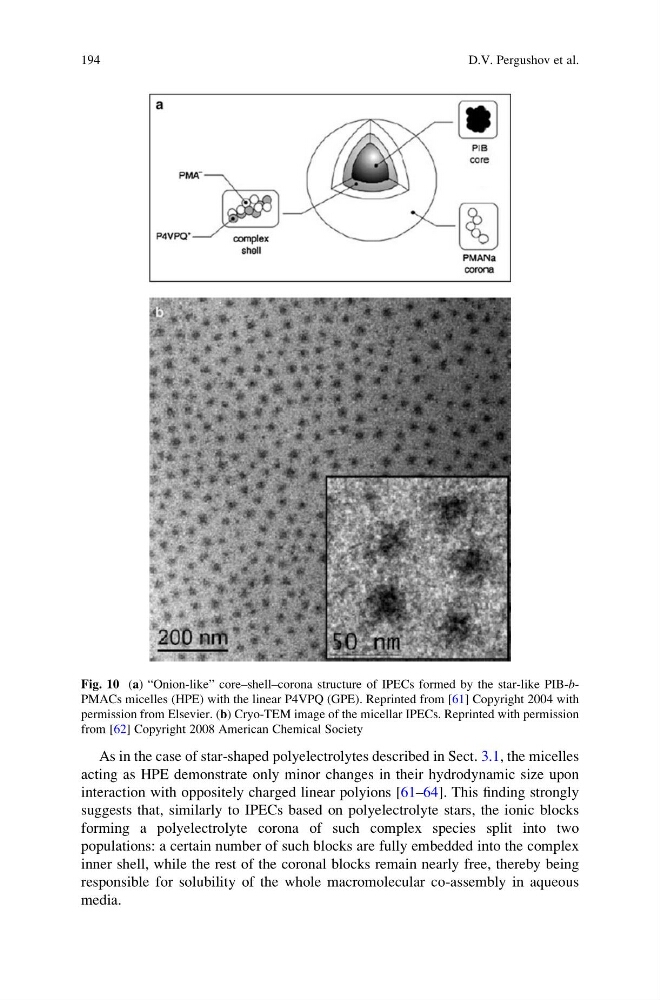
Fig. 10 (a) “Onion-like” core–shell–corona structure of IPECs formed by the star-like PIB-bPMACs micelles (HPE) with the linear P4VPQ (GPE). Reprinted from [61] Copyright 2004 with
permission from Elsevier. (b) Cryo-TEM image of the micellar IPECs. Reprinted with permission
from [62] Copyright 2008 American Chemical Society
194
D.V. Pergushov et al.
acting as HPE demonstrate only minor changes in their hydrodynamic size upon
interaction with oppositely charged linear polyions [61–64]. This finding strongly
suggests that, similarly to IPECs based on polyelectrolyte stars, the ionic blocks
forming a polyelectrolyte corona of such complex species split into two
populations: a certain number of such blocks are fully embedded into the complex
inner shell, while the rest of the coronal blocks remain nearly free, thereby being
responsible for solubility of the whole macromolecular co-assembly in aqueous
media.
Fig. 10 (a) “Onion-like” core–shell–corona structure of IPECs formed by the star-like PIB-bPMACs micelles (HPE) with the linear P4VPQ (GPE). Reprinted from [61] Copyright 2004 with
permission from Elsevier. (b) Cryo-TEM image of the micellar IPECs. Reprinted with permission
from [62] Copyright 2008 American Chemical Society
194
D.V. Pergushov et al.