

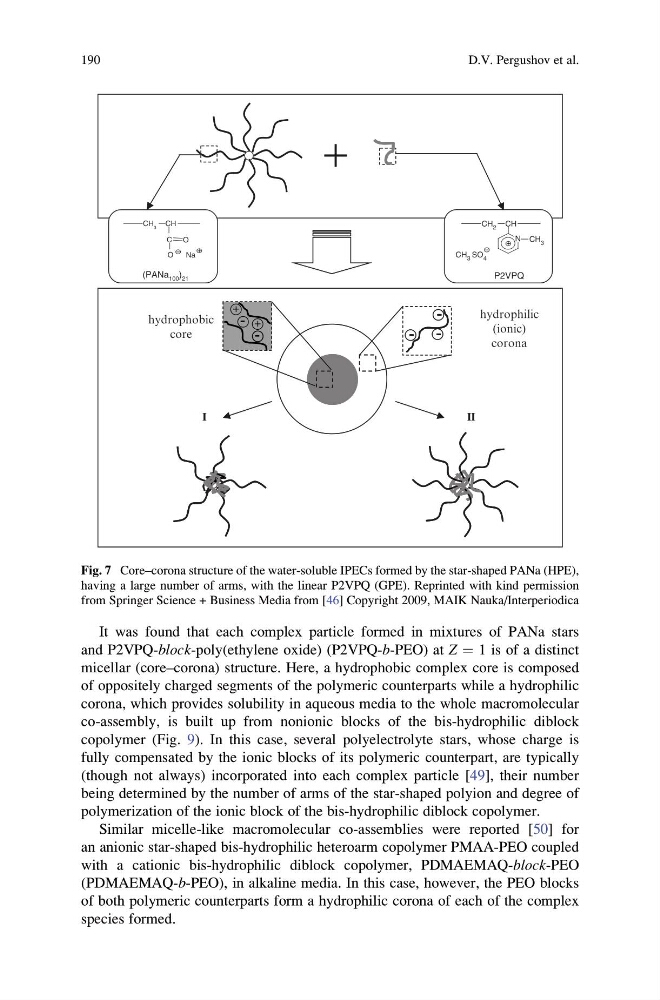
It was found that each complex particle formed in mixtures of PANa stars
and P2VPQ-block-poly(ethylene oxide) (P2VPQ-b-PEO) at Z ¼ 1 is of a distinct
micellar (core–corona) structure. Here, a hydrophobic complex core is composed
of oppositely charged segments of the polymeric counterparts while a hydrophilic
corona, which provides solubility in aqueous media to the whole macromolecular
co-assembly, is built up from nonionic blocks of the bis-hydrophilic diblock
copolymer (Fig. 9). In this case, several polyelectrolyte stars, whose charge is
fully compensated by the ionic blocks of its polymeric counterpart, are typically
(though not always) incorporated into each complex particle [49], their number
being determined by the number of arms of the star-shaped polyion and degree of
polymerization of the ionic block of the bis-hydrophilic diblock copolymer.
Similar micelle-like macromolecular co-assemblies were reported [50] for
an anionic star-shaped bis-hydrophilic heteroarm copolymer PMAA-PEO coupled
with a cationic bis-hydrophilic diblock copolymer, PDMAEMAQ-block-PEO
(PDMAEMAQ-b-PEO), in alkaline media. In this case, however, the PEO blocks
of both polymeric counterparts form a hydrophilic corona of each of the complex
species formed.
+
+
-
- +
-
-
-
CH 3 SO 4
CH
CH 2
N CH 3
(PANa 100 ) 21
P2VPQ
hydrophobic
core
hydrophilic
(ionic)
corona
I
I I
CH
CH 2
O
Na
C
O
+
+
-
- +
-
-
-
- -
- -
- -
CH 3 SO 4
CH
CH 2
N CH 3
(PANa 100 ) 21
P2VPQ
I
I I
CH
CH 3
O
Na
C
O
Fig. 7 Core–corona structure of the water-soluble IPECs formed by the star-shaped PANa (HPE),
having a large number of arms, with the linear P2VPQ (GPE). Reprinted with kind permission
from Springer Science + Business Media from [46] Copyright 2009, MAIK Nauka/Interperiodica
190
D.V. Pergushov et al.
and P2VPQ-block-poly(ethylene oxide) (P2VPQ-b-PEO) at Z ¼ 1 is of a distinct
micellar (core–corona) structure. Here, a hydrophobic complex core is composed
of oppositely charged segments of the polymeric counterparts while a hydrophilic
corona, which provides solubility in aqueous media to the whole macromolecular
co-assembly, is built up from nonionic blocks of the bis-hydrophilic diblock
copolymer (Fig. 9). In this case, several polyelectrolyte stars, whose charge is
fully compensated by the ionic blocks of its polymeric counterpart, are typically
(though not always) incorporated into each complex particle [49], their number
being determined by the number of arms of the star-shaped polyion and degree of
polymerization of the ionic block of the bis-hydrophilic diblock copolymer.
Similar micelle-like macromolecular co-assemblies were reported [50] for
an anionic star-shaped bis-hydrophilic heteroarm copolymer PMAA-PEO coupled
with a cationic bis-hydrophilic diblock copolymer, PDMAEMAQ-block-PEO
(PDMAEMAQ-b-PEO), in alkaline media. In this case, however, the PEO blocks
of both polymeric counterparts form a hydrophilic corona of each of the complex
species formed.
+
+
-
- +
-
-
-
CH 3 SO 4
CH
CH 2
N CH 3
(PANa 100 ) 21
P2VPQ
hydrophobic
core
hydrophilic
(ionic)
corona
I
I I
CH
CH 2
O
Na
C
O
+
+
-
- +
-
-
-
- -
- -
- -
CH 3 SO 4
CH
CH 2
N CH 3
(PANa 100 ) 21
P2VPQ
I
I I
CH
CH 3
O
Na
C
O
Fig. 7 Core–corona structure of the water-soluble IPECs formed by the star-shaped PANa (HPE),
having a large number of arms, with the linear P2VPQ (GPE). Reprinted with kind permission
from Springer Science + Business Media from [46] Copyright 2009, MAIK Nauka/Interperiodica
190
D.V. Pergushov et al.