

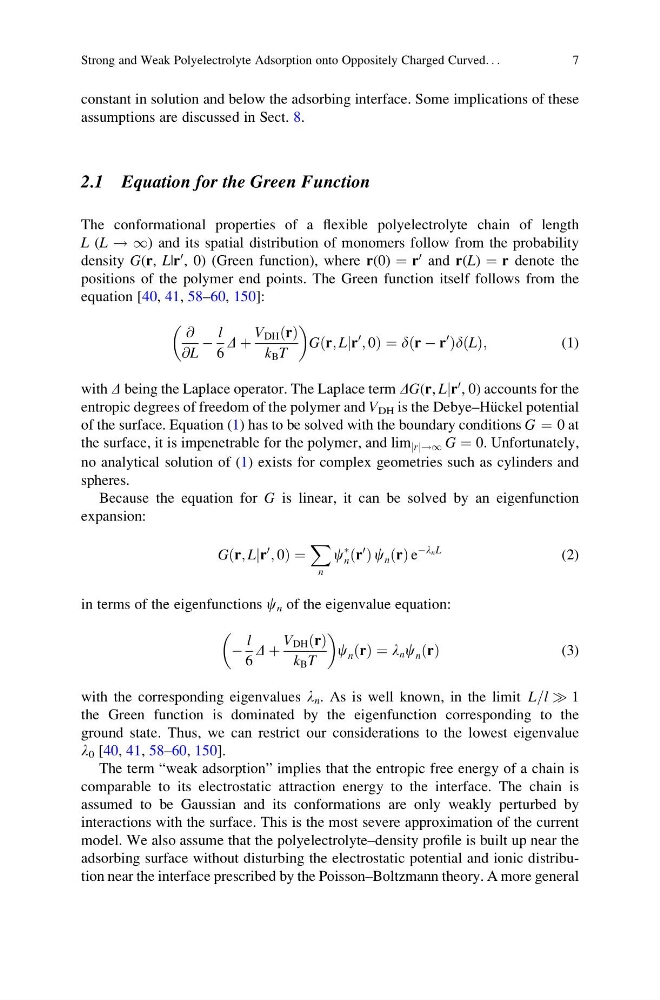
constant in solution and below the adsorbing interface. Some implications of these
assumptions are discussed in Sect. 8.
2.1 Equation for the Green Function
The conformational properties of a flexible polyelectrolyte chain of length
L (L ! 1) and its spatial distribution of monomers follow from the probability
density G(r, L|r
0 , 0) (Green function), where r(0) ¼ r
0 and r(L) ¼ r denote the
positions of the polymer end points. The Green function itself follows from the
equation [40, 41, 58–60, 150]:
@
@L
À
l
6
D þ
V DH ðrÞ
k B T
Gðr; Ljr
0
; 0Þ ¼ dðr À r
0
ÞdðLÞ;
(1)
with D being the Laplace operator. The Laplace term DG(r, Ljr
0 , 0) accounts for the
entropic degrees of freedom of the polymer and V DH is the Debye–Hu ¨ckel potential
of the surface. Equation (1) has to be solved with the boundary conditions G ¼ 0 at
the surface, it is impenetrable for the polymer, and lim jrj!1 G ¼ 0. Unfortunately,
no analytical solution of (1) exists for complex geometries such as cylinders and
spheres.
Because the equation for G is linear, it can be solved by an eigenfunction
expansion:
Gðr; Ljr
0
; 0Þ ¼
X
n
c
Ã
n ðr
0
Þ c n ðrÞ e
Àl n L
(2)
in terms of the eigenfunctions c n of the eigenvalue equation:
À
l
6
D þ
V DH ðrÞ
k B T
c n ðrÞ ¼ l n c n ðrÞ
(3)
with the corresponding eigenvalues l n . As is well known, in the limit L=l ) 1
the Green function is dominated by the eigenfunction corresponding to the
ground state. Thus, we can restrict our considerations to the lowest eigenvalue
l 0 [40, 41, 58–60, 150].
The term “weak adsorption” implies that the entropic free energy of a chain is
comparable to its electrostatic attraction energy to the interface. The chain is
assumed to be Gaussian and its conformations are only weakly perturbed by
interactions with the surface. This is the most severe approximation of the current
model. We also assume that the polyelectrolyte–density profile is built up near the
adsorbing surface without disturbing the electrostatic potential and ionic distribution near the interface prescribed by the Poisson–Boltzmann theory. A more general
Strong and Weak Polyelectrolyte Adsorption onto Oppositely Charged Curved. . .
7
assumptions are discussed in Sect. 8.
2.1 Equation for the Green Function
The conformational properties of a flexible polyelectrolyte chain of length
L (L ! 1) and its spatial distribution of monomers follow from the probability
density G(r, L|r
0 , 0) (Green function), where r(0) ¼ r
0 and r(L) ¼ r denote the
positions of the polymer end points. The Green function itself follows from the
equation [40, 41, 58–60, 150]:
@
@L
À
l
6
D þ
V DH ðrÞ
k B T
Gðr; Ljr
0
; 0Þ ¼ dðr À r
0
ÞdðLÞ;
(1)
with D being the Laplace operator. The Laplace term DG(r, Ljr
0 , 0) accounts for the
entropic degrees of freedom of the polymer and V DH is the Debye–Hu ¨ckel potential
of the surface. Equation (1) has to be solved with the boundary conditions G ¼ 0 at
the surface, it is impenetrable for the polymer, and lim jrj!1 G ¼ 0. Unfortunately,
no analytical solution of (1) exists for complex geometries such as cylinders and
spheres.
Because the equation for G is linear, it can be solved by an eigenfunction
expansion:
Gðr; Ljr
0
; 0Þ ¼
X
n
c
Ã
n ðr
0
Þ c n ðrÞ e
Àl n L
(2)
in terms of the eigenfunctions c n of the eigenvalue equation:
À
l
6
D þ
V DH ðrÞ
k B T
c n ðrÞ ¼ l n c n ðrÞ
(3)
with the corresponding eigenvalues l n . As is well known, in the limit L=l ) 1
the Green function is dominated by the eigenfunction corresponding to the
ground state. Thus, we can restrict our considerations to the lowest eigenvalue
l 0 [40, 41, 58–60, 150].
The term “weak adsorption” implies that the entropic free energy of a chain is
comparable to its electrostatic attraction energy to the interface. The chain is
assumed to be Gaussian and its conformations are only weakly perturbed by
interactions with the surface. This is the most severe approximation of the current
model. We also assume that the polyelectrolyte–density profile is built up near the
adsorbing surface without disturbing the electrostatic potential and ionic distribution near the interface prescribed by the Poisson–Boltzmann theory. A more general
Strong and Weak Polyelectrolyte Adsorption onto Oppositely Charged Curved. . .
7