

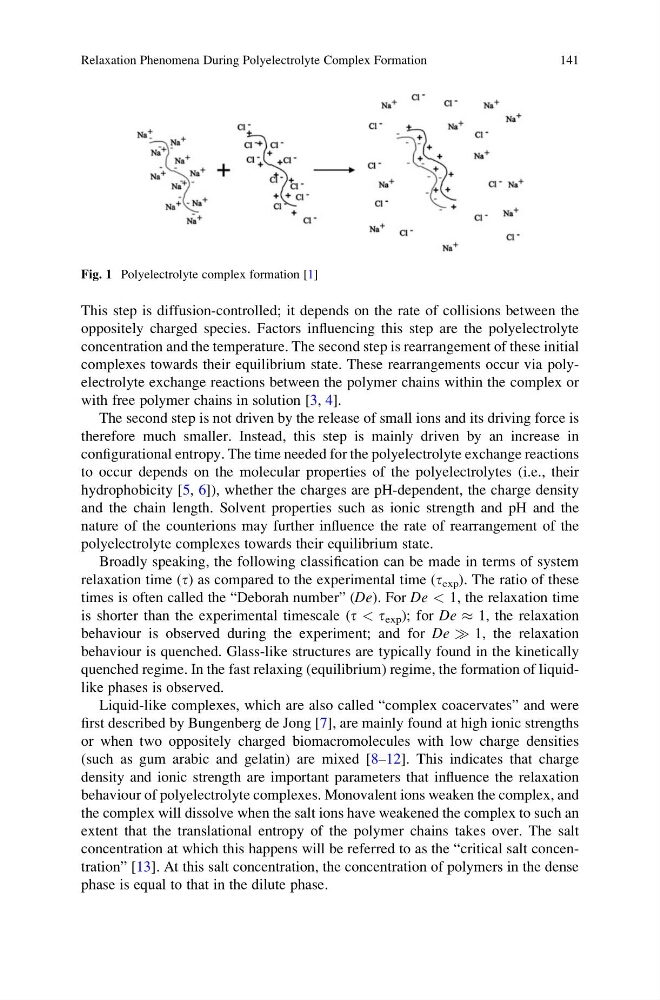
This step is diffusion-controlled; it depends on the rate of collisions between the
oppositely charged species. Factors influencing this step are the polyelectrolyte
concentration and the temperature. The second step is rearrangement of these initial
complexes towards their equilibrium state. These rearrangements occur via polyelectrolyte exchange reactions between the polymer chains within the complex or
with free polymer chains in solution [3, 4].
The second step is not driven by the release of small ions and its driving force is
therefore much smaller. Instead, this step is mainly driven by an increase in
configurational entropy. The time needed for the polyelectrolyte exchange reactions
to occur depends on the molecular properties of the polyelectrolytes (i.e., their
hydrophobicity [5, 6]), whether the charges are pH-dependent, the charge density
and the chain length. Solvent properties such as ionic strength and pH and the
nature of the counterions may further influence the rate of rearrangement of the
polyelectrolyte complexes towards their equilibrium state.
Broadly speaking, the following classification can be made in terms of system
relaxation time (t) as compared to the experimental time (t exp ). The ratio of these
times is often called the “Deborah number” (De). For De < 1, the relaxation time
is shorter than the experimental timescale (t < t exp ); for De % 1, the relaxation
behaviour is observed during the experiment; and for De ) 1, the relaxation
behaviour is quenched. Glass-like structures are typically found in the kinetically
quenched regime. In the fast relaxing (equilibrium) regime, the formation of liquidlike phases is observed.
Liquid-like complexes, which are also called “complex coacervates” and were
first described by Bungenberg de Jong [7], are mainly found at high ionic strengths
or when two oppositely charged biomacromolecules with low charge densities
(such as gum arabic and gelatin) are mixed [8–12]. This indicates that charge
density and ionic strength are important parameters that influence the relaxation
behaviour of polyelectrolyte complexes. Monovalent ions weaken the complex, and
the complex will dissolve when the salt ions have weakened the complex to such an
extent that the translational entropy of the polymer chains takes over. The salt
concentration at which this happens will be referred to as the “critical salt concentration” [13]. At this salt concentration, the concentration of polymers in the dense
phase is equal to that in the dilute phase.
Fig. 1 Polyelectrolyte complex formation [1]
Relaxation Phenomena During Polyelectrolyte Complex Formation
141
oppositely charged species. Factors influencing this step are the polyelectrolyte
concentration and the temperature. The second step is rearrangement of these initial
complexes towards their equilibrium state. These rearrangements occur via polyelectrolyte exchange reactions between the polymer chains within the complex or
with free polymer chains in solution [3, 4].
The second step is not driven by the release of small ions and its driving force is
therefore much smaller. Instead, this step is mainly driven by an increase in
configurational entropy. The time needed for the polyelectrolyte exchange reactions
to occur depends on the molecular properties of the polyelectrolytes (i.e., their
hydrophobicity [5, 6]), whether the charges are pH-dependent, the charge density
and the chain length. Solvent properties such as ionic strength and pH and the
nature of the counterions may further influence the rate of rearrangement of the
polyelectrolyte complexes towards their equilibrium state.
Broadly speaking, the following classification can be made in terms of system
relaxation time (t) as compared to the experimental time (t exp ). The ratio of these
times is often called the “Deborah number” (De). For De < 1, the relaxation time
is shorter than the experimental timescale (t < t exp ); for De % 1, the relaxation
behaviour is observed during the experiment; and for De ) 1, the relaxation
behaviour is quenched. Glass-like structures are typically found in the kinetically
quenched regime. In the fast relaxing (equilibrium) regime, the formation of liquidlike phases is observed.
Liquid-like complexes, which are also called “complex coacervates” and were
first described by Bungenberg de Jong [7], are mainly found at high ionic strengths
or when two oppositely charged biomacromolecules with low charge densities
(such as gum arabic and gelatin) are mixed [8–12]. This indicates that charge
density and ionic strength are important parameters that influence the relaxation
behaviour of polyelectrolyte complexes. Monovalent ions weaken the complex, and
the complex will dissolve when the salt ions have weakened the complex to such an
extent that the translational entropy of the polymer chains takes over. The salt
concentration at which this happens will be referred to as the “critical salt concentration” [13]. At this salt concentration, the concentration of polymers in the dense
phase is equal to that in the dilute phase.
Fig. 1 Polyelectrolyte complex formation [1]
Relaxation Phenomena During Polyelectrolyte Complex Formation
141