

magnitude higher as compared to NaPEC with x ¼ 0.55. Again, such an increase in
conductivity with ion concentration cannot be explained by the increase in the
charge carrier concentration itself, but by a concentration-dependent mobility. As in
other glassy materials, the change of mobility with charge density follows a power
law [49, 50]. Next, we describe investigations into the variation of the mobility with
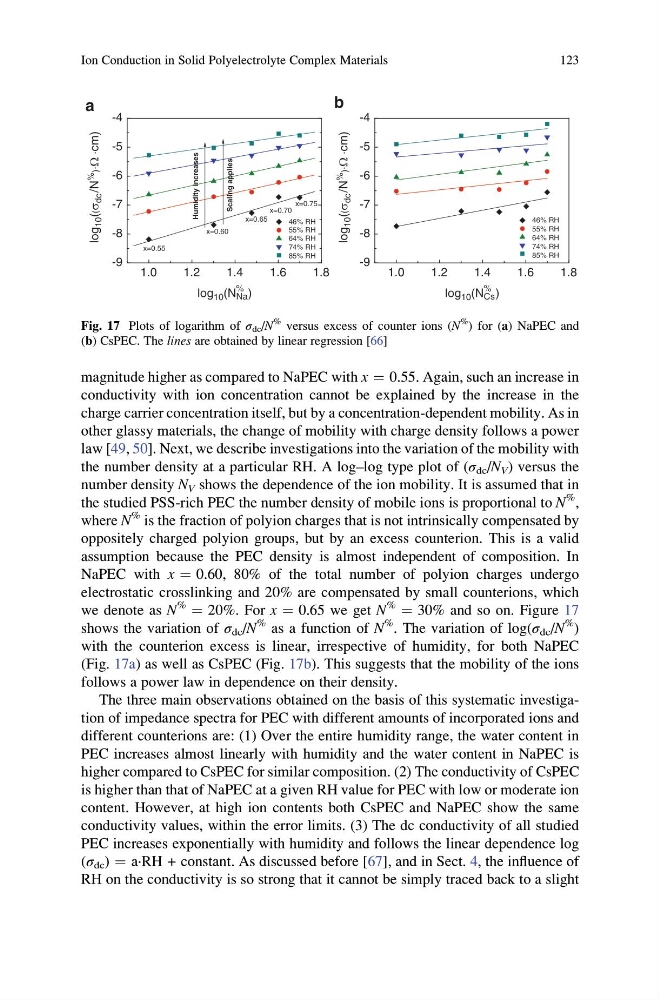
the number density at a particular RH. A log–log type plot of (σ dc /N V ) versus the
number density N V shows the dependence of the ion mobility. It is assumed that in
the studied PSS-rich PEC the number density of mobile ions is proportional to N
% ,
where N
% is the fraction of polyion charges that is not intrinsically compensated by
oppositely charged polyion groups, but by an excess counterion. This is a valid
assumption because the PEC density is almost independent of composition. In
NaPEC with x ¼ 0.60, 80% of the total number of polyion charges undergo
electrostatic crosslinking and 20% are compensated by small counterions, which
we denote as N
%
¼ 20%. For x ¼ 0.65 we get N
%
¼ 30% and so on. Figure 17
shows the variation of σ dc /N
% as a function of N
% . The variation of log(σ dc /N
% )
with the counterion excess is linear, irrespective of humidity, for both NaPEC
(Fig. 17a) as well as CsPEC (Fig. 17b). This suggests that the mobility of the ions
follows a power law in dependence on their density.
The three main observations obtained on the basis of this systematic investigation of impedance spectra for PEC with different amounts of incorporated ions and
different counterions are: (1) Over the entire humidity range, the water content in
PEC increases almost linearly with humidity and the water content in NaPEC is
higher compared to CsPEC for similar composition. (2) The conductivity of CsPEC
is higher than that of NaPEC at a given RH value for PEC with low or moderate ion
content. However, at high ion contents both CsPEC and NaPEC show the same
conductivity values, within the error limits. (3) The dc conductivity of all studied
PEC increases exponentially with humidity and follows the linear dependence log
(σ dc ) ¼ a·RH + constant. As discussed before [67], and in Sect. 4, the influence of
RH on the conductivity is so strong that it cannot be simply traced back to a slight
1.0
1.2
1.4
1.6
1.8
-9
-8
-7
-6
-5
-4
x=0.75
x=0.70
x=0.65
x=0.60
x=0.55
Scaling applies
Humidity increases
a
log
10 ((σ
dc /N
%
)⋅Ω
⋅cm)
46% RH
55% RH
64% RH
74% RH
85% RH
b
log
10 ((σ
dc /N %
)⋅Ω
⋅cm)
log 10 (N )
%
Cs
log 10 (N )
%
Na
1.0
1.2
1.4
1.6
1.8
-9
-8
-7
-6
-5
-4
46% RH
55% RH
64% RH
74% RH
85% RH
Fig. 17 Plots of logarithm of σ dc /N
% versus excess of counter ions (N
%
) for (a) NaPEC and
(b) CsPEC. The lines are obtained by linear regression [66]
Ion Conduction in Solid Polyelectrolyte Complex Materials
123
conductivity with ion concentration cannot be explained by the increase in the
charge carrier concentration itself, but by a concentration-dependent mobility. As in
other glassy materials, the change of mobility with charge density follows a power
law [49, 50]. Next, we describe investigations into the variation of the mobility with
the number density at a particular RH. A log–log type plot of (σ dc /N V ) versus the
number density N V shows the dependence of the ion mobility. It is assumed that in
the studied PSS-rich PEC the number density of mobile ions is proportional to N
% ,
where N
% is the fraction of polyion charges that is not intrinsically compensated by
oppositely charged polyion groups, but by an excess counterion. This is a valid
assumption because the PEC density is almost independent of composition. In
NaPEC with x ¼ 0.60, 80% of the total number of polyion charges undergo
electrostatic crosslinking and 20% are compensated by small counterions, which
we denote as N
%
¼ 20%. For x ¼ 0.65 we get N
%
¼ 30% and so on. Figure 17
shows the variation of σ dc /N
% as a function of N
% . The variation of log(σ dc /N
% )
with the counterion excess is linear, irrespective of humidity, for both NaPEC
(Fig. 17a) as well as CsPEC (Fig. 17b). This suggests that the mobility of the ions
follows a power law in dependence on their density.
The three main observations obtained on the basis of this systematic investigation of impedance spectra for PEC with different amounts of incorporated ions and
different counterions are: (1) Over the entire humidity range, the water content in
PEC increases almost linearly with humidity and the water content in NaPEC is
higher compared to CsPEC for similar composition. (2) The conductivity of CsPEC
is higher than that of NaPEC at a given RH value for PEC with low or moderate ion
content. However, at high ion contents both CsPEC and NaPEC show the same
conductivity values, within the error limits. (3) The dc conductivity of all studied
PEC increases exponentially with humidity and follows the linear dependence log
(σ dc ) ¼ a·RH + constant. As discussed before [67], and in Sect. 4, the influence of
RH on the conductivity is so strong that it cannot be simply traced back to a slight
1.0
1.2
1.4
1.6
1.8
-9
-8
-7
-6
-5
-4
x=0.75
x=0.70
x=0.65
x=0.60
x=0.55
Scaling applies
Humidity increases
a
log
10 ((σ
dc /N
%
)⋅Ω
⋅cm)
46% RH
55% RH
64% RH
74% RH
85% RH
b
log
10 ((σ
dc /N %
)⋅Ω
⋅cm)
log 10 (N )
%
Cs
log 10 (N )
%
Na
1.0
1.2
1.4
1.6
1.8
-9
-8
-7
-6
-5
-4
46% RH
55% RH
64% RH
74% RH
85% RH
Fig. 17 Plots of logarithm of σ dc /N
% versus excess of counter ions (N
%
) for (a) NaPEC and
(b) CsPEC. The lines are obtained by linear regression [66]
Ion Conduction in Solid Polyelectrolyte Complex Materials
123