

Experimentally, a large number of similar studies on the influence of chain
stiffness, colloid charge density, and salt concentration have been performed [43,
44, 121–138]. Some theoretical trends regarding the effect of surface curvature and
salt concentration on critical adsorption and polyelectrolyte–colloid complexation are
supported by experimental observations. These studies, however, also revealed a
number of discrepancies and additional physical parameters to be taken into account,
as compared with the outcomes of theoretical studies and computer simulations.
In this review article, we focus on two aspects of polyelectrolyte adsorption –
first, the critical adsorption transition and its dependence on the surface geometry
and, second, the particular charge patterns of strongly adsorbed polyelectrolytes on
cylinders and spheres – and study their properties using analytical theory. The first
aspect is the limit of what we denote as weak adsorption. Here, the polyelectrolyte
entropy plays a major role and determines the critical parameters. In the second
case, the strong adsorption limit, the electrostatic energy dominates over the
conformational degrees of freedom and the charge–charge interactions determine
the complexation properties [139]. In both cases, we adopt the linearized
Poisson–Boltzmann equation as the basis for determining the electrostatic potential
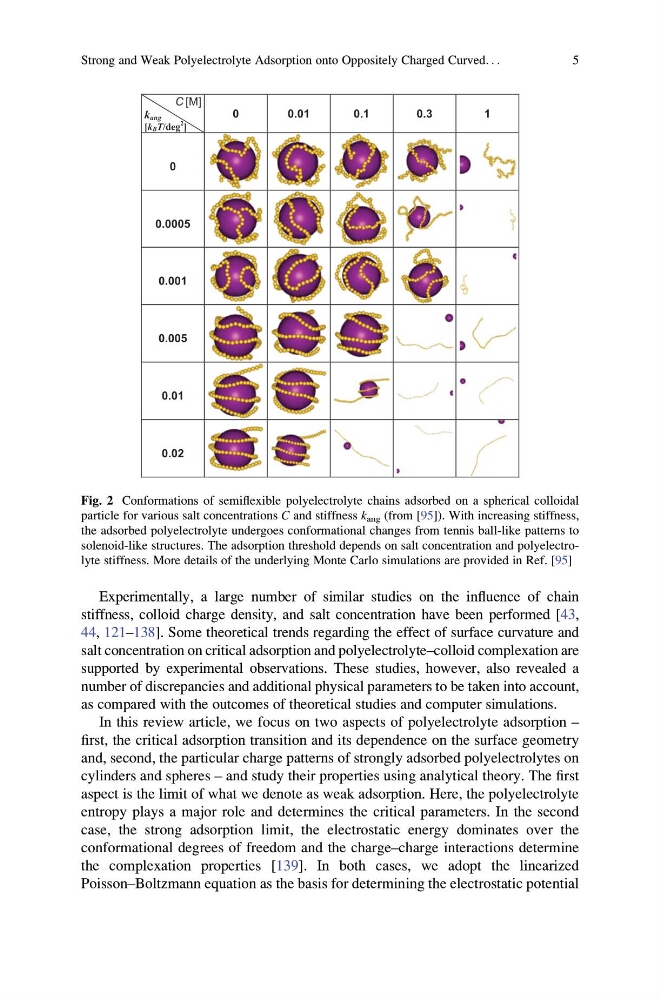
Fig. 2 Conformations of semiflexible polyelectrolyte chains adsorbed on a spherical colloidal
particle for various salt concentrations C and stiffness k ang (from [95]). With increasing stiffness,
the adsorbed polyelectrolyte undergoes conformational changes from tennis ball-like patterns to
solenoid-like structures. The adsorption threshold depends on salt concentration and polyelectrolyte stiffness. More details of the underlying Monte Carlo simulations are provided in Ref. [95]
Strong and Weak Polyelectrolyte Adsorption onto Oppositely Charged Curved. . .
5
stiffness, colloid charge density, and salt concentration have been performed [43,
44, 121–138]. Some theoretical trends regarding the effect of surface curvature and
salt concentration on critical adsorption and polyelectrolyte–colloid complexation are
supported by experimental observations. These studies, however, also revealed a
number of discrepancies and additional physical parameters to be taken into account,
as compared with the outcomes of theoretical studies and computer simulations.
In this review article, we focus on two aspects of polyelectrolyte adsorption –
first, the critical adsorption transition and its dependence on the surface geometry
and, second, the particular charge patterns of strongly adsorbed polyelectrolytes on
cylinders and spheres – and study their properties using analytical theory. The first
aspect is the limit of what we denote as weak adsorption. Here, the polyelectrolyte
entropy plays a major role and determines the critical parameters. In the second
case, the strong adsorption limit, the electrostatic energy dominates over the
conformational degrees of freedom and the charge–charge interactions determine
the complexation properties [139]. In both cases, we adopt the linearized
Poisson–Boltzmann equation as the basis for determining the electrostatic potential
Fig. 2 Conformations of semiflexible polyelectrolyte chains adsorbed on a spherical colloidal
particle for various salt concentrations C and stiffness k ang (from [95]). With increasing stiffness,
the adsorbed polyelectrolyte undergoes conformational changes from tennis ball-like patterns to
solenoid-like structures. The adsorption threshold depends on salt concentration and polyelectrolyte stiffness. More details of the underlying Monte Carlo simulations are provided in Ref. [95]
Strong and Weak Polyelectrolyte Adsorption onto Oppositely Charged Curved. . .
5