

Such effects are known to be more strongly prounced the thinner the film and/or the
higher the conductivity.
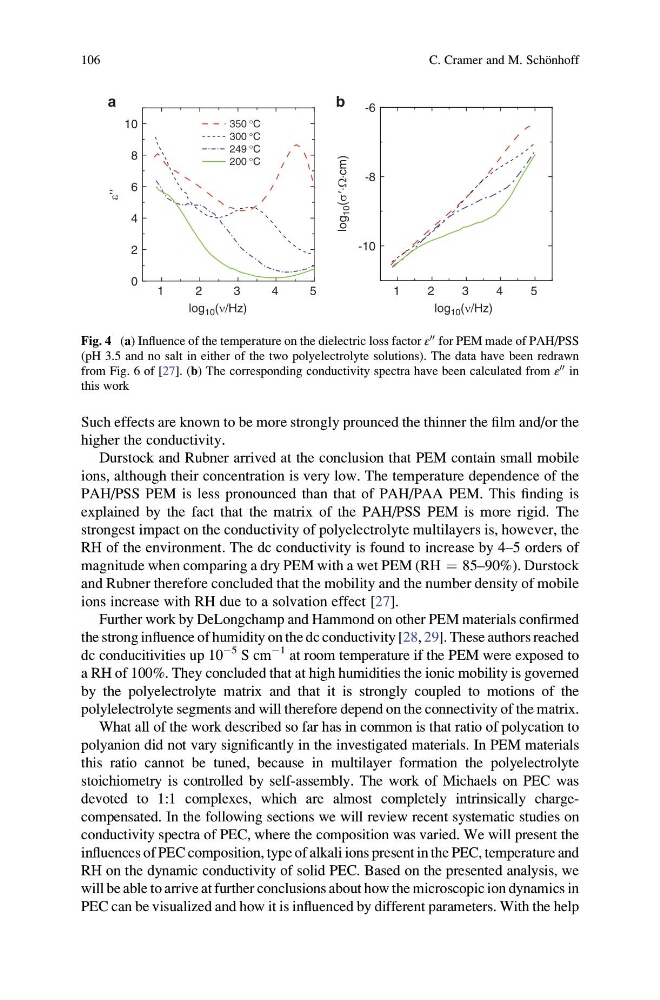
Durstock and Rubner arrived at the conclusion that PEM contain small mobile
ions, although their concentration is very low. The temperature dependence of the
PAH/PSS PEM is less pronounced than that of PAH/PAA PEM. This finding is
explained by the fact that the matrix of the PAH/PSS PEM is more rigid. The
strongest impact on the conductivity of polyelectrolyte multilayers is, however, the
RH of the environment. The dc conductivity is found to increase by 4–5 orders of
magnitude when comparing a dry PEM with a wet PEM (RH ¼ 85–90%). Durstock
and Rubner therefore concluded that the mobility and the number density of mobile
ions increase with RH due to a solvation effect [27].
Further work by DeLongchamp and Hammond on other PEM materials confirmed
the strong influence of humidity on the dc conductivity [28, 29]. These authors reached
dc conducitivities up 10
À5 S cm
À1 at room temperature if the PEM were exposed to
a RH of 100%. They concluded that at high humidities the ionic mobility is governed
by the polyelectrolyte matrix and that it is strongly coupled to motions of the
polylelectrolyte segments and will therefore depend on the connectivity of the matrix.
What all of the work described so far has in common is that ratio of polycation to
polyanion did not vary significantly in the investigated materials. In PEM materials
this ratio cannot be tuned, because in multilayer formation the polyelectrolyte
stoichiometry is controlled by self-assembly. The work of Michaels on PEC was
devoted to 1:1 complexes, which are almost completely intrinsically chargecompensated. In the following sections we will review recent systematic studies on
conductivity spectra of PEC, where the composition was varied. We will present the
influences of PEC composition, type of alkali ions present in the PEC, temperature and
RH on the dynamic conductivity of solid PEC. Based on the presented analysis, we
will be able to arrive at further conclusions about how the microscopic ion dynamics in
PEC can be visualized and how it is influenced by different parameters. With the help
1
2
3
4
5
-10
-8
-6
b
log
10 (s¢×W×cm)
1
2
3
4
5
0
2
4
6
8
10
350 °C
300 °C
249 °C
200 °C
a
e¢¢
log 10 (n/Hz)
log 10 (n/Hz)
Fig. 4 (a) Influence of the temperature on the dielectric loss factor ε
00 for PEM made of PAH/PSS
(pH 3.5 and no salt in either of the two polyelectrolyte solutions). The data have been redrawn
from Fig. 6 of [27]. (b) The corresponding conductivity spectra have been calculated from ε
00 in
this work
106
C. Cramer and M. Scho ¨nhoff
higher the conductivity.
Durstock and Rubner arrived at the conclusion that PEM contain small mobile
ions, although their concentration is very low. The temperature dependence of the
PAH/PSS PEM is less pronounced than that of PAH/PAA PEM. This finding is
explained by the fact that the matrix of the PAH/PSS PEM is more rigid. The
strongest impact on the conductivity of polyelectrolyte multilayers is, however, the
RH of the environment. The dc conductivity is found to increase by 4–5 orders of
magnitude when comparing a dry PEM with a wet PEM (RH ¼ 85–90%). Durstock
and Rubner therefore concluded that the mobility and the number density of mobile
ions increase with RH due to a solvation effect [27].
Further work by DeLongchamp and Hammond on other PEM materials confirmed
the strong influence of humidity on the dc conductivity [28, 29]. These authors reached
dc conducitivities up 10
À5 S cm
À1 at room temperature if the PEM were exposed to
a RH of 100%. They concluded that at high humidities the ionic mobility is governed
by the polyelectrolyte matrix and that it is strongly coupled to motions of the
polylelectrolyte segments and will therefore depend on the connectivity of the matrix.
What all of the work described so far has in common is that ratio of polycation to
polyanion did not vary significantly in the investigated materials. In PEM materials
this ratio cannot be tuned, because in multilayer formation the polyelectrolyte
stoichiometry is controlled by self-assembly. The work of Michaels on PEC was
devoted to 1:1 complexes, which are almost completely intrinsically chargecompensated. In the following sections we will review recent systematic studies on
conductivity spectra of PEC, where the composition was varied. We will present the
influences of PEC composition, type of alkali ions present in the PEC, temperature and
RH on the dynamic conductivity of solid PEC. Based on the presented analysis, we
will be able to arrive at further conclusions about how the microscopic ion dynamics in
PEC can be visualized and how it is influenced by different parameters. With the help
1
2
3
4
5
-10
-8
-6
b
log
10 (s¢×W×cm)
1
2
3
4
5
0
2
4
6
8
10
350 °C
300 °C
249 °C
200 °C
a
e¢¢
log 10 (n/Hz)
log 10 (n/Hz)
Fig. 4 (a) Influence of the temperature on the dielectric loss factor ε
00 for PEM made of PAH/PSS
(pH 3.5 and no salt in either of the two polyelectrolyte solutions). The data have been redrawn
from Fig. 6 of [27]. (b) The corresponding conductivity spectra have been calculated from ε
00 in
this work
106
C. Cramer and M. Scho ¨nhoff