

The formation of thermodynamically stable charged complexes is determined
by a large number of parameters, the most important of which are the length of
the polymer, its linear charge distribution and persistence length, the size, charge
and curvature of the complexing object, and the salt concentration. This renders
the development of a comprehensive theory difficult. Moreover, the long-range
character of electrostatic interactions poses an extra challenge and exact analytical
results are the exception rather than the rule. This explains why the understanding
of charged complexes is still in an unsatisfactory state despite significant efforts and
progress in recent years.
During the last decade, a wealth of theoretical results have been presented on
weak polyelectrolyte adsorption onto oppositely charged planar and curved surfaces
(see, e.g., [45–54] for the latest results). The spectrum of applied methods is wide and
is often dictated by the particular aspect that the authors are addressing. In terms
of critical adsorption, one of the first fundamental exact analytical studies was
performed by Wiegel [40] for a planar surface. Odijk [55] investigated the binding
of polyelectrolytes to an oppositely charged cylinder using a perturbation theory.
Later, Muthukumar et al. [41, 56] used a variational method to study the adsorption
onto planar, cylindrical, and spherical surfaces. In particular, Muthukumar [41] has
taken into account the conformational changes of the polyelectrolyte upon altering
C [M]
a / b
0
0.01
0.1
0.3
1
2
5
6
10
15
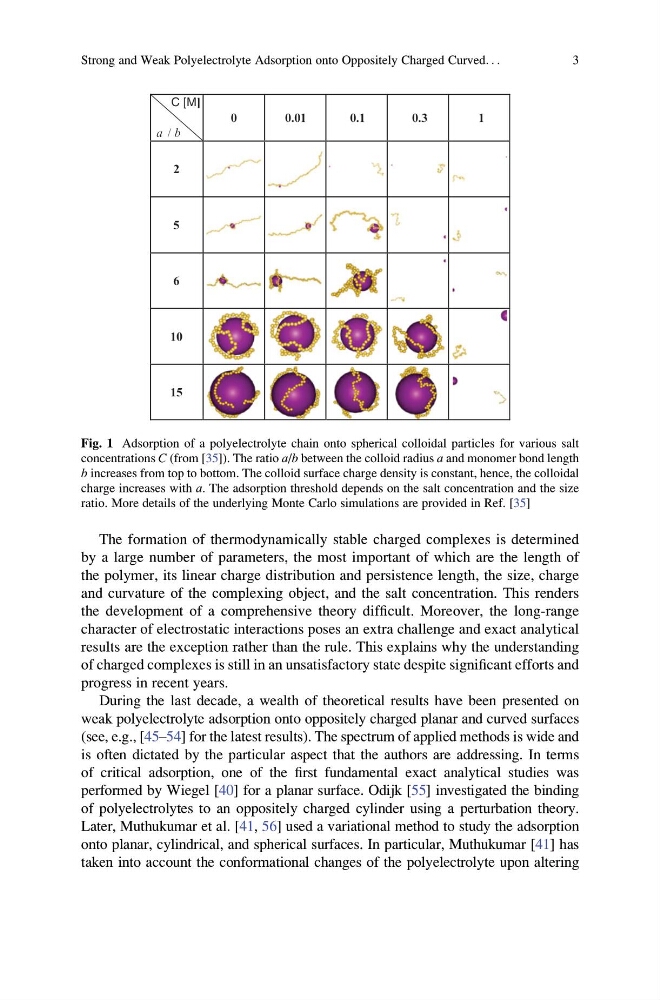
Fig. 1 Adsorption of a polyelectrolyte chain onto spherical colloidal particles for various salt
concentrations C (from [35]). The ratio a/b between the colloid radius a and monomer bond length
b increases from top to bottom. The colloid surface charge density is constant, hence, the colloidal
charge increases with a. The adsorption threshold depends on the salt concentration and the size
ratio. More details of the underlying Monte Carlo simulations are provided in Ref. [35]
Strong and Weak Polyelectrolyte Adsorption onto Oppositely Charged Curved. . .
3
by a large number of parameters, the most important of which are the length of
the polymer, its linear charge distribution and persistence length, the size, charge
and curvature of the complexing object, and the salt concentration. This renders
the development of a comprehensive theory difficult. Moreover, the long-range
character of electrostatic interactions poses an extra challenge and exact analytical
results are the exception rather than the rule. This explains why the understanding
of charged complexes is still in an unsatisfactory state despite significant efforts and
progress in recent years.
During the last decade, a wealth of theoretical results have been presented on
weak polyelectrolyte adsorption onto oppositely charged planar and curved surfaces
(see, e.g., [45–54] for the latest results). The spectrum of applied methods is wide and
is often dictated by the particular aspect that the authors are addressing. In terms
of critical adsorption, one of the first fundamental exact analytical studies was
performed by Wiegel [40] for a planar surface. Odijk [55] investigated the binding
of polyelectrolytes to an oppositely charged cylinder using a perturbation theory.
Later, Muthukumar et al. [41, 56] used a variational method to study the adsorption
onto planar, cylindrical, and spherical surfaces. In particular, Muthukumar [41] has
taken into account the conformational changes of the polyelectrolyte upon altering
C [M]
a / b
0
0.01
0.1
0.3
1
2
5
6
10
15
Fig. 1 Adsorption of a polyelectrolyte chain onto spherical colloidal particles for various salt
concentrations C (from [35]). The ratio a/b between the colloid radius a and monomer bond length
b increases from top to bottom. The colloid surface charge density is constant, hence, the colloidal
charge increases with a. The adsorption threshold depends on the salt concentration and the size
ratio. More details of the underlying Monte Carlo simulations are provided in Ref. [35]
Strong and Weak Polyelectrolyte Adsorption onto Oppositely Charged Curved. . .
3