

substrates, characteristic 2D matching between the PE and the substrate lattices was
demonstrated. From a morphological point of view, epitaxial growth results in
characteristic crosshatched patterns made of crystalline lamellae growing along
specific in-plane directions. Figure 1a, b depicts the textured film morphologies and
the electron diffraction pattern for epitaxied PE films grown on anthracene single
crystal substrates. Figure 1c, d shows a schematic interpretation of the electron
diffraction (ED) pattern and the orientation of PE chains on the anthracene crystal.
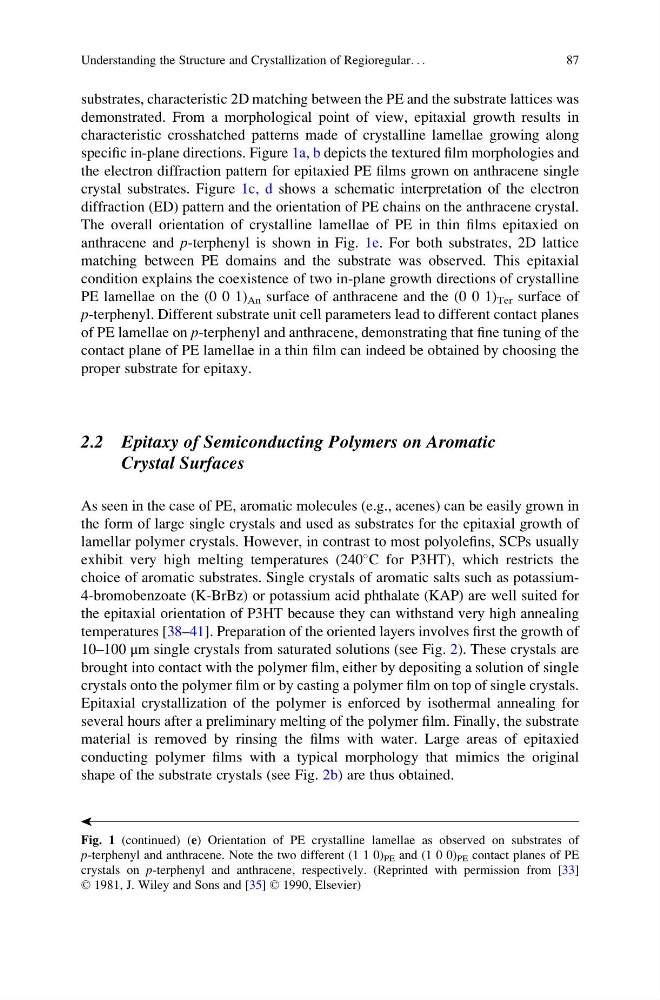
The overall orientation of crystalline lamellae of PE in thin films epitaxied on
anthracene and p-terphenyl is shown in Fig. 1e. For both substrates, 2D lattice
matching between PE domains and the substrate was observed. This epitaxial
condition explains the coexistence of two in-plane growth directions of crystalline
PE lamellae on the (0 0 1) An surface of anthracene and the (0 0 1) Ter surface of
p-terphenyl. Different substrate unit cell parameters lead to different contact planes
of PE lamellae on p-terphenyl and anthracene, demonstrating that fine tuning of the
contact plane of PE lamellae in a thin film can indeed be obtained by choosing the
proper substrate for epitaxy.
2.2 Epitaxy of Semiconducting Polymers on Aromatic
Crystal Surfaces
As seen in the case of PE, aromatic molecules (e.g., acenes) can be easily grown in
the form of large single crystals and used as substrates for the epitaxial growth of
lamellar polymer crystals. However, in contrast to most polyolefins, SCPs usually
exhibit very high melting temperatures (240
C for P3HT), which restricts the
choice of aromatic substrates. Single crystals of aromatic salts such as potassium4-bromobenzoate (K-BrBz) or potassium acid phthalate (KAP) are well suited for
the epitaxial orientation of P3HT because they can withstand very high annealing
temperatures [38–41]. Preparation of the oriented layers involves first the growth of
10–100 μm single crystals from saturated solutions (see Fig. 2). These crystals are
brought into contact with the polymer film, either by depositing a solution of single
crystals onto the polymer film or by casting a polymer film on top of single crystals.
Epitaxial crystallization of the polymer is enforced by isothermal annealing for
several hours after a preliminary melting of the polymer film. Finally, the substrate
material is removed by rinsing the films with water. Large areas of epitaxied
conducting polymer films with a typical morphology that mimics the original
shape of the substrate crystals (see Fig. 2b) are thus obtained.
⁄
ä
Fig. 1 (continued) (e) Orientation of PE crystalline lamellae as observed on substrates of
p-terphenyl and anthracene. Note the two different (1 1 0) PE and (1 0 0) PE contact planes of PE
crystals on p-terphenyl and anthracene, respectively. (Reprinted with permission from [33]
© 1981, J. Wiley and Sons and [35] © 1990, Elsevier)
Understanding the Structure and Crystallization of Regioregular. . .
87
demonstrated. From a morphological point of view, epitaxial growth results in
characteristic crosshatched patterns made of crystalline lamellae growing along
specific in-plane directions. Figure 1a, b depicts the textured film morphologies and
the electron diffraction pattern for epitaxied PE films grown on anthracene single
crystal substrates. Figure 1c, d shows a schematic interpretation of the electron
diffraction (ED) pattern and the orientation of PE chains on the anthracene crystal.
The overall orientation of crystalline lamellae of PE in thin films epitaxied on
anthracene and p-terphenyl is shown in Fig. 1e. For both substrates, 2D lattice
matching between PE domains and the substrate was observed. This epitaxial
condition explains the coexistence of two in-plane growth directions of crystalline
PE lamellae on the (0 0 1) An surface of anthracene and the (0 0 1) Ter surface of
p-terphenyl. Different substrate unit cell parameters lead to different contact planes
of PE lamellae on p-terphenyl and anthracene, demonstrating that fine tuning of the
contact plane of PE lamellae in a thin film can indeed be obtained by choosing the
proper substrate for epitaxy.
2.2 Epitaxy of Semiconducting Polymers on Aromatic
Crystal Surfaces
As seen in the case of PE, aromatic molecules (e.g., acenes) can be easily grown in
the form of large single crystals and used as substrates for the epitaxial growth of
lamellar polymer crystals. However, in contrast to most polyolefins, SCPs usually
exhibit very high melting temperatures (240
C for P3HT), which restricts the
choice of aromatic substrates. Single crystals of aromatic salts such as potassium4-bromobenzoate (K-BrBz) or potassium acid phthalate (KAP) are well suited for
the epitaxial orientation of P3HT because they can withstand very high annealing
temperatures [38–41]. Preparation of the oriented layers involves first the growth of
10–100 μm single crystals from saturated solutions (see Fig. 2). These crystals are
brought into contact with the polymer film, either by depositing a solution of single
crystals onto the polymer film or by casting a polymer film on top of single crystals.
Epitaxial crystallization of the polymer is enforced by isothermal annealing for
several hours after a preliminary melting of the polymer film. Finally, the substrate
material is removed by rinsing the films with water. Large areas of epitaxied
conducting polymer films with a typical morphology that mimics the original
shape of the substrate crystals (see Fig. 2b) are thus obtained.
⁄
ä
Fig. 1 (continued) (e) Orientation of PE crystalline lamellae as observed on substrates of
p-terphenyl and anthracene. Note the two different (1 1 0) PE and (1 0 0) PE contact planes of PE
crystals on p-terphenyl and anthracene, respectively. (Reprinted with permission from [33]
© 1981, J. Wiley and Sons and [35] © 1990, Elsevier)
Understanding the Structure and Crystallization of Regioregular. . .
87