

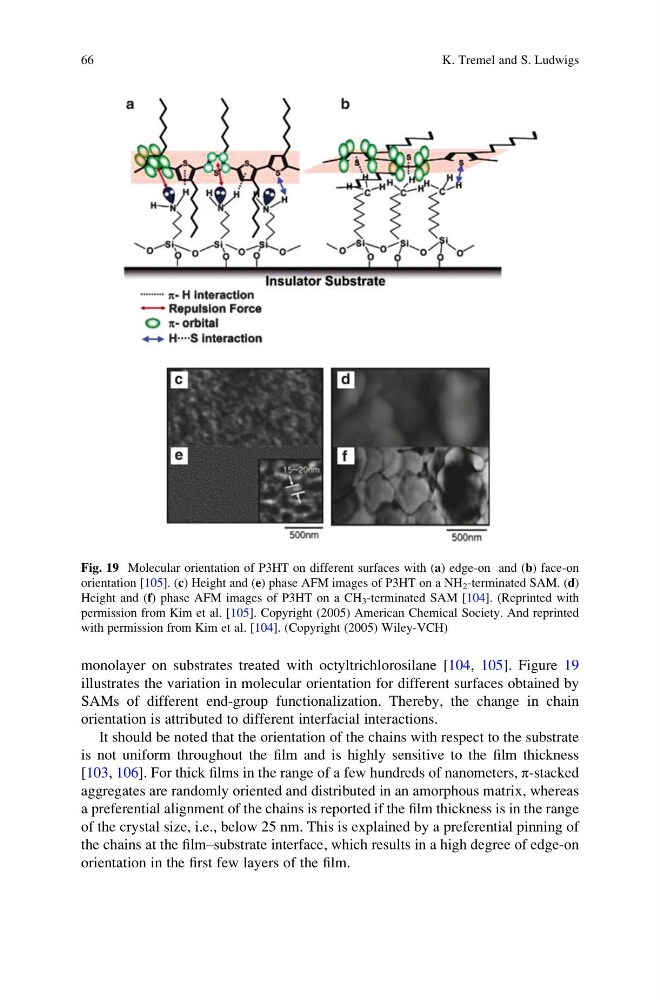
monolayer on substrates treated with octyltrichlorosilane [104, 105]. Figure 19
illustrates the variation in molecular orientation for different surfaces obtained by
SAMs of different end-group functionalization. Thereby, the change in chain
orientation is attributed to different interfacial interactions.
It should be noted that the orientation of the chains with respect to the substrate
is not uniform throughout the film and is highly sensitive to the film thickness
[103, 106]. For thick films in the range of a few hundreds of nanometers, π-stacked
aggregates are randomly oriented and distributed in an amorphous matrix, whereas
a preferential alignment of the chains is reported if the film thickness is in the range
of the crystal size, i.e., below 25 nm. This is explained by a preferential pinning of
the chains at the film–substrate interface, which results in a high degree of edge-on
orientation in the first few layers of the film.
Fig. 19 Molecular orientation of P3HT on different surfaces with (a) edge-on and (b) face-on
orientation [105]. (c) Height and (e) phase AFM images of P3HT on a NH 2 -terminated SAM. (d)
Height and (f) phase AFM images of P3HT on a CH 3 -terminated SAM [104]. (Reprinted with
permission from Kim et al. [105]. Copyright (2005) American Chemical Society. And reprinted
with permission from Kim et al. [104]. (Copyright (2005) Wiley-VCH)
66
K. Tremel and S. Ludwigs
illustrates the variation in molecular orientation for different surfaces obtained by
SAMs of different end-group functionalization. Thereby, the change in chain
orientation is attributed to different interfacial interactions.
It should be noted that the orientation of the chains with respect to the substrate
is not uniform throughout the film and is highly sensitive to the film thickness
[103, 106]. For thick films in the range of a few hundreds of nanometers, π-stacked
aggregates are randomly oriented and distributed in an amorphous matrix, whereas
a preferential alignment of the chains is reported if the film thickness is in the range
of the crystal size, i.e., below 25 nm. This is explained by a preferential pinning of
the chains at the film–substrate interface, which results in a high degree of edge-on
orientation in the first few layers of the film.
Fig. 19 Molecular orientation of P3HT on different surfaces with (a) edge-on and (b) face-on
orientation [105]. (c) Height and (e) phase AFM images of P3HT on a NH 2 -terminated SAM. (d)
Height and (f) phase AFM images of P3HT on a CH 3 -terminated SAM [104]. (Reprinted with
permission from Kim et al. [105]. Copyright (2005) American Chemical Society. And reprinted
with permission from Kim et al. [104]. (Copyright (2005) Wiley-VCH)
66
K. Tremel and S. Ludwigs