

with Ni(cod) 2 and ligand exchange with dppe, dppp, dppb, and bpy ligands
[148]. The surface coverage decreased on ligand exchange due to disproportionation reactions [102, 105, 150, 169, 181–183], which can be lowered by the
presence of a substituent ortho to the Ni complex on the initiator moiety [159,
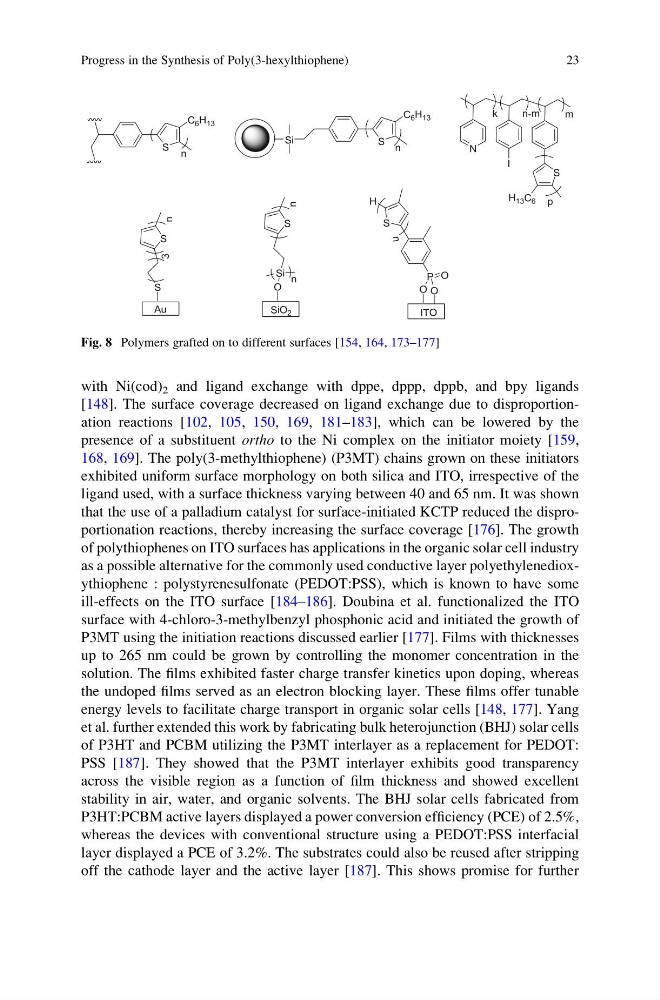
168, 169]. The poly(3-methylthiophene) (P3MT) chains grown on these initiators
exhibited uniform surface morphology on both silica and ITO, irrespective of the
ligand used, with a surface thickness varying between 40 and 65 nm. It was shown
that the use of a palladium catalyst for surface-initiated KCTP reduced the disproportionation reactions, thereby increasing the surface coverage [176]. The growth
of polythiophenes on ITO surfaces has applications in the organic solar cell industry
as a possible alternative for the commonly used conductive layer polyethylenedioxythiophene : polystyrenesulfonate (PEDOT:PSS), which is known to have some
ill-effects on the ITO surface [184–186]. Doubina et al. functionalized the ITO
surface with 4-chloro-3-methylbenzyl phosphonic acid and initiated the growth of
P3MT using the initiation reactions discussed earlier [177]. Films with thicknesses
up to 265 nm could be grown by controlling the monomer concentration in the
solution. The films exhibited faster charge transfer kinetics upon doping, whereas
the undoped films served as an electron blocking layer. These films offer tunable
energy levels to facilitate charge transport in organic solar cells [148, 177]. Yang
et al. further extended this work by fabricating bulk heterojunction (BHJ) solar cells
of P3HT and PCBM utilizing the P3MT interlayer as a replacement for PEDOT:
PSS [187]. They showed that the P3MT interlayer exhibits good transparency
across the visible region as a function of film thickness and showed excellent
stability in air, water, and organic solvents. The BHJ solar cells fabricated from
P3HT:PCBM active layers displayed a power conversion efficiency (PCE) of 2.5%,
whereas the devices with conventional structure using a PEDOT:PSS interfacial
layer displayed a PCE of 3.2%. The substrates could also be reused after stripping
off the cathode layer and the active layer [187]. This shows promise for further
S
C 6 H 13
n
Si
S
C 6 H 13
n
N
I
S
H 13 C 6 p
k
n-m
m
S
S
n
3
Au
O
S
n
SiO 2
Si n
O
S
H
n
ITO
P
O
O
Fig. 8 Polymers grafted on to different surfaces [154, 164, 173–177]
Progress in the Synthesis of Poly(3-hexylthiophene)
23
[148]. The surface coverage decreased on ligand exchange due to disproportionation reactions [102, 105, 150, 169, 181–183], which can be lowered by the
presence of a substituent ortho to the Ni complex on the initiator moiety [159,
168, 169]. The poly(3-methylthiophene) (P3MT) chains grown on these initiators
exhibited uniform surface morphology on both silica and ITO, irrespective of the
ligand used, with a surface thickness varying between 40 and 65 nm. It was shown
that the use of a palladium catalyst for surface-initiated KCTP reduced the disproportionation reactions, thereby increasing the surface coverage [176]. The growth
of polythiophenes on ITO surfaces has applications in the organic solar cell industry
as a possible alternative for the commonly used conductive layer polyethylenedioxythiophene : polystyrenesulfonate (PEDOT:PSS), which is known to have some
ill-effects on the ITO surface [184–186]. Doubina et al. functionalized the ITO
surface with 4-chloro-3-methylbenzyl phosphonic acid and initiated the growth of
P3MT using the initiation reactions discussed earlier [177]. Films with thicknesses
up to 265 nm could be grown by controlling the monomer concentration in the
solution. The films exhibited faster charge transfer kinetics upon doping, whereas
the undoped films served as an electron blocking layer. These films offer tunable
energy levels to facilitate charge transport in organic solar cells [148, 177]. Yang
et al. further extended this work by fabricating bulk heterojunction (BHJ) solar cells
of P3HT and PCBM utilizing the P3MT interlayer as a replacement for PEDOT:
PSS [187]. They showed that the P3MT interlayer exhibits good transparency
across the visible region as a function of film thickness and showed excellent
stability in air, water, and organic solvents. The BHJ solar cells fabricated from
P3HT:PCBM active layers displayed a power conversion efficiency (PCE) of 2.5%,
whereas the devices with conventional structure using a PEDOT:PSS interfacial
layer displayed a PCE of 3.2%. The substrates could also be reused after stripping
off the cathode layer and the active layer [187]. This shows promise for further
S
C 6 H 13
n
Si
S
C 6 H 13
n
N
I
S
H 13 C 6 p
k
n-m
m
S
S
n
3
Au
O
S
n
SiO 2
Si n
O
S
H
n
ITO
P
O
O
Fig. 8 Polymers grafted on to different surfaces [154, 164, 173–177]
Progress in the Synthesis of Poly(3-hexylthiophene)
23