

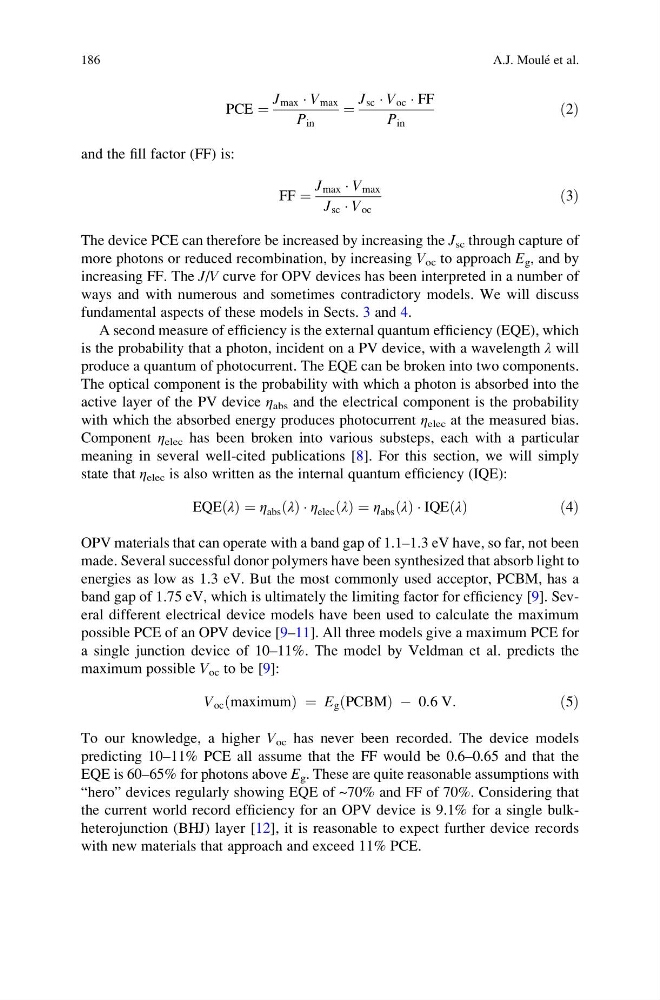
PCE ¼
J max Á V max
P in
¼
J sc Á V oc Á FF
P in
ð2Þ
and the fill factor (FF) is:
FF ¼
J max Á V max
J sc Á V oc
ð3Þ
The device PCE can therefore be increased by increasing the J sc through capture of
more photons or reduced recombination, by increasing V oc to approach E g , and by
increasing FF. The J/V curve for OPV devices has been interpreted in a number of
ways and with numerous and sometimes contradictory models. We will discuss
fundamental aspects of these models in Sects. 3 and 4.
A second measure of efficiency is the external quantum efficiency (EQE), which
is the probability that a photon, incident on a PV device, with a wavelength λ will
produce a quantum of photocurrent. The EQE can be broken into two components.
The optical component is the probability with which a photon is absorbed into the
active layer of the PV device η abs and the electrical component is the probability
with which the absorbed energy produces photocurrent η elec at the measured bias.
Component η elec has been broken into various substeps, each with a particular
meaning in several well-cited publications [8]. For this section, we will simply
state that η elec is also written as the internal quantum efficiency (IQE):
EQE λ
ð Þ ¼ η abs λ
ð Þ Á η elec λ
ð Þ ¼ η abs λ
ð Þ Á IQE λ
ð Þ
ð4Þ
OPV materials that can operate with a band gap of 1.1–1.3 eV have, so far, not been
made. Several successful donor polymers have been synthesized that absorb light to
energies as low as 1.3 eV. But the most commonly used acceptor, PCBM, has a
band gap of 1.75 eV, which is ultimately the limiting factor for efficiency [9]. Several different electrical device models have been used to calculate the maximum
possible PCE of an OPV device [9–11]. All three models give a maximum PCE for
a single junction device of 10–11%. The model by Veldman et al. predicts the
maximum possible V oc to be [9]:
V oc maximum
ð
Þ ¼ E g PCBM
ð
Þ À 0:6 V:
ð5Þ
To our knowledge, a higher V oc has never been recorded. The device models
predicting 10–11% PCE all assume that the FF would be 0.6–0.65 and that the
EQE is 60–65% for photons above E g . These are quite reasonable assumptions with
“hero” devices regularly showing EQE of ~70% and FF of 70%. Considering that
the current world record efficiency for an OPV device is 9.1% for a single bulkheterojunction (BHJ) layer [12], it is reasonable to expect further device records
with new materials that approach and exceed 11% PCE.
186
A.J. Moule ´ et al.
J max Á V max
P in
¼
J sc Á V oc Á FF
P in
ð2Þ
and the fill factor (FF) is:
FF ¼
J max Á V max
J sc Á V oc
ð3Þ
The device PCE can therefore be increased by increasing the J sc through capture of
more photons or reduced recombination, by increasing V oc to approach E g , and by
increasing FF. The J/V curve for OPV devices has been interpreted in a number of
ways and with numerous and sometimes contradictory models. We will discuss
fundamental aspects of these models in Sects. 3 and 4.
A second measure of efficiency is the external quantum efficiency (EQE), which
is the probability that a photon, incident on a PV device, with a wavelength λ will
produce a quantum of photocurrent. The EQE can be broken into two components.
The optical component is the probability with which a photon is absorbed into the
active layer of the PV device η abs and the electrical component is the probability
with which the absorbed energy produces photocurrent η elec at the measured bias.
Component η elec has been broken into various substeps, each with a particular
meaning in several well-cited publications [8]. For this section, we will simply
state that η elec is also written as the internal quantum efficiency (IQE):
EQE λ
ð Þ ¼ η abs λ
ð Þ Á η elec λ
ð Þ ¼ η abs λ
ð Þ Á IQE λ
ð Þ
ð4Þ
OPV materials that can operate with a band gap of 1.1–1.3 eV have, so far, not been
made. Several successful donor polymers have been synthesized that absorb light to
energies as low as 1.3 eV. But the most commonly used acceptor, PCBM, has a
band gap of 1.75 eV, which is ultimately the limiting factor for efficiency [9]. Several different electrical device models have been used to calculate the maximum
possible PCE of an OPV device [9–11]. All three models give a maximum PCE for
a single junction device of 10–11%. The model by Veldman et al. predicts the
maximum possible V oc to be [9]:
V oc maximum
ð
Þ ¼ E g PCBM
ð
Þ À 0:6 V:
ð5Þ
To our knowledge, a higher V oc has never been recorded. The device models
predicting 10–11% PCE all assume that the FF would be 0.6–0.65 and that the
EQE is 60–65% for photons above E g . These are quite reasonable assumptions with
“hero” devices regularly showing EQE of ~70% and FF of 70%. Considering that
the current world record efficiency for an OPV device is 9.1% for a single bulkheterojunction (BHJ) layer [12], it is reasonable to expect further device records
with new materials that approach and exceed 11% PCE.
186
A.J. Moule ´ et al.