

OPV devices, modules, and scale-up. Section 2 discusses fabrication of poly-3hexylthiophene (P3HT)-based OPV layers, with a focus on practical aspects like
how to choose a solvent and how this choice affects other aspects of fabrication.
Essentially, this chapter addresses the experimental process of controlling morphology in a P3HT:PCBM blend film, without dwelling on a discussion of the
actual morphology of any particular film. Section 3 describes how optical absorption spectra provide detailed information on the crystallization of P3HT in blends
with PCBM. Finally, Sect. 4 contains a detailed discussion on the elementary
processes involved in photocurrent generation, and how photocurrent losses are
related to blend morphology.
1.1 Device Characteristics
A photodiode or PV device converts light energy into electrical energy. The energy
of a photon can be expressed by the simple formula:
E ¼ hv ¼
hc
λ
,
ð1Þ
where E is energy, h is Planck’s constant, v is frequency, c is the speed of light, and
λ is wavelength. The sun emits photons over a wide energy range in a spectrum that
is close to a black body spectrum of ~6,000 K when measured in space. Some of the
light is absorbed by the atmosphere by molecules such as O 3 , O 2 , H 2 O, CH 4 , and
CO 2 or scattered by dust, clouds or pollution. The light spectrum that reaches the
earth’s surface is for these reasons somewhat different at every place and, due to
weather and the rotation of the planet, changes constantly. For the sake of settling
arguments, scientists have agreed to test PV devices using an approximate spectrum
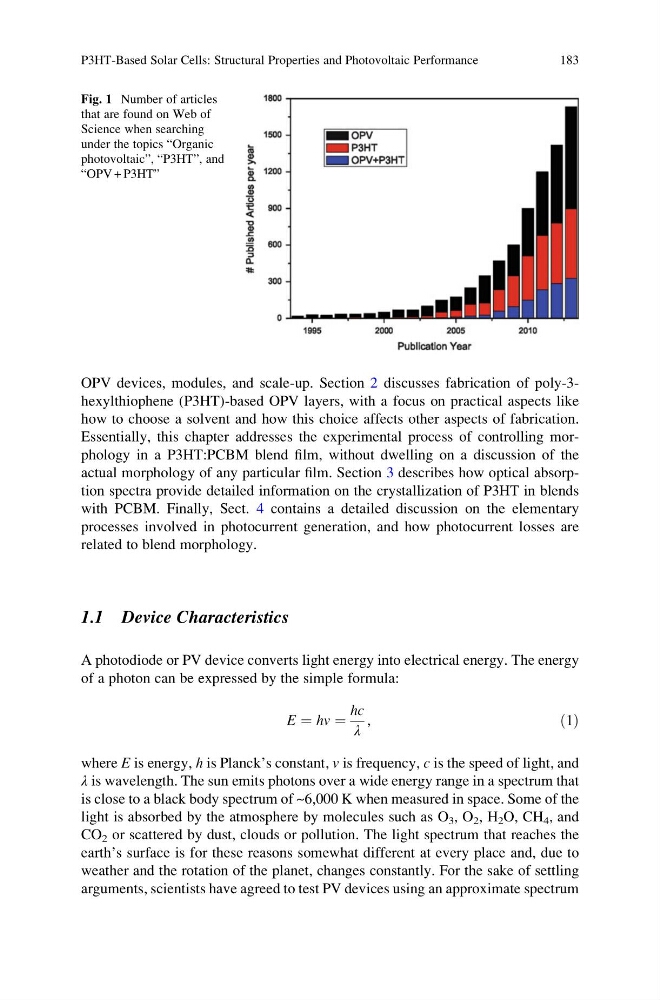
Fig. 1 Number of articles
that are found on Web of
Science when searching
under the topics “Organic
photovoltaic”, “P3HT”, and
“OPV + P3HT”
P3HT-Based Solar Cells: Structural Properties and Photovoltaic Performance
183
how to choose a solvent and how this choice affects other aspects of fabrication.
Essentially, this chapter addresses the experimental process of controlling morphology in a P3HT:PCBM blend film, without dwelling on a discussion of the
actual morphology of any particular film. Section 3 describes how optical absorption spectra provide detailed information on the crystallization of P3HT in blends
with PCBM. Finally, Sect. 4 contains a detailed discussion on the elementary
processes involved in photocurrent generation, and how photocurrent losses are
related to blend morphology.
1.1 Device Characteristics
A photodiode or PV device converts light energy into electrical energy. The energy
of a photon can be expressed by the simple formula:
E ¼ hv ¼
hc
λ
,
ð1Þ
where E is energy, h is Planck’s constant, v is frequency, c is the speed of light, and
λ is wavelength. The sun emits photons over a wide energy range in a spectrum that
is close to a black body spectrum of ~6,000 K when measured in space. Some of the
light is absorbed by the atmosphere by molecules such as O 3 , O 2 , H 2 O, CH 4 , and
CO 2 or scattered by dust, clouds or pollution. The light spectrum that reaches the
earth’s surface is for these reasons somewhat different at every place and, due to
weather and the rotation of the planet, changes constantly. For the sake of settling
arguments, scientists have agreed to test PV devices using an approximate spectrum
Fig. 1 Number of articles
that are found on Web of
Science when searching
under the topics “Organic
photovoltaic”, “P3HT”, and
“OPV + P3HT”
P3HT-Based Solar Cells: Structural Properties and Photovoltaic Performance
183