

calculation for different snapshots obtained via classical molecular dynamics (see
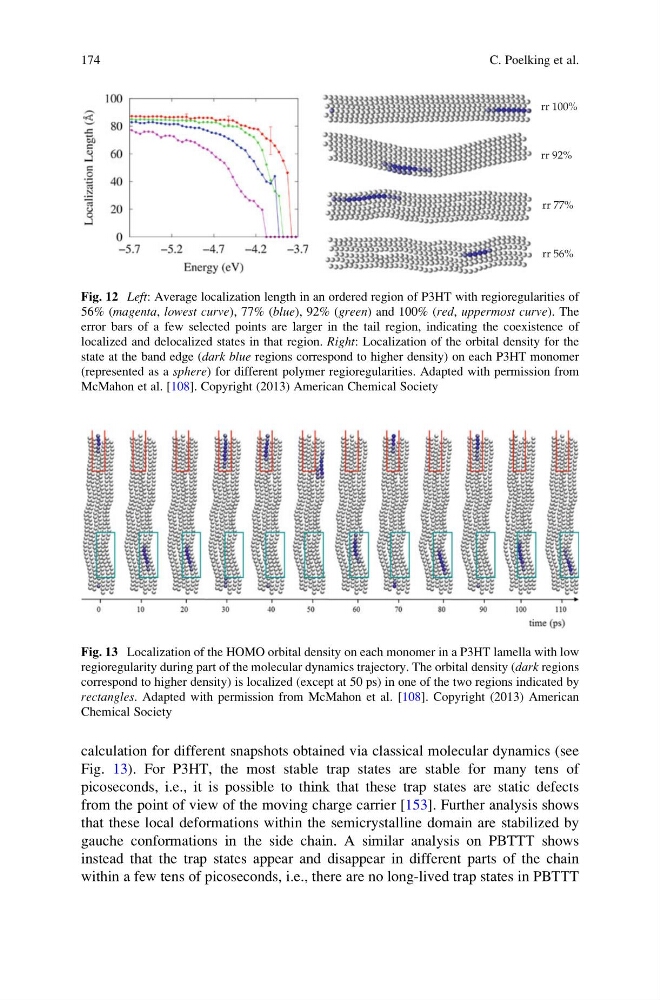
Fig. 13). For P3HT, the most stable trap states are stable for many tens of
picoseconds, i.e., it is possible to think that these trap states are static defects
from the point of view of the moving charge carrier [153]. Further analysis shows
that these local deformations within the semicrystalline domain are stabilized by
gauche conformations in the side chain. A similar analysis on PBTTT shows
instead that the trap states appear and disappear in different parts of the chain
within a few tens of picoseconds, i.e., there are no long-lived trap states in PBTTT
Fig. 12 Left: Average localization length in an ordered region of P3HT with regioregularities of
56% (magenta, lowest curve), 77% (blue), 92% (green) and 100% (red, uppermost curve). The
error bars of a few selected points are larger in the tail region, indicating the coexistence of
localized and delocalized states in that region. Right: Localization of the orbital density for the
state at the band edge (dark blue regions correspond to higher density) on each P3HT monomer
(represented as a sphere) for different polymer regioregularities. Adapted with permission from
McMahon et al. [108]. Copyright (2013) American Chemical Society
Fig. 13 Localization of the HOMO orbital density on each monomer in a P3HT lamella with low
regioregularity during part of the molecular dynamics trajectory. The orbital density (dark regions
correspond to higher density) is localized (except at 50 ps) in one of the two regions indicated by
rectangles. Adapted with permission from McMahon et al. [108]. Copyright (2013) American
Chemical Society
174
C. Poelking et al.
Fig. 13). For P3HT, the most stable trap states are stable for many tens of
picoseconds, i.e., it is possible to think that these trap states are static defects
from the point of view of the moving charge carrier [153]. Further analysis shows
that these local deformations within the semicrystalline domain are stabilized by
gauche conformations in the side chain. A similar analysis on PBTTT shows
instead that the trap states appear and disappear in different parts of the chain
within a few tens of picoseconds, i.e., there are no long-lived trap states in PBTTT
Fig. 12 Left: Average localization length in an ordered region of P3HT with regioregularities of
56% (magenta, lowest curve), 77% (blue), 92% (green) and 100% (red, uppermost curve). The
error bars of a few selected points are larger in the tail region, indicating the coexistence of
localized and delocalized states in that region. Right: Localization of the orbital density for the
state at the band edge (dark blue regions correspond to higher density) on each P3HT monomer
(represented as a sphere) for different polymer regioregularities. Adapted with permission from
McMahon et al. [108]. Copyright (2013) American Chemical Society
Fig. 13 Localization of the HOMO orbital density on each monomer in a P3HT lamella with low
regioregularity during part of the molecular dynamics trajectory. The orbital density (dark regions
correspond to higher density) is localized (except at 50 ps) in one of the two regions indicated by
rectangles. Adapted with permission from McMahon et al. [108]. Copyright (2013) American
Chemical Society
174
C. Poelking et al.