

induce glass-like features in structure and dynamics. Analyzing the de-correlation
in polymorphs I
0 and I, this exponent remains the same. There is, however, an offset
between the two time characteristics that persists up to delay times in the nanosecond range. This offset is a consequence of structural decorrelations within the first
few femtoseconds: Side chains in form I are in a dynamically disordered state and,
hence, damp backbone dynamics more effectively than the hexyl groups in form I
0 .
This damping apparently dominates dynamics on this short time scale.
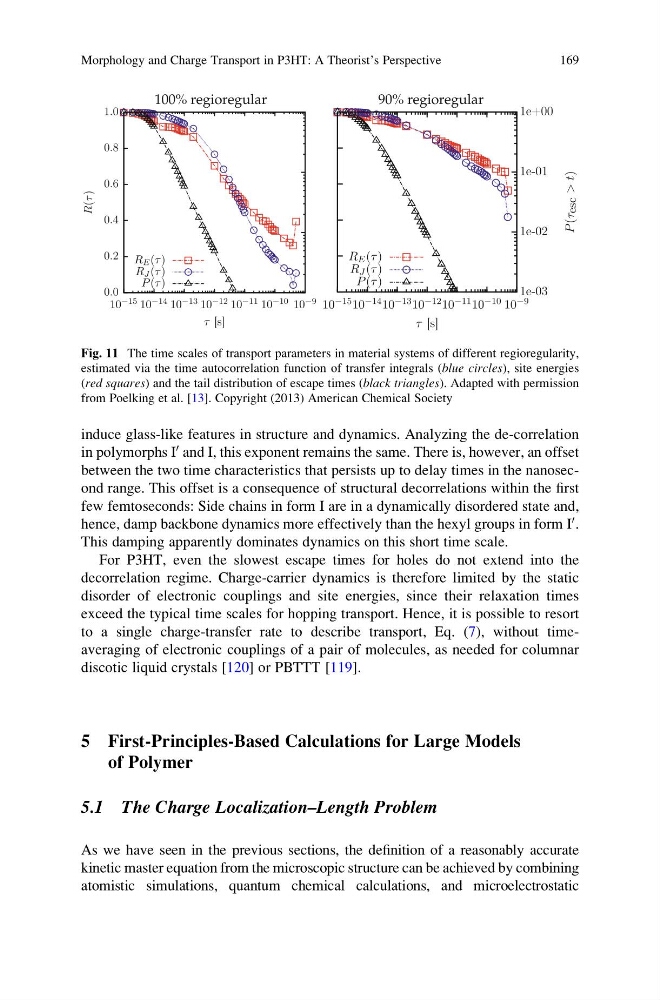
For P3HT, even the slowest escape times for holes do not extend into the
decorrelation regime. Charge-carrier dynamics is therefore limited by the static
disorder of electronic couplings and site energies, since their relaxation times
exceed the typical time scales for hopping transport. Hence, it is possible to resort
to a single charge-transfer rate to describe transport, Eq. (7), without timeaveraging of electronic couplings of a pair of molecules, as needed for columnar
discotic liquid crystals [120] or PBTTT [119].
5 First-Principles-Based Calculations for Large Models
of Polymer
5.1 The Charge Localization–Length Problem
As we have seen in the previous sections, the definition of a reasonably accurate
kinetic master equation from the microscopic structure can be achieved by combining
atomistic simulations, quantum chemical calculations, and microelectrostatic
Fig. 11 The time scales of transport parameters in material systems of different regioregularity,
estimated via the time autocorrelation function of transfer integrals (blue circles), site energies
(red squares) and the tail distribution of escape times (black triangles). Adapted with permission
from Poelking et al. [13]. Copyright (2013) American Chemical Society
Morphology and Charge Transport in P3HT: A Theorist’s Perspective
169
in polymorphs I
0 and I, this exponent remains the same. There is, however, an offset
between the two time characteristics that persists up to delay times in the nanosecond range. This offset is a consequence of structural decorrelations within the first
few femtoseconds: Side chains in form I are in a dynamically disordered state and,
hence, damp backbone dynamics more effectively than the hexyl groups in form I
0 .
This damping apparently dominates dynamics on this short time scale.
For P3HT, even the slowest escape times for holes do not extend into the
decorrelation regime. Charge-carrier dynamics is therefore limited by the static
disorder of electronic couplings and site energies, since their relaxation times
exceed the typical time scales for hopping transport. Hence, it is possible to resort
to a single charge-transfer rate to describe transport, Eq. (7), without timeaveraging of electronic couplings of a pair of molecules, as needed for columnar
discotic liquid crystals [120] or PBTTT [119].
5 First-Principles-Based Calculations for Large Models
of Polymer
5.1 The Charge Localization–Length Problem
As we have seen in the previous sections, the definition of a reasonably accurate
kinetic master equation from the microscopic structure can be achieved by combining
atomistic simulations, quantum chemical calculations, and microelectrostatic
Fig. 11 The time scales of transport parameters in material systems of different regioregularity,
estimated via the time autocorrelation function of transfer integrals (blue circles), site energies
(red squares) and the tail distribution of escape times (black triangles). Adapted with permission
from Poelking et al. [13]. Copyright (2013) American Chemical Society
Morphology and Charge Transport in P3HT: A Theorist’s Perspective
169