

[40]. One should note that even on this classical level of description, only highly
crystalline morphologies and high-temperature amorphous melts can be studied.
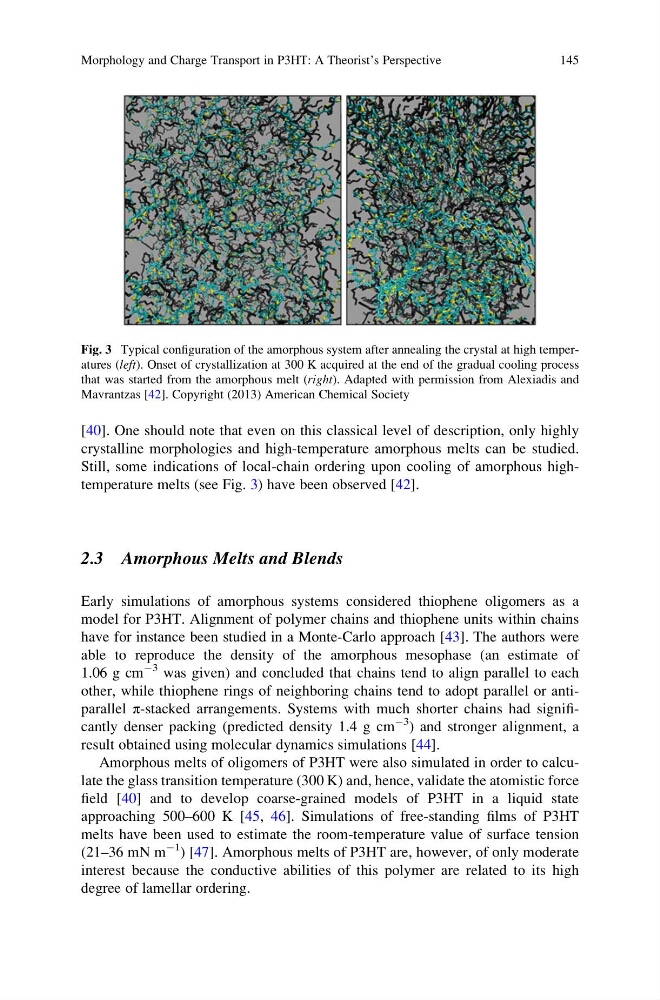
Still, some indications of local-chain ordering upon cooling of amorphous hightemperature melts (see Fig. 3) have been observed [42].
2.3 Amorphous Melts and Blends
Early simulations of amorphous systems considered thiophene oligomers as a
model for P3HT. Alignment of polymer chains and thiophene units within chains
have for instance been studied in a Monte-Carlo approach [43]. The authors were
able to reproduce the density of the amorphous mesophase (an estimate of
1.06 g cm
À3 was given) and concluded that chains tend to align parallel to each
other, while thiophene rings of neighboring chains tend to adopt parallel or antiparallel π-stacked arrangements. Systems with much shorter chains had significantly denser packing (predicted density 1.4 g cm
À3 ) and stronger alignment, a
result obtained using molecular dynamics simulations [44].
Amorphous melts of oligomers of P3HT were also simulated in order to calculate the glass transition temperature (300 K) and, hence, validate the atomistic force
field [40] and to develop coarse-grained models of P3HT in a liquid state
approaching 500–600 K [45, 46]. Simulations of free-standing films of P3HT
melts have been used to estimate the room-temperature value of surface tension
(21–36 mN m
À1 ) [47]. Amorphous melts of P3HT are, however, of only moderate
interest because the conductive abilities of this polymer are related to its high
degree of lamellar ordering.
Fig. 3 Typical configuration of the amorphous system after annealing the crystal at high temperatures (left). Onset of crystallization at 300 K acquired at the end of the gradual cooling process
that was started from the amorphous melt (right). Adapted with permission from Alexiadis and
Mavrantzas [42]. Copyright (2013) American Chemical Society
Morphology and Charge Transport in P3HT: A Theorist’s Perspective
145
crystalline morphologies and high-temperature amorphous melts can be studied.
Still, some indications of local-chain ordering upon cooling of amorphous hightemperature melts (see Fig. 3) have been observed [42].
2.3 Amorphous Melts and Blends
Early simulations of amorphous systems considered thiophene oligomers as a
model for P3HT. Alignment of polymer chains and thiophene units within chains
have for instance been studied in a Monte-Carlo approach [43]. The authors were
able to reproduce the density of the amorphous mesophase (an estimate of
1.06 g cm
À3 was given) and concluded that chains tend to align parallel to each
other, while thiophene rings of neighboring chains tend to adopt parallel or antiparallel π-stacked arrangements. Systems with much shorter chains had significantly denser packing (predicted density 1.4 g cm
À3 ) and stronger alignment, a
result obtained using molecular dynamics simulations [44].
Amorphous melts of oligomers of P3HT were also simulated in order to calculate the glass transition temperature (300 K) and, hence, validate the atomistic force
field [40] and to develop coarse-grained models of P3HT in a liquid state
approaching 500–600 K [45, 46]. Simulations of free-standing films of P3HT
melts have been used to estimate the room-temperature value of surface tension
(21–36 mN m
À1 ) [47]. Amorphous melts of P3HT are, however, of only moderate
interest because the conductive abilities of this polymer are related to its high
degree of lamellar ordering.
Fig. 3 Typical configuration of the amorphous system after annealing the crystal at high temperatures (left). Onset of crystallization at 300 K acquired at the end of the gradual cooling process
that was started from the amorphous melt (right). Adapted with permission from Alexiadis and
Mavrantzas [42]. Copyright (2013) American Chemical Society
Morphology and Charge Transport in P3HT: A Theorist’s Perspective
145