

(Fig. 3). This repulsion leads to dihedral twists in the polymer backbone, thereby
reducing the packing efficacy of the polymer chains and leading to inferior optoelectronic properties compared with the regioregular counterpart [69–73].
The differences in the chemical environment of the aromatic proton at the
4-position of the thiophene ring in the regioisomeric triads shown in Fig. 2 lead
to different chemical shifts in the
1 H NMR spectrum. The Wudl group synthesized
regiochemically defined poly(3,3
0 -dihexyl-2,2
0 -bithiophene) using oxidative and
electrochemical polymerization of 3,3
0 -dihexyl-2,2
0 -bithiophene. A careful comparison of the
1 H and
13 C NMR spectra of poly(3,3
0 -dihexyl-2,2
0 -bithiophene) with
P3HT enabled estimation of the chemical shifts of the regioisomers [74]. Further
studies enabled the exact elucidation of the chemical shifts for each of the aromatic
protons in the regioisomers [75]. It was established that the aromatic protons
involved in HT–HT coupling are observed at 6.98 ppm in the
1 H NMR spectrum
of P3HT whereas those involved in HT–HH are found at 7.00 ppm, TT–HT at
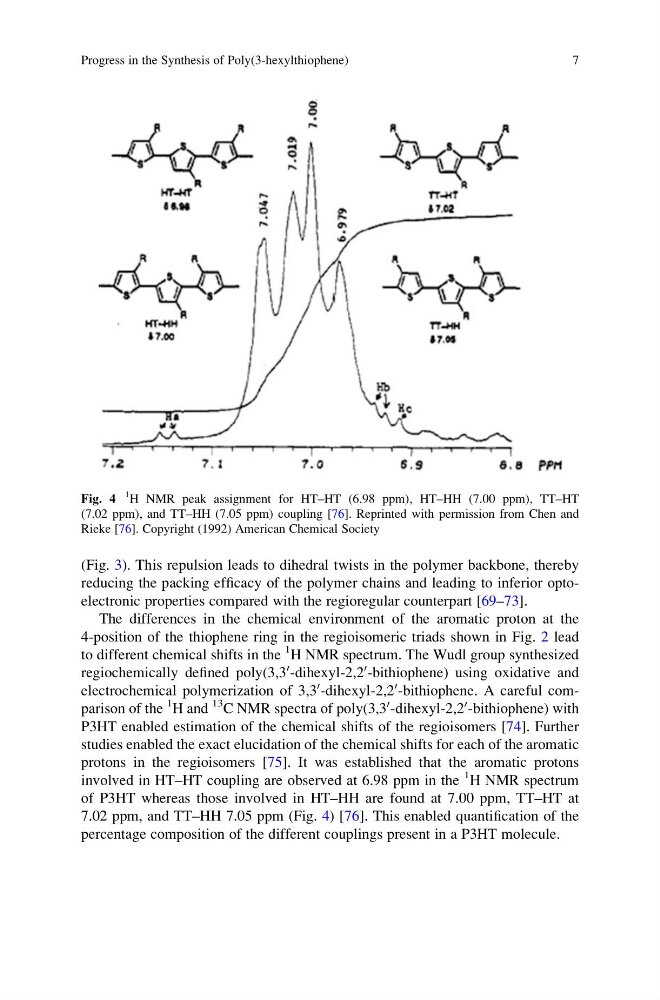
7.02 ppm, and TT–HH 7.05 ppm (Fig. 4) [76]. This enabled quantification of the
percentage composition of the different couplings present in a P3HT molecule.
Fig. 4
1
H NMR peak assignment for HT–HT (6.98 ppm), HT–HH (7.00 ppm), TT–HT
(7.02 ppm), and TT–HH (7.05 ppm) coupling [76]. Reprinted with permission from Chen and
Rieke [76]. Copyright (1992) American Chemical Society
Progress in the Synthesis of Poly(3-hexylthiophene)
7
reducing the packing efficacy of the polymer chains and leading to inferior optoelectronic properties compared with the regioregular counterpart [69–73].
The differences in the chemical environment of the aromatic proton at the
4-position of the thiophene ring in the regioisomeric triads shown in Fig. 2 lead
to different chemical shifts in the
1 H NMR spectrum. The Wudl group synthesized
regiochemically defined poly(3,3
0 -dihexyl-2,2
0 -bithiophene) using oxidative and
electrochemical polymerization of 3,3
0 -dihexyl-2,2
0 -bithiophene. A careful comparison of the
1 H and
13 C NMR spectra of poly(3,3
0 -dihexyl-2,2
0 -bithiophene) with
P3HT enabled estimation of the chemical shifts of the regioisomers [74]. Further
studies enabled the exact elucidation of the chemical shifts for each of the aromatic
protons in the regioisomers [75]. It was established that the aromatic protons
involved in HT–HT coupling are observed at 6.98 ppm in the
1 H NMR spectrum
of P3HT whereas those involved in HT–HH are found at 7.00 ppm, TT–HT at
7.02 ppm, and TT–HH 7.05 ppm (Fig. 4) [76]. This enabled quantification of the
percentage composition of the different couplings present in a P3HT molecule.
Fig. 4
1
H NMR peak assignment for HT–HT (6.98 ppm), HT–HH (7.00 ppm), TT–HT
(7.02 ppm), and TT–HH (7.05 ppm) coupling [76]. Reprinted with permission from Chen and
Rieke [76]. Copyright (1992) American Chemical Society
Progress in the Synthesis of Poly(3-hexylthiophene)
7