

allow for enough rotational freedom to reduce the conjugation length and therefore increase the ionization potential by 0.1 eV, which makes PQT significantly
more air-stable than P3HT (see Fig. 9) [99]. However, this rotational freedom also
reduces overall ordering, which led McCullough and coworkers to introduce a
fused thieno[3,2-b]thiophene unit [113]. The thienothiophene units are quite rigid
and planarize the backbone, which is advantageous for π–π stacking and intra- and
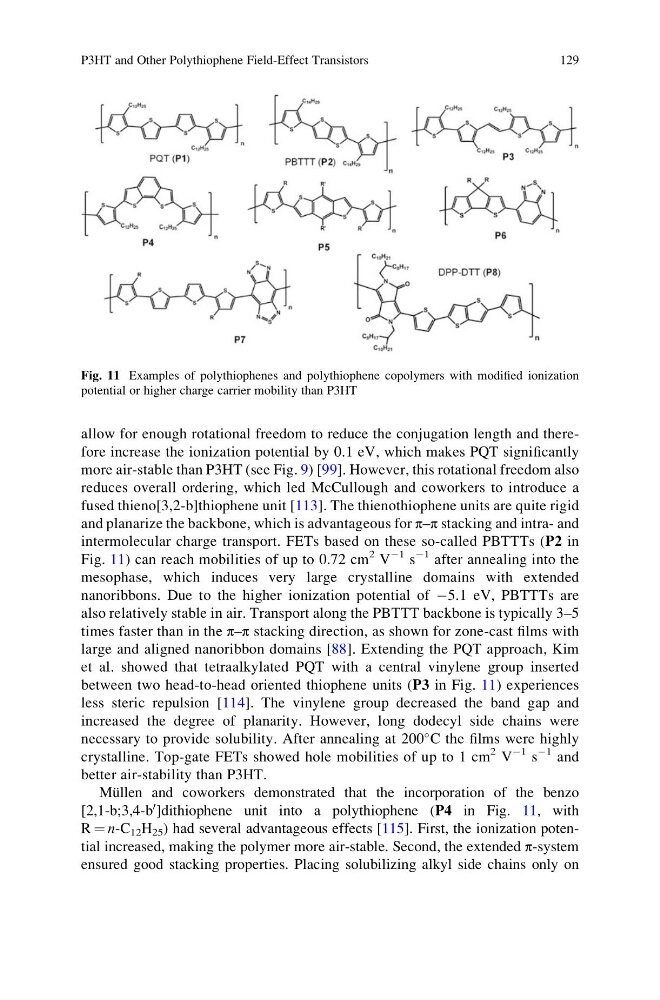
intermolecular charge transport. FETs based on these so-called PBTTTs (P2 in
Fig. 11) can reach mobilities of up to 0.72 cm
2 V
À1 s
À1 after annealing into the
mesophase, which induces very large crystalline domains with extended
nanoribbons. Due to the higher ionization potential of À5.1 eV, PBTTTs are
also relatively stable in air. Transport along the PBTTT backbone is typically 3–5
times faster than in the π–π stacking direction, as shown for zone-cast films with
large and aligned nanoribbon domains [88]. Extending the PQT approach, Kim
et al. showed that tetraalkylated PQT with a central vinylene group inserted
between two head-to-head oriented thiophene units (P3 in Fig. 11) experiences
less steric repulsion [114]. The vinylene group decreased the band gap and
increased the degree of planarity. However, long dodecyl side chains were
necessary to provide solubility. After annealing at 200
C the films were highly
crystalline. Top-gate FETs showed hole mobilities of up to 1 cm
2 V
À1 s
À1 and
better air-stability than P3HT.
Mu ¨llen and coworkers demonstrated that the incorporation of the benzo
[2,1-b;3,4-b
0 ]dithiophene unit into a polythiophene (P4 in Fig. 11, with
R ¼ n-C 12 H 25 ) had several advantageous effects [115]. First, the ionization potential increased, making the polymer more air-stable. Second, the extended π-system
ensured good stacking properties. Placing solubilizing alkyl side chains only on
Fig. 11 Examples of polythiophenes and polythiophene copolymers with modified ionization
potential or higher charge carrier mobility than P3HT
P3HT and Other Polythiophene Field-Effect Transistors
129
more air-stable than P3HT (see Fig. 9) [99]. However, this rotational freedom also
reduces overall ordering, which led McCullough and coworkers to introduce a
fused thieno[3,2-b]thiophene unit [113]. The thienothiophene units are quite rigid
and planarize the backbone, which is advantageous for π–π stacking and intra- and
intermolecular charge transport. FETs based on these so-called PBTTTs (P2 in
Fig. 11) can reach mobilities of up to 0.72 cm
2 V
À1 s
À1 after annealing into the
mesophase, which induces very large crystalline domains with extended
nanoribbons. Due to the higher ionization potential of À5.1 eV, PBTTTs are
also relatively stable in air. Transport along the PBTTT backbone is typically 3–5
times faster than in the π–π stacking direction, as shown for zone-cast films with
large and aligned nanoribbon domains [88]. Extending the PQT approach, Kim
et al. showed that tetraalkylated PQT with a central vinylene group inserted
between two head-to-head oriented thiophene units (P3 in Fig. 11) experiences
less steric repulsion [114]. The vinylene group decreased the band gap and
increased the degree of planarity. However, long dodecyl side chains were
necessary to provide solubility. After annealing at 200
C the films were highly
crystalline. Top-gate FETs showed hole mobilities of up to 1 cm
2 V
À1 s
À1 and
better air-stability than P3HT.
Mu ¨llen and coworkers demonstrated that the incorporation of the benzo
[2,1-b;3,4-b
0 ]dithiophene unit into a polythiophene (P4 in Fig. 11, with
R ¼ n-C 12 H 25 ) had several advantageous effects [115]. First, the ionization potential increased, making the polymer more air-stable. Second, the extended π-system
ensured good stacking properties. Placing solubilizing alkyl side chains only on
Fig. 11 Examples of polythiophenes and polythiophene copolymers with modified ionization
potential or higher charge carrier mobility than P3HT
P3HT and Other Polythiophene Field-Effect Transistors
129