

morphology by the molecular structure of the components would be very beneficial.
This is the goal for designing block copolymers of P3HT and insulating polymers of
different kinds that phase-separate on the nanoscale. Variation in the length of the
different blocks leads to different equilibrium morphologies (e.g., lamellar or
cylindrical) [91], which could be utilized for devices. Two different types of
diblock copolymers can be distinguished: rod–coil copolymers, which have an
amorphous insulating block [92–94], and crystalline diblock copolymers, in
which the insulating polymer is also semicrystalline and adds another driving
force for ordering [95–98]. Depending on the employed synthetic route, either the
P3HT length or the length of the insulating part can be varied. Unfortunately, many
of these synthetically challenging and therefore expensive block copolymers do not
show significantly higher mobilities than their pure rr-P3HT counterparts and are
certainly far from reaching the high mobilities necessary for most applications. In
the best cases, the mobilities remained similar and the threshold voltage and on/off
current ratio were improved. For example, films of P3HT-polyethylene copolymers
that were processed from hot solutions similar to blends of the same composition
resulted in high mobility (0.01–0.1 cm
2 V
À1 s
À1
) FETs with good on/off ratios (~10
5
).
Again, crystallization of the polyethylene block probably caused the pre-crystallized
P3HT segments to form a low-percolation-threshold co-continuous structure [97]. Yu
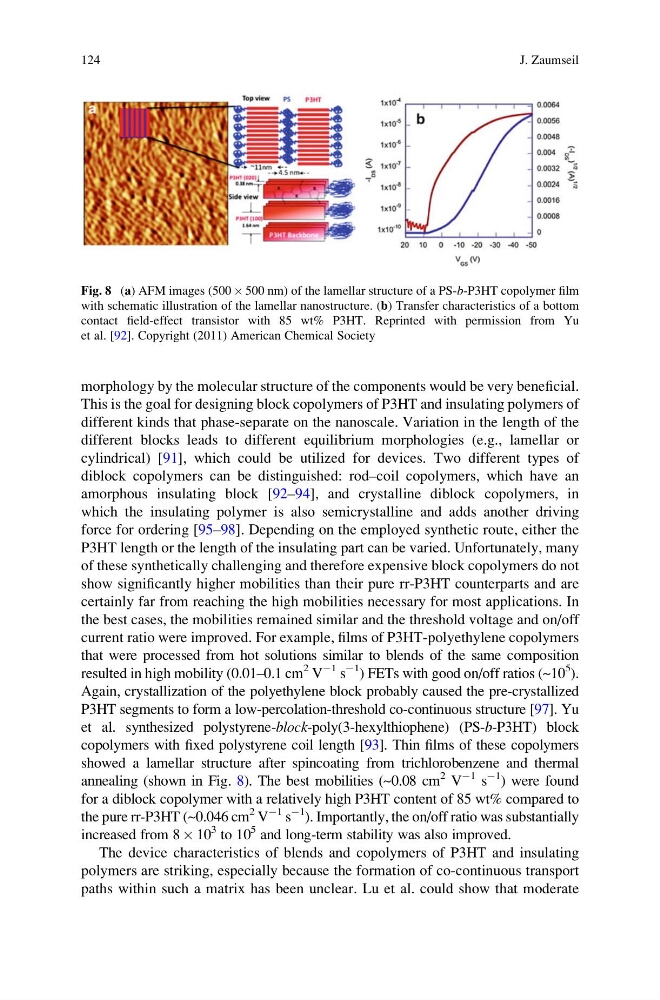
et al. synthesized polystyrene-block-poly(3-hexylthiophene) (PS-b-P3HT) block
copolymers with fixed polystyrene coil length [93]. Thin films of these copolymers
showed a lamellar structure after spincoating from trichlorobenzene and thermal
annealing (shown in Fig. 8). The best mobilities (~0.08 cm
2 V
À1 s
À1
) were found
for a diblock copolymer with a relatively high P3HT content of 85 wt% compared to
the pure rr-P3HT (~0.046 cm
2 V
À1 s
À1
). Importantly, the on/off ratio was substantially
increased from 8 Â 10
3 to 10
5 and long-term stability was also improved.
The device characteristics of blends and copolymers of P3HT and insulating
polymers are striking, especially because the formation of co-continuous transport
paths within such a matrix has been unclear. Lu et al. could show that moderate
Fig. 8 (a) AFM images (500 Â 500 nm) of the lamellar structure of a PS-b-P3HT copolymer film
with schematic illustration of the lamellar nanostructure. (b) Transfer characteristics of a bottom
contact field-effect transistor with 85 wt% P3HT. Reprinted with permission from Yu
et al. [92]. Copyright (2011) American Chemical Society
124
J. Zaumseil
This is the goal for designing block copolymers of P3HT and insulating polymers of
different kinds that phase-separate on the nanoscale. Variation in the length of the
different blocks leads to different equilibrium morphologies (e.g., lamellar or
cylindrical) [91], which could be utilized for devices. Two different types of
diblock copolymers can be distinguished: rod–coil copolymers, which have an
amorphous insulating block [92–94], and crystalline diblock copolymers, in
which the insulating polymer is also semicrystalline and adds another driving
force for ordering [95–98]. Depending on the employed synthetic route, either the
P3HT length or the length of the insulating part can be varied. Unfortunately, many
of these synthetically challenging and therefore expensive block copolymers do not
show significantly higher mobilities than their pure rr-P3HT counterparts and are
certainly far from reaching the high mobilities necessary for most applications. In
the best cases, the mobilities remained similar and the threshold voltage and on/off
current ratio were improved. For example, films of P3HT-polyethylene copolymers
that were processed from hot solutions similar to blends of the same composition
resulted in high mobility (0.01–0.1 cm
2 V
À1 s
À1
) FETs with good on/off ratios (~10
5
).
Again, crystallization of the polyethylene block probably caused the pre-crystallized
P3HT segments to form a low-percolation-threshold co-continuous structure [97]. Yu
et al. synthesized polystyrene-block-poly(3-hexylthiophene) (PS-b-P3HT) block
copolymers with fixed polystyrene coil length [93]. Thin films of these copolymers
showed a lamellar structure after spincoating from trichlorobenzene and thermal
annealing (shown in Fig. 8). The best mobilities (~0.08 cm
2 V
À1 s
À1
) were found
for a diblock copolymer with a relatively high P3HT content of 85 wt% compared to
the pure rr-P3HT (~0.046 cm
2 V
À1 s
À1
). Importantly, the on/off ratio was substantially
increased from 8 Â 10
3 to 10
5 and long-term stability was also improved.
The device characteristics of blends and copolymers of P3HT and insulating
polymers are striking, especially because the formation of co-continuous transport
paths within such a matrix has been unclear. Lu et al. could show that moderate
Fig. 8 (a) AFM images (500 Â 500 nm) of the lamellar structure of a PS-b-P3HT copolymer film
with schematic illustration of the lamellar nanostructure. (b) Transfer characteristics of a bottom
contact field-effect transistor with 85 wt% P3HT. Reprinted with permission from Yu
et al. [92]. Copyright (2011) American Chemical Society
124
J. Zaumseil