

recrystallization and by low nucleation density recrystallization under confinement
[87]. In the former case, charge transport takes place along the polymer chains and
across low-angle boundaries between lamellae. In the latter case, charges have to
move in the π–π stacking direction. Interestingly, only for high molecular weight
samples a significantly higher mobility (~0.01 cm
2 V
À1 s
À1 ) along the polymer
backbones (i.e., perpendicular to the π–π stacking direction) compared to the π–π
stacking direction (~0.003 cm
2 V
À1 s
À1 ) was observed. Because transport along the
backbone direction is ultimately limited by the boundaries between adjacent lamellae, long polymer chains are more likely to act as tie molecules connecting the two
lamellae. In samples with low molecular weight this is less likely and the mobility is
limited even compared to transport in the π–π stacking direction, which is slower
but does not require tie molecules.
Similar differences between intrachain and interchain transport were also found
for the related π-stacked polythiophene poly{2,5-bis(3-alkylthiophen-2-yl)thieno
[3,2-b]thiophene} (PBTTT; P2 in Fig. 11) [88]. Here, the mobilities along the
chains in well-ordered ribbons formed by zone casting ranged from 0.13 to
0.2 cm
2 V
À1 s
À1 versus 0.026 to 0.06 cm
2 V
À1 s
À1 perpendicular to the chains,
i.e., in the π–π stacking direction. The obtained ratio was not as high as expected,
probably due to limitation of the mobility along the chains by disordered grain
boundaries.
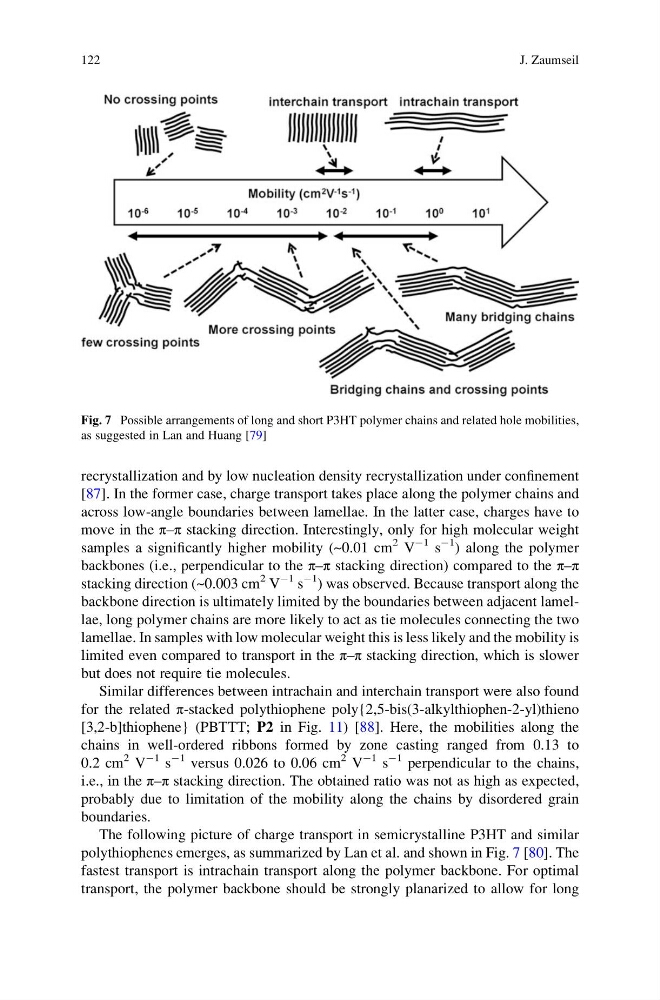
The following picture of charge transport in semicrystalline P3HT and similar
polythiophenes emerges, as summarized by Lan et al. and shown in Fig. 7 [80]. The
fastest transport is intrachain transport along the polymer backbone. For optimal
transport, the polymer backbone should be strongly planarized to allow for long
Fig. 7 Possible arrangements of long and short P3HT polymer chains and related hole mobilities,
as suggested in Lan and Huang [79]
122
J. Zaumseil
[87]. In the former case, charge transport takes place along the polymer chains and
across low-angle boundaries between lamellae. In the latter case, charges have to
move in the π–π stacking direction. Interestingly, only for high molecular weight
samples a significantly higher mobility (~0.01 cm
2 V
À1 s
À1 ) along the polymer
backbones (i.e., perpendicular to the π–π stacking direction) compared to the π–π
stacking direction (~0.003 cm
2 V
À1 s
À1 ) was observed. Because transport along the
backbone direction is ultimately limited by the boundaries between adjacent lamellae, long polymer chains are more likely to act as tie molecules connecting the two
lamellae. In samples with low molecular weight this is less likely and the mobility is
limited even compared to transport in the π–π stacking direction, which is slower
but does not require tie molecules.
Similar differences between intrachain and interchain transport were also found
for the related π-stacked polythiophene poly{2,5-bis(3-alkylthiophen-2-yl)thieno
[3,2-b]thiophene} (PBTTT; P2 in Fig. 11) [88]. Here, the mobilities along the
chains in well-ordered ribbons formed by zone casting ranged from 0.13 to
0.2 cm
2 V
À1 s
À1 versus 0.026 to 0.06 cm
2 V
À1 s
À1 perpendicular to the chains,
i.e., in the π–π stacking direction. The obtained ratio was not as high as expected,
probably due to limitation of the mobility along the chains by disordered grain
boundaries.
The following picture of charge transport in semicrystalline P3HT and similar
polythiophenes emerges, as summarized by Lan et al. and shown in Fig. 7 [80]. The
fastest transport is intrachain transport along the polymer backbone. For optimal
transport, the polymer backbone should be strongly planarized to allow for long
Fig. 7 Possible arrangements of long and short P3HT polymer chains and related hole mobilities,
as suggested in Lan and Huang [79]
122
J. Zaumseil