

For the fabrication of circuits, the semiconductor has to be patterned and neither
spincasting nor dropcasting are appropriate for large scale production. Various
printing techniques such as flexography, offset, gravure, screen, inkjet, or aerosoljet printing are used [44, 45]. Each of these techniques allows for different minimum feature sizes and requires P3HT ink formulations with different viscosities,
resulting in different P3HT film morphologies. For example, inkjet printing and
aerosol-jet printing produce relatively rough and disordered films [46, 47]. So far,
no clear correlation between the applied printing technique for P3HT thin films and
device performance has been established.
In addition to the deposition technique, the preparation of the P3HT solution has
an effect on the microstructure and final hole mobility within the polymer layer.
Mild ultrasonication of the P3HT solution for several minutes before spincasting
enhances the mobility, especially for high molecular weight P3HTs [48–50]. In a
comprehensive study of microstructure and transport properties of P3HT films
spincast from ultrasonicated solutions, Zhao et al. reported a 20-fold increase in
field-effect mobility (from 5 Â 10
À4 to 0.01 cm
2 V
À1 s
À1 ) of high M W (68 kDa)
P3HT films spincoated from toluene after 6 min of ultrasonication compared to
untreated solutions [50]. On the other hand low M W (35 kDa) P3HT films produced
in the same way showed only a slight decrease in mobility with sonication time. The
observed mobility enhancement appears to be a result of the disentanglement of the
P3HT chains during sonication. Entanglements are more frequent in high M W
polymers and thus the effect can be expected to be larger than for lower molecular
weight polymers. Ultrasonication facilitates free movement and disentanglement of
the chains, which can then form ordered aggregates more efficiently. Consequently,
the lamellar thickness of the high molecular weight P3HT film increased from 14.9
to 19.3 nm with ultrasonication time, as shown by TEM. Furthermore, absorption
spectra indicated an increase in the fraction of P3HT molecules involved in
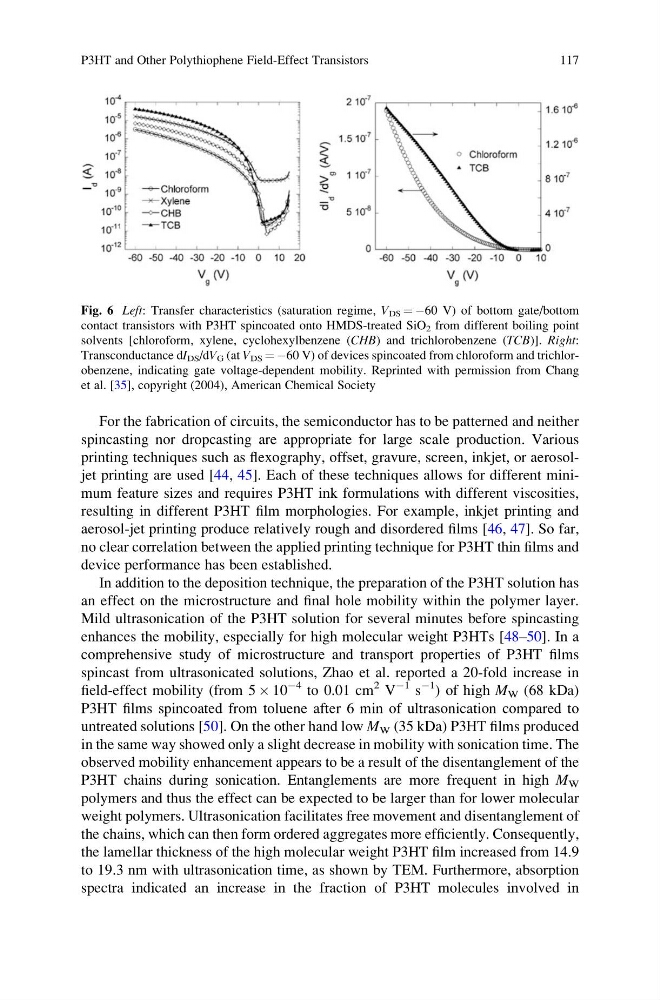
Fig. 6 Left: Transfer characteristics (saturation regime, V DS ¼ À60 V) of bottom gate/bottom
contact transistors with P3HT spincoated onto HMDS-treated SiO 2 from different boiling point
solvents [chloroform, xylene, cyclohexylbenzene (CHB) and trichlorobenzene (TCB)]. Right:
Transconductance dI DS /dV G (at V DS ¼ À60 V) of devices spincoated from chloroform and trichlorobenzene, indicating gate voltage-dependent mobility. Reprinted with permission from Chang
et al. [35], copyright (2004), American Chemical Society
P3HT and Other Polythiophene Field-Effect Transistors
117
spincasting nor dropcasting are appropriate for large scale production. Various
printing techniques such as flexography, offset, gravure, screen, inkjet, or aerosoljet printing are used [44, 45]. Each of these techniques allows for different minimum feature sizes and requires P3HT ink formulations with different viscosities,
resulting in different P3HT film morphologies. For example, inkjet printing and
aerosol-jet printing produce relatively rough and disordered films [46, 47]. So far,
no clear correlation between the applied printing technique for P3HT thin films and
device performance has been established.
In addition to the deposition technique, the preparation of the P3HT solution has
an effect on the microstructure and final hole mobility within the polymer layer.
Mild ultrasonication of the P3HT solution for several minutes before spincasting
enhances the mobility, especially for high molecular weight P3HTs [48–50]. In a
comprehensive study of microstructure and transport properties of P3HT films
spincast from ultrasonicated solutions, Zhao et al. reported a 20-fold increase in
field-effect mobility (from 5 Â 10
À4 to 0.01 cm
2 V
À1 s
À1 ) of high M W (68 kDa)
P3HT films spincoated from toluene after 6 min of ultrasonication compared to
untreated solutions [50]. On the other hand low M W (35 kDa) P3HT films produced
in the same way showed only a slight decrease in mobility with sonication time. The
observed mobility enhancement appears to be a result of the disentanglement of the
P3HT chains during sonication. Entanglements are more frequent in high M W
polymers and thus the effect can be expected to be larger than for lower molecular
weight polymers. Ultrasonication facilitates free movement and disentanglement of
the chains, which can then form ordered aggregates more efficiently. Consequently,
the lamellar thickness of the high molecular weight P3HT film increased from 14.9
to 19.3 nm with ultrasonication time, as shown by TEM. Furthermore, absorption
spectra indicated an increase in the fraction of P3HT molecules involved in
Fig. 6 Left: Transfer characteristics (saturation regime, V DS ¼ À60 V) of bottom gate/bottom
contact transistors with P3HT spincoated onto HMDS-treated SiO 2 from different boiling point
solvents [chloroform, xylene, cyclohexylbenzene (CHB) and trichlorobenzene (TCB)]. Right:
Transconductance dI DS /dV G (at V DS ¼ À60 V) of devices spincoated from chloroform and trichlorobenzene, indicating gate voltage-dependent mobility. Reprinted with permission from Chang
et al. [35], copyright (2004), American Chemical Society
P3HT and Other Polythiophene Field-Effect Transistors
117