

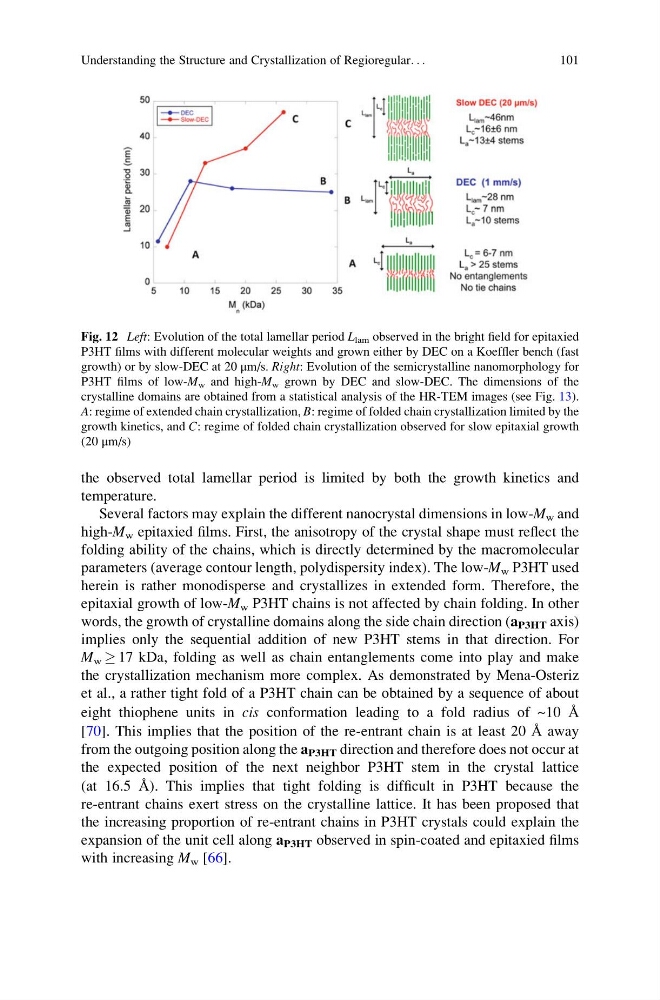
the observed total lamellar period is limited by both the growth kinetics and
temperature.
Several factors may explain the different nanocrystal dimensions in low-M w and
high-M w epitaxied films. First, the anisotropy of the crystal shape must reflect the
folding ability of the chains, which is directly determined by the macromolecular
parameters (average contour length, polydispersity index). The low-M w P3HT used
herein is rather monodisperse and crystallizes in extended form. Therefore, the
epitaxial growth of low-M w P3HT chains is not affected by chain folding. In other
words, the growth of crystalline domains along the side chain direction (a P3HT axis)
implies only the sequential addition of new P3HT stems in that direction. For
M w ! 17 kDa, folding as well as chain entanglements come into play and make
the crystallization mechanism more complex. As demonstrated by Mena-Osteriz
et al., a rather tight fold of a P3HT chain can be obtained by a sequence of about
eight thiophene units in cis conformation leading to a fold radius of ~10 Å
[70]. This implies that the position of the re-entrant chain is at least 20 Å away
from the outgoing position along the a P3HT direction and therefore does not occur at
the expected position of the next neighbor P3HT stem in the crystal lattice
(at 16.5 Å). This implies that tight folding is difficult in P3HT because the
re-entrant chains exert stress on the crystalline lattice. It has been proposed that
the increasing proportion of re-entrant chains in P3HT crystals could explain the
expansion of the unit cell along a P3HT observed in spin-coated and epitaxied films
with increasing M w [66].
Fig. 12 Left: Evolution of the total lamellar period L lam observed in the bright field for epitaxied
P3HT films with different molecular weights and grown either by DEC on a Koeffler bench (fast
growth) or by slow-DEC at 20 μm/s. Right: Evolution of the semicrystalline nanomorphology for
P3HT films of low-M w and high-M w grown by DEC and slow-DEC. The dimensions of the
crystalline domains are obtained from a statistical analysis of the HR-TEM images (see Fig. 13).
A: regime of extended chain crystallization, B: regime of folded chain crystallization limited by the
growth kinetics, and C: regime of folded chain crystallization observed for slow epitaxial growth
(20 μm/s)
Understanding the Structure and Crystallization of Regioregular. . .
101
temperature.
Several factors may explain the different nanocrystal dimensions in low-M w and
high-M w epitaxied films. First, the anisotropy of the crystal shape must reflect the
folding ability of the chains, which is directly determined by the macromolecular
parameters (average contour length, polydispersity index). The low-M w P3HT used
herein is rather monodisperse and crystallizes in extended form. Therefore, the
epitaxial growth of low-M w P3HT chains is not affected by chain folding. In other
words, the growth of crystalline domains along the side chain direction (a P3HT axis)
implies only the sequential addition of new P3HT stems in that direction. For
M w ! 17 kDa, folding as well as chain entanglements come into play and make
the crystallization mechanism more complex. As demonstrated by Mena-Osteriz
et al., a rather tight fold of a P3HT chain can be obtained by a sequence of about
eight thiophene units in cis conformation leading to a fold radius of ~10 Å
[70]. This implies that the position of the re-entrant chain is at least 20 Å away
from the outgoing position along the a P3HT direction and therefore does not occur at
the expected position of the next neighbor P3HT stem in the crystal lattice
(at 16.5 Å). This implies that tight folding is difficult in P3HT because the
re-entrant chains exert stress on the crystalline lattice. It has been proposed that
the increasing proportion of re-entrant chains in P3HT crystals could explain the
expansion of the unit cell along a P3HT observed in spin-coated and epitaxied films
with increasing M w [66].
Fig. 12 Left: Evolution of the total lamellar period L lam observed in the bright field for epitaxied
P3HT films with different molecular weights and grown either by DEC on a Koeffler bench (fast
growth) or by slow-DEC at 20 μm/s. Right: Evolution of the semicrystalline nanomorphology for
P3HT films of low-M w and high-M w grown by DEC and slow-DEC. The dimensions of the
crystalline domains are obtained from a statistical analysis of the HR-TEM images (see Fig. 13).
A: regime of extended chain crystallization, B: regime of folded chain crystallization limited by the
growth kinetics, and C: regime of folded chain crystallization observed for slow epitaxial growth
(20 μm/s)
Understanding the Structure and Crystallization of Regioregular. . .
101