

structure in the epitaxied films is not substrate-induced but corresponds indeed to
form I [56, 57]. The two structural models of form I proposed by Dudenko et al. and
Kayunkid et al. lead to significantly different ED patterns for the [0 1 0] and the
[0 0 1] zones, as seen in Fig. 9. Overall, only the model by Kayunkid et al. gives
satisfactory agreement with the experimental ED data. One of the most characteristic features of the [0 0 1] pattern is the asymmetry in the intensities of the (h 2 0)
and (h 4 0) layer lines, which is not observed in the calculated pattern using
the model of Dudenko et al. Furthermore, in the latter pattern, the intensity of the
1 0 1 reflection is strongly overestimated with respect to the experimental pattern.
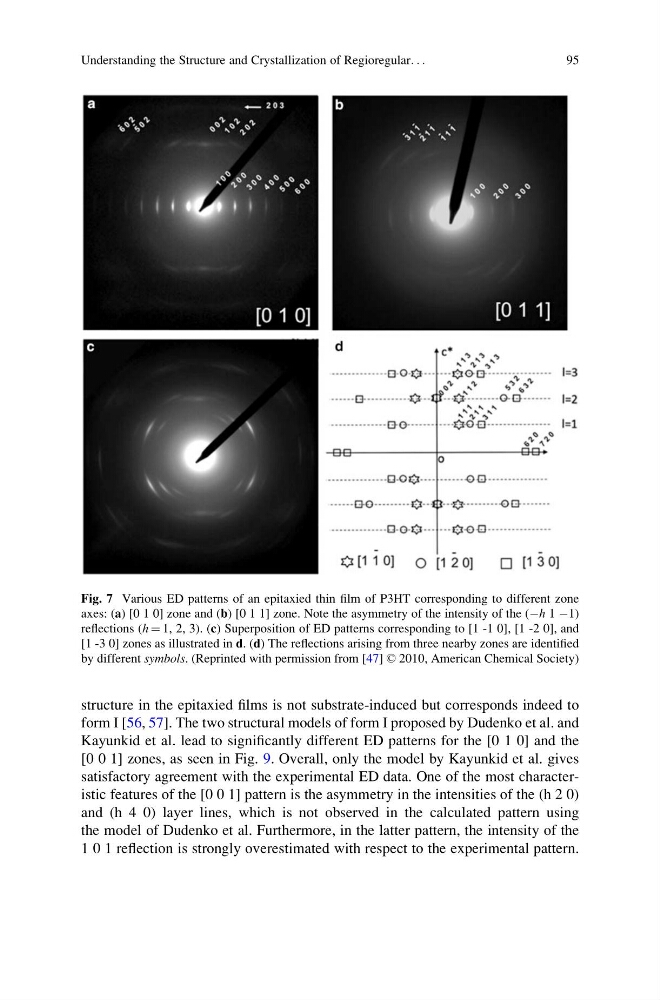
Fig. 7 Various ED patterns of an epitaxied thin film of P3HT corresponding to different zone
axes: (a) [0 1 0] zone and (b) [0 1 1] zone. Note the asymmetry of the intensity of the (Àh 1 À1)
reflections (h ¼ 1, 2, 3). (c) Superposition of ED patterns corresponding to [1 -1 0], [1 -2 0], and
[1 -3 0] zones as illustrated in d. (d) The reflections arising from three nearby zones are identified
by different symbols. (Reprinted with permission from [47] © 2010, American Chemical Society)
Understanding the Structure and Crystallization of Regioregular. . .
95
form I [56, 57]. The two structural models of form I proposed by Dudenko et al. and
Kayunkid et al. lead to significantly different ED patterns for the [0 1 0] and the
[0 0 1] zones, as seen in Fig. 9. Overall, only the model by Kayunkid et al. gives
satisfactory agreement with the experimental ED data. One of the most characteristic features of the [0 0 1] pattern is the asymmetry in the intensities of the (h 2 0)
and (h 4 0) layer lines, which is not observed in the calculated pattern using
the model of Dudenko et al. Furthermore, in the latter pattern, the intensity of the
1 0 1 reflection is strongly overestimated with respect to the experimental pattern.
Fig. 7 Various ED patterns of an epitaxied thin film of P3HT corresponding to different zone
axes: (a) [0 1 0] zone and (b) [0 1 1] zone. Note the asymmetry of the intensity of the (Àh 1 À1)
reflections (h ¼ 1, 2, 3). (c) Superposition of ED patterns corresponding to [1 -1 0], [1 -2 0], and
[1 -3 0] zones as illustrated in d. (d) The reflections arising from three nearby zones are identified
by different symbols. (Reprinted with permission from [47] © 2010, American Chemical Society)
Understanding the Structure and Crystallization of Regioregular. . .
95