

At lower filler loadings, particularly below the percolation threshold this property is
little explored. The nonlinear behavior called Payne effect was absent in the neat
elastomers at the same strain levels. Kraus, Maier and Goritz [9] and Huber Vilgis
proposed various mechanisms in order to explain this effect of which the Maier
Goritz mechanism considers various interactions existing within the composite
systems. They proposed stress-induced debonding of polymer chains from the filler
surface as the reason behind the Payne effect due to filler-structure breakdown.
Though the decrease of storage and loss moduli with strain in filled systems were
explained mathematically the theory failed to account for many other rheological
features. Filler-structure based theories and the debonding theory are difficult to
distinguish experimentally since filler-filler and filler-matrix interactions are both
dependent on specific filler characteristics such as surface treatment.
Very recently our group has explored the non linear viscoelastic effects in filled
elastomers as Ponnamma et al. [10, 11] and Sadasivuni et al. [12] report Payne
effect in 2D filler reinforced elastomers. This chapter aims in investigating the
effect of layered silicates and graphene nanolayers on various elastomer matrices
based on various filler concentrations and filler-matrix interactions.
2 Two-Dimensional Nanoparticles
Graphitic fillers and layered silicates are the main two dimensional fillers used to
reinforce elastomer matrices. Here the significance of the most important
nanoplatelets—nanoclay and graphene—on the nonlinear viscoelasticity of rubbers
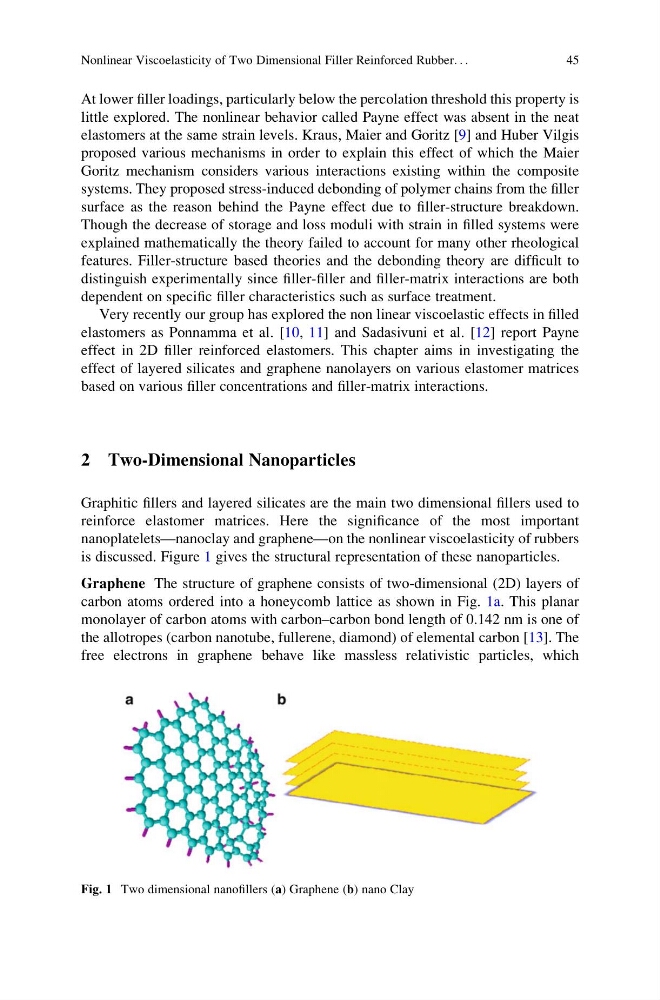
is discussed. Figure 1 gives the structural representation of these nanoparticles.
Graphene The structure of graphene consists of two-dimensional (2D) layers of
carbon atoms ordered into a honeycomb lattice as shown in Fig. 1a. This planar
monolayer of carbon atoms with carbon–carbon bond length of 0.142 nm is one of
the allotropes (carbon nanotube, fullerene, diamond) of elemental carbon [13]. The
free electrons in graphene behave like massless relativistic particles, which
Fig. 1 Two dimensional nanofillers (a) Graphene (b) nano Clay
Nonlinear Viscoelasticity of Two Dimensional Filler Reinforced Rubber. . .
45
little explored. The nonlinear behavior called Payne effect was absent in the neat
elastomers at the same strain levels. Kraus, Maier and Goritz [9] and Huber Vilgis
proposed various mechanisms in order to explain this effect of which the Maier
Goritz mechanism considers various interactions existing within the composite
systems. They proposed stress-induced debonding of polymer chains from the filler
surface as the reason behind the Payne effect due to filler-structure breakdown.
Though the decrease of storage and loss moduli with strain in filled systems were
explained mathematically the theory failed to account for many other rheological
features. Filler-structure based theories and the debonding theory are difficult to
distinguish experimentally since filler-filler and filler-matrix interactions are both
dependent on specific filler characteristics such as surface treatment.
Very recently our group has explored the non linear viscoelastic effects in filled
elastomers as Ponnamma et al. [10, 11] and Sadasivuni et al. [12] report Payne
effect in 2D filler reinforced elastomers. This chapter aims in investigating the
effect of layered silicates and graphene nanolayers on various elastomer matrices
based on various filler concentrations and filler-matrix interactions.
2 Two-Dimensional Nanoparticles
Graphitic fillers and layered silicates are the main two dimensional fillers used to
reinforce elastomer matrices. Here the significance of the most important
nanoplatelets—nanoclay and graphene—on the nonlinear viscoelasticity of rubbers
is discussed. Figure 1 gives the structural representation of these nanoparticles.
Graphene The structure of graphene consists of two-dimensional (2D) layers of
carbon atoms ordered into a honeycomb lattice as shown in Fig. 1a. This planar
monolayer of carbon atoms with carbon–carbon bond length of 0.142 nm is one of
the allotropes (carbon nanotube, fullerene, diamond) of elemental carbon [13]. The
free electrons in graphene behave like massless relativistic particles, which
Fig. 1 Two dimensional nanofillers (a) Graphene (b) nano Clay
Nonlinear Viscoelasticity of Two Dimensional Filler Reinforced Rubber. . .
45