

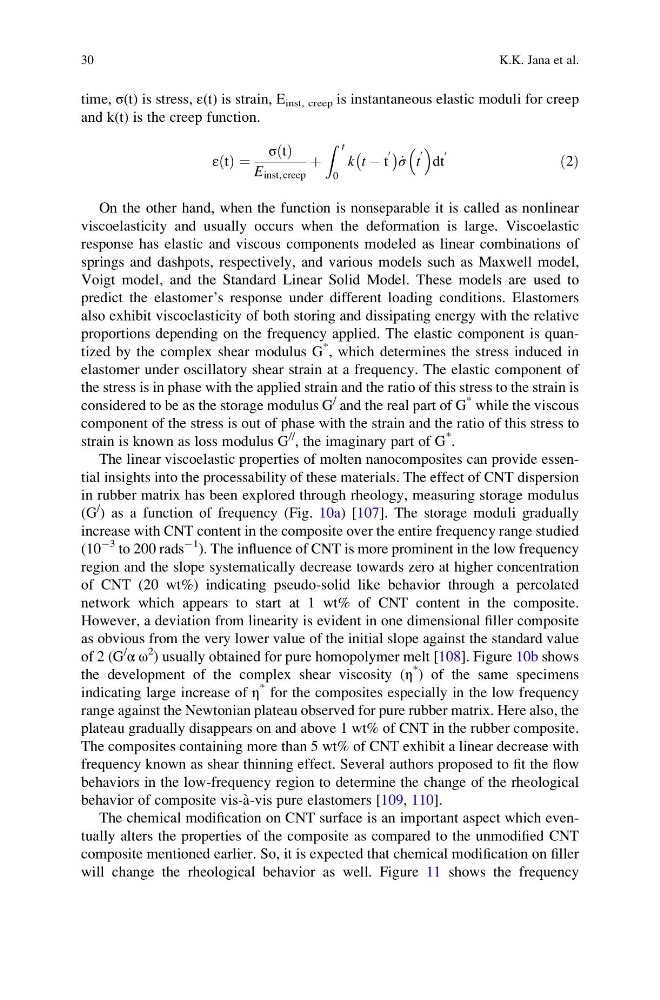
time, σ(t) is stress, ε(t) is strain, E inst, creep is instantaneous elastic moduli for creep
and k(t) is the creep function.
ε t
ð Þ ¼
σ t
ð Þ
E inst, creep
þ
Z t
0
k
À
t À t
0 Á _
σ t
0
dt
0
ð2Þ
On the other hand, when the function is nonseparable it is called as nonlinear
viscoelasticity and usually occurs when the deformation is large. Viscoelastic
response has elastic and viscous components modeled as linear combinations of
springs and dashpots, respectively, and various models such as Maxwell model,
Voigt model, and the Standard Linear Solid Model. These models are used to
predict the elastomer’s response under different loading conditions. Elastomers
also exhibit viscoelasticity of both storing and dissipating energy with the relative
proportions depending on the frequency applied. The elastic component is quantized by the complex shear modulus G
* , which determines the stress induced in
elastomer under oscillatory shear strain at a frequency. The elastic component of
the stress is in phase with the applied strain and the ratio of this stress to the strain is
considered to be as the storage modulus G
/ and the real part of G
* while the viscous
component of the stress is out of phase with the strain and the ratio of this stress to
strain is known as loss modulus G
// , the imaginary part of G
* .
The linear viscoelastic properties of molten nanocomposites can provide essential insights into the processability of these materials. The effect of CNT dispersion
in rubber matrix has been explored through rheology, measuring storage modulus
(G
/
) as a function of frequency (Fig. 10a) [107]. The storage moduli gradually
increase with CNT content in the composite over the entire frequency range studied
(10
À3 to 200 rads
À1 ). The influence of CNT is more prominent in the low frequency
region and the slope systematically decrease towards zero at higher concentration
of CNT (20 wt%) indicating pseudo-solid like behavior through a percolated
network which appears to start at 1 wt% of CNT content in the composite.
However, a deviation from linearity is evident in one dimensional filler composite
as obvious from the very lower value of the initial slope against the standard value
of 2 (G
/
α ω
2 ) usually obtained for pure homopolymer melt [108]. Figure 10b shows
the development of the complex shear viscosity (η
* ) of the same specimens
indicating large increase of η
* for the composites especially in the low frequency
range against the Newtonian plateau observed for pure rubber matrix. Here also, the
plateau gradually disappears on and above 1 wt% of CNT in the rubber composite.
The composites containing more than 5 wt% of CNT exhibit a linear decrease with
frequency known as shear thinning effect. Several authors proposed to fit the flow
behaviors in the low-frequency region to determine the change of the rheological
behavior of composite vis-a `-vis pure elastomers [109, 110].
The chemical modification on CNT surface is an important aspect which eventually alters the properties of the composite as compared to the unmodified CNT
composite mentioned earlier. So, it is expected that chemical modification on filler
will change the rheological behavior as well. Figure 11 shows the frequency
30
K.K. Jana et al.
and k(t) is the creep function.
ε t
ð Þ ¼
σ t
ð Þ
E inst, creep
þ
Z t
0
k
À
t À t
0 Á _
σ t
0
dt
0
ð2Þ
On the other hand, when the function is nonseparable it is called as nonlinear
viscoelasticity and usually occurs when the deformation is large. Viscoelastic
response has elastic and viscous components modeled as linear combinations of
springs and dashpots, respectively, and various models such as Maxwell model,
Voigt model, and the Standard Linear Solid Model. These models are used to
predict the elastomer’s response under different loading conditions. Elastomers
also exhibit viscoelasticity of both storing and dissipating energy with the relative
proportions depending on the frequency applied. The elastic component is quantized by the complex shear modulus G
* , which determines the stress induced in
elastomer under oscillatory shear strain at a frequency. The elastic component of
the stress is in phase with the applied strain and the ratio of this stress to the strain is
considered to be as the storage modulus G
/ and the real part of G
* while the viscous
component of the stress is out of phase with the strain and the ratio of this stress to
strain is known as loss modulus G
// , the imaginary part of G
* .
The linear viscoelastic properties of molten nanocomposites can provide essential insights into the processability of these materials. The effect of CNT dispersion
in rubber matrix has been explored through rheology, measuring storage modulus
(G
/
) as a function of frequency (Fig. 10a) [107]. The storage moduli gradually
increase with CNT content in the composite over the entire frequency range studied
(10
À3 to 200 rads
À1 ). The influence of CNT is more prominent in the low frequency
region and the slope systematically decrease towards zero at higher concentration
of CNT (20 wt%) indicating pseudo-solid like behavior through a percolated
network which appears to start at 1 wt% of CNT content in the composite.
However, a deviation from linearity is evident in one dimensional filler composite
as obvious from the very lower value of the initial slope against the standard value
of 2 (G
/
α ω
2 ) usually obtained for pure homopolymer melt [108]. Figure 10b shows
the development of the complex shear viscosity (η
* ) of the same specimens
indicating large increase of η
* for the composites especially in the low frequency
range against the Newtonian plateau observed for pure rubber matrix. Here also, the
plateau gradually disappears on and above 1 wt% of CNT in the rubber composite.
The composites containing more than 5 wt% of CNT exhibit a linear decrease with
frequency known as shear thinning effect. Several authors proposed to fit the flow
behaviors in the low-frequency region to determine the change of the rheological
behavior of composite vis-a `-vis pure elastomers [109, 110].
The chemical modification on CNT surface is an important aspect which eventually alters the properties of the composite as compared to the unmodified CNT
composite mentioned earlier. So, it is expected that chemical modification on filler
will change the rheological behavior as well. Figure 11 shows the frequency
30
K.K. Jana et al.