

h γ
ð Þ ¼
1
1 þ
γ
γ c
B
ð12Þ
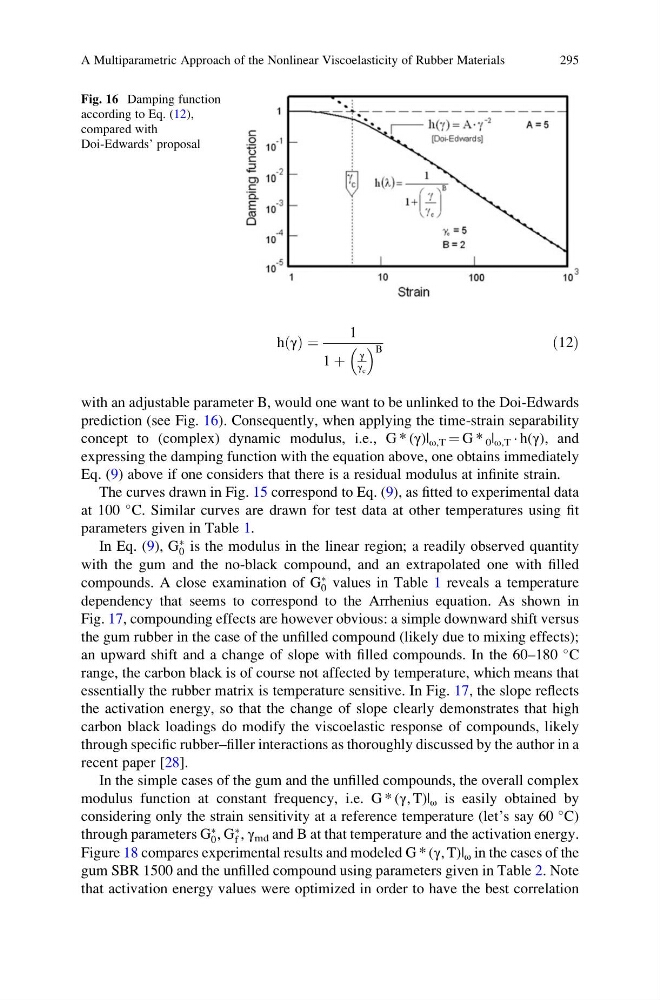
with an adjustable parameter B, would one want to be unlinked to the Doi-Edwards
prediction (see Fig. 16). Consequently, when applying the time-strain separability
concept to (complex) dynamic modulus, i.e., G * (γ)| ω,T ¼ G * 0 | ω,T Á h(γ), and
expressing the damping function with the equation above, one obtains immediately
Eq. (9) above if one considers that there is a residual modulus at infinite strain.
The curves drawn in Fig. 15 correspond to Eq. (9), as fitted to experimental data
at 100
C. Similar curves are drawn for test data at other temperatures using fit
parameters given in Table 1.
In Eq. (9), G
Ã
0 is the modulus in the linear region; a readily observed quantity
with the gum and the no-black compound, and an extrapolated one with filled
compounds. A close examination of G
Ã
0 values in Table 1 reveals a temperature
dependency that seems to correspond to the Arrhenius equation. As shown in
Fig. 17, compounding effects are however obvious: a simple downward shift versus
the gum rubber in the case of the unfilled compound (likely due to mixing effects);
an upward shift and a change of slope with filled compounds. In the 60–180
C
range, the carbon black is of course not affected by temperature, which means that
essentially the rubber matrix is temperature sensitive. In Fig. 17, the slope reflects
the activation energy, so that the change of slope clearly demonstrates that high
carbon black loadings do modify the viscoelastic response of compounds, likely
through specific rubber–filler interactions as thoroughly discussed by the author in a
recent paper [28].
In the simple cases of the gum and the unfilled compounds, the overall complex
modulus function at constant frequency, i.e. G * (γ, T)| ω is easily obtained by
considering only the strain sensitivity at a reference temperature (let’s say 60
C)
through parameters G
Ã
0 , G
Ã
f , γ md and B at that temperature and the activation energy.
Figure 18 compares experimental results and modeled G * (γ, T)| ω in the cases of the
gum SBR 1500 and the unfilled compound using parameters given in Table 2. Note
that activation energy values were optimized in order to have the best correlation
Fig. 16 Damping function
according to Eq. (12),
compared with
Doi-Edwards’ proposal
A Multiparametric Approach of the Nonlinear Viscoelasticity of Rubber Materials
295
ð Þ ¼
1
1 þ
γ
γ c
B
ð12Þ
with an adjustable parameter B, would one want to be unlinked to the Doi-Edwards
prediction (see Fig. 16). Consequently, when applying the time-strain separability
concept to (complex) dynamic modulus, i.e., G * (γ)| ω,T ¼ G * 0 | ω,T Á h(γ), and
expressing the damping function with the equation above, one obtains immediately
Eq. (9) above if one considers that there is a residual modulus at infinite strain.
The curves drawn in Fig. 15 correspond to Eq. (9), as fitted to experimental data
at 100
C. Similar curves are drawn for test data at other temperatures using fit
parameters given in Table 1.
In Eq. (9), G
Ã
0 is the modulus in the linear region; a readily observed quantity
with the gum and the no-black compound, and an extrapolated one with filled
compounds. A close examination of G
Ã
0 values in Table 1 reveals a temperature
dependency that seems to correspond to the Arrhenius equation. As shown in
Fig. 17, compounding effects are however obvious: a simple downward shift versus
the gum rubber in the case of the unfilled compound (likely due to mixing effects);
an upward shift and a change of slope with filled compounds. In the 60–180
C
range, the carbon black is of course not affected by temperature, which means that
essentially the rubber matrix is temperature sensitive. In Fig. 17, the slope reflects
the activation energy, so that the change of slope clearly demonstrates that high
carbon black loadings do modify the viscoelastic response of compounds, likely
through specific rubber–filler interactions as thoroughly discussed by the author in a
recent paper [28].
In the simple cases of the gum and the unfilled compounds, the overall complex
modulus function at constant frequency, i.e. G * (γ, T)| ω is easily obtained by
considering only the strain sensitivity at a reference temperature (let’s say 60
C)
through parameters G
Ã
0 , G
Ã
f , γ md and B at that temperature and the activation energy.
Figure 18 compares experimental results and modeled G * (γ, T)| ω in the cases of the
gum SBR 1500 and the unfilled compound using parameters given in Table 2. Note
that activation energy values were optimized in order to have the best correlation
Fig. 16 Damping function
according to Eq. (12),
compared with
Doi-Edwards’ proposal
A Multiparametric Approach of the Nonlinear Viscoelasticity of Rubber Materials
295