

readily possible only in the case of simple macromolecular systems with relatively
narrow molecular weight distribution (MWD), for instance linear homopolymers as
well as certain polymers having simple, well defined architecture, for instance
H-type or pom-pom polymers, at the expense however of sometimes quite complex
calculations. Reasons are well known: on one side “real” polymers such as those
used worldwide by millions tons/year in the industry are rarely conform to ideal
macromolecular models and, on the other side, relatively large MWD polymers are
preferred by engineers because of their easier processing. Despite undeniable progresses achieved over the last decades in controlling (certain) polymerization
processes, synthetic materials still exhibit a number of architectural “accidents”
that make the application of the linear viscoelastic theory somewhat limited, not to
mention the side effects of residues from the synthesis (e.g. catalyst residues, soaps
and other emulsifying agents) as well as the sometimes significant role of purposely
added ingredients (e.g. oils, waxes, antidegradant,. . .) that, even in small quantities,
are known to modify the viscoelastic behavior. The situation is of course worst with
polymers of natural origin, with the notable example of Natural Rubber (with
worldwide consumption of around 10 millions tons/year) whose true structure is
still subject to investigation despite key findings in recent years [3], namely the role
of the so-called non-rubber ingredients, i.e. protein residues, phospholipids, etc. In
addition, a growing number of macromolecular-based materials nowadays used in
the polymer industry are in fact complex polymer systems (with the typical case of
filled rubber compounds) that exhibit a strong nonlinear viscoelastic character of
internal (or morphological) origin, even at the lowest possible strain in available
experimental techniques. Indeed, when submitted to sufficiently large strains, any
simple (pure) polymer eventually exhibits non-linear viscoelastic properties; in
such case the observed behavior is called extrinsic non-linear viscoelasticity,
since owing to external factors (i.e. the applied strain). With complex polymer
systems, an intrinsic nonlinear character superimposes to the non-linearity associated with large strain. This additional response to applied strain has an internal
origin, i.e. their morphology. As demonstrated elsewhere [4, 5], harmonic testing
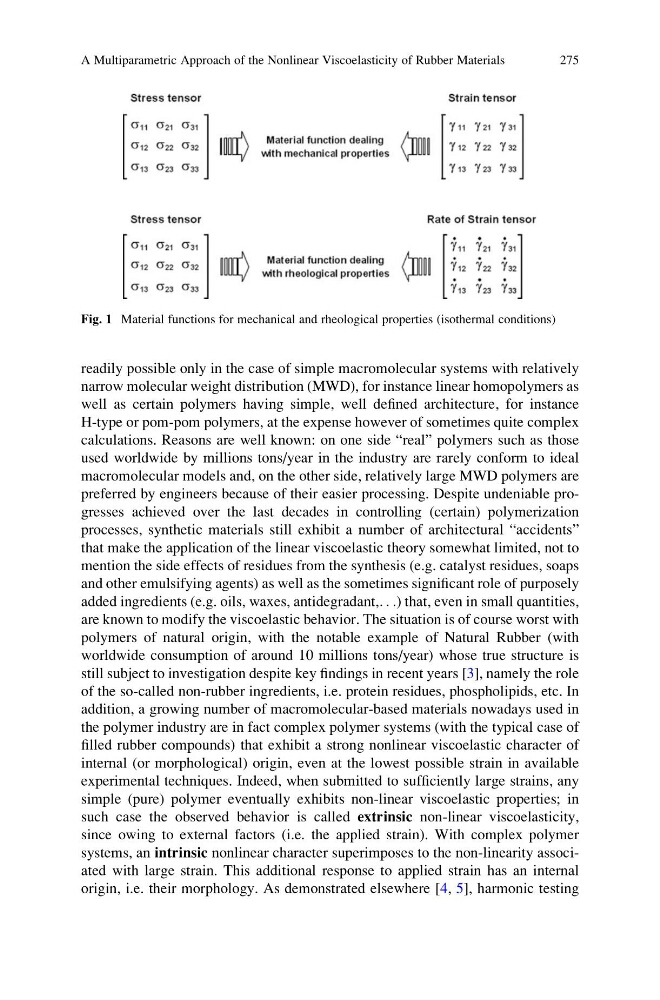
Fig. 1 Material functions for mechanical and rheological properties (isothermal conditions)
A Multiparametric Approach of the Nonlinear Viscoelasticity of Rubber Materials
275
narrow molecular weight distribution (MWD), for instance linear homopolymers as
well as certain polymers having simple, well defined architecture, for instance
H-type or pom-pom polymers, at the expense however of sometimes quite complex
calculations. Reasons are well known: on one side “real” polymers such as those
used worldwide by millions tons/year in the industry are rarely conform to ideal
macromolecular models and, on the other side, relatively large MWD polymers are
preferred by engineers because of their easier processing. Despite undeniable progresses achieved over the last decades in controlling (certain) polymerization
processes, synthetic materials still exhibit a number of architectural “accidents”
that make the application of the linear viscoelastic theory somewhat limited, not to
mention the side effects of residues from the synthesis (e.g. catalyst residues, soaps
and other emulsifying agents) as well as the sometimes significant role of purposely
added ingredients (e.g. oils, waxes, antidegradant,. . .) that, even in small quantities,
are known to modify the viscoelastic behavior. The situation is of course worst with
polymers of natural origin, with the notable example of Natural Rubber (with
worldwide consumption of around 10 millions tons/year) whose true structure is
still subject to investigation despite key findings in recent years [3], namely the role
of the so-called non-rubber ingredients, i.e. protein residues, phospholipids, etc. In
addition, a growing number of macromolecular-based materials nowadays used in
the polymer industry are in fact complex polymer systems (with the typical case of
filled rubber compounds) that exhibit a strong nonlinear viscoelastic character of
internal (or morphological) origin, even at the lowest possible strain in available
experimental techniques. Indeed, when submitted to sufficiently large strains, any
simple (pure) polymer eventually exhibits non-linear viscoelastic properties; in
such case the observed behavior is called extrinsic non-linear viscoelasticity,
since owing to external factors (i.e. the applied strain). With complex polymer
systems, an intrinsic nonlinear character superimposes to the non-linearity associated with large strain. This additional response to applied strain has an internal
origin, i.e. their morphology. As demonstrated elsewhere [4, 5], harmonic testing
Fig. 1 Material functions for mechanical and rheological properties (isothermal conditions)
A Multiparametric Approach of the Nonlinear Viscoelasticity of Rubber Materials
275